Aroma molecule · ester
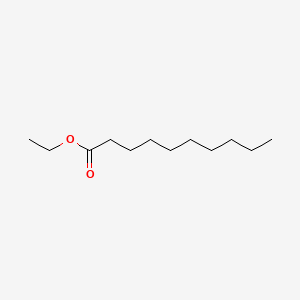
ethyl decanoate
Smells ofgrape, waxy
Found in 66 ingredients; measured in 9 of them and clearly above the level you can smell in seaweed, wine, grape and beer and 1 more.
Working on a formulation or a product line? This compound data is available by API for R&D teams.
Where you’d actually smell it
Each food placed by its measured amount of ethyl decanoate divided by the smallest amount people can smell (14 ppb, our working threshold). Past 1× it may be noticeable; this is a screening indicator, since the food’s matrix and its other aromas shift what you actually smell. 9 of the foods we list have a measured value; 5 are above the line.
Scroll sideways to see the whole ruler →
Only foods we hold ethyl decanoate in and have a measured concentration for are placed. Every measured row, with its source, is in the table below.
01How little it takes
- in waterpapers disagree 122
- in a foodpapers disagree 200
- in alcohol 1,120
- in wine/beer 200
Parts per billion (ppb), log scale · tick = median of published values, bar = full range, from open-access paper tables (not reviewed)
02Where it turns up
- Fruit26
- Drinks14
- Grains, nuts & fats6
- Meat & fish4
- Vegetables3
- Dairy3
- Herbs & spices2
- Other8
of the 66 ingredients that contain it, by food group
03What it travels with
line weight = ingredients carrying both, of 66 · only molecules found with it at least 1.5× as often as across all foods
What does ethyl decanoate smell like?
Sources describe it as grape, waxy.
It is a key food odorant (individualist): identified in the meta-analysis of 227 food samples as one of 151 individualist odorants, which appear in under 5% of foods and carry the signature of specific ingredients. Source: Dunkel et al. 2014, Angew. Chem. Int. Ed. 53, 7124–7143
How this molecule is described
Also filed as: decanoic acid ethyl ester · decanoic acid, ethyl ester · ethyl caprate — same molecule, unified here.
- grape, waxy shown above Flavornet Cas, Flavornet Name, Flavordb Odor Column 3 sources agree
- fatty FlavorDB 2.0, Flavordb Odor Column 2 sources agree
- chemical FlavorDB 2.0, Flavordb Odor Column 2 sources agree
- fruity FlavorDB 2.0
- apple, anise, butter, rancid, fatty FlavorDB 2.0
- fruity, fatty FlavorDB 2.0
About these descriptions
Ordered by how many independent descriptor streams give each wording, then by how often it appears. The bar is replication (one source copied onto many ingredients scores high), not corroboration.Which foods contain ethyl decanoate?
We list 66 ingredients that contain it, but presence is not the same as smell. What matters is how much is there compared with how little it takes to notice it. That ratio is the odour activity value (OAV). Above 1 suggests it may be noticeable; it is a screening indicator, not a guarantee.
- Clearly there (10× or more): seaweed, wine, grape, beer, baijiu.
- Present but below the threshold: cheese, bread, tea, apple.
Found in
Measured foods first, then real food profiles, then thin or composite records (marked). The figure beside each is how many compounds that ingredient has in total, not the amount of ethyl decanoate in it. ✓n = sources that recorded the link.
- seaweed measured · 6,179× threshold 128 cmpds
- wine measured · 5,684× threshold ✓1 538 cmpds
- grape measured · 4,421× threshold ✓1 570 cmpds
- beer measured · 107× threshold ✓1 444 cmpds
- baijiu measured · 99× threshold 200 cmpds
- cheese measured · 0.49× threshold 285 cmpds
- bread measured · 0.14× threshold 196 cmpds
- tea measured · 0.14× threshold ✓1 578 cmpds
Measured concentrations
| Food | Concentration (ppb) | OAV | Source |
|---|---|---|---|
| green tea | 110,000.0 | 7,857 | PMID 35495905 |
| seaweed | 86,500.0 | 6,179 | PMID 36969824 |
| wine | 79,583.0 | 5,684 | PMID 30704594 |
| grape | 61,900.0 | 4,421 | PMID 34623142 |
| black tea | 50,000.0 | 3,571 | PMID 37780253 |
| beer | 1,500.0 | 107 | PMID 37185768 |
| baijiu | 1,381.0 | 98.6 | Corpus paper |
| lime | 843.0 | 60.2 | Corpus paper |
| sausage | 221.0 | 15.8 | DOI |
| mace | 200.0 | 14.3 | PMID 38001348 |
| rice | 200.0 | 14.3 | Corpus paper |
| fish | 54.6 | 3.90 | Corpus paper |
| cheese | 6.9 | 0.49 | Corpus paper |
| tea | 2.0 | 0.14 | Corpus paper |
| bread | 2.0 | 0.14 | — |
| apple | 1.6 | 0.11 | — |
OAV = measured concentration ÷ odour threshold (14.0 ppb). OAV ≥ 1 suggests it may be perceptible; treat it as a screening indicator. Concentrations from open-access papers; a row whose food is not one of the ingredients above is listed here but not placed on the ruler.
These OAVs depend on which threshold you divide by. Published values for this molecule span 14–200 ppb and the column above uses the lowest, which makes every OAV as large as it can be. At the high end each figure would be 14× smaller, and rows near the line would cross it. Read the colours as “worth a look”, not as a measurement.
How strong is ethyl decanoate?
Our working odour threshold is 14.0 ppb. Varies by food: 14–200 ppb; the figure is the lowest of those.
Thresholds in published tables
| Medium | Median | Range | Values | Papers | Papers agree? |
|---|---|---|---|---|---|
| air | 770 µg/L air | 0.1–1.31e+03 | 8 | 6 | no (4.1 decades) |
| ethanol solution | 1120 ppb | 200–1.5e+03 | 17 | 17 | yes |
| food matrix | 200 ppb | 0.02–2.3e+04 | 68 | 64 | no (2.6 decades) |
| model wine or beer | 200 ppb | 200–2e+05 | 7 | 7 | yes |
| not applicable | 200 ppb | 200–200 | 2 | 2 | yes |
| unstated | 200 ppb | 0.4–1.12e+06 | 136 | 123 | yes |
| water | 122 ppb | 0.02–6.3e+03 | 24 | 23 | no (2.5 decades) |
Numbers printed in open-access papers, grouped by the medium the table states. Median and full range; “agree” means two or more papers whose middle 80% of values sit within 100×. Not reviewed.
- Volatility
- medium
- Retention index
- 1598
What is it found with?
Of the 66 ingredients that carry ethyl decanoate, 62 also carry 2-phenylethanol, 59 3-methylbutanal and 59 isobutyraldehyde. These are the most frequent companions among molecules that turn up with ethyl decanoate at least 1.5 times as often as they do across all foods; the very common molecules found nearly everywhere are left out because they say nothing about it.
Is ethyl decanoate safe to eat?
Ethyl decanoate is listed by FEMA as generally recognized as safe (GRAS) for use as a flavoring: FEMA number 2432, published in GRAS 3. Check current FDA and EFSA guidance for your market and use level.
- FEMA number
- 2432 ✓ exact match
- Publication
- GRAS 3
- FEMA name
- ETHYL DECANOATE
Use-level matrix not extracted for this substance; check the source publication for current ppm guidance.
Source: FEMA GRAS publications 1–33.
See all 66 ingredients with Pro
The free page shows the first 8. The inverted compound index is a Pro feature: reverse-search any of 5,133 flavor molecules across the full graph.
Look up another compound — search by name, CAS number, PubChem CID, or FEMA #.
The Sunday pairing: one pairing, the chemistry behind it, and how to cook it. No spam, unsubscribe anytime.
Prefer an account? Create a free account for sign-in; Pro adds the full results and chemistry.
Try the pairing tools to see which ingredient combinations rely on ethyl decanoate, or compare two ingredients side by side.
Cite this analysis
CompKitchen (2026). ethyl decanoate compound data sheet. https://compkitchen.com/compound/ethyl%20decanoate. Accessed 2026-11-22.
@misc{compkitchen_compound_ethyl_decanoate_compound_data_sheet_2026,
  title  = {ethyl decanoate compound data sheet},
  author = {{CompKitchen}},
  year   = {2026},
  url    = {https://compkitchen.com/compound/ethyl%20decanoate},
  note   = {Accessed: 2026-11-22}
}
Methodology DOI: 10.5281/zenodo.19719458 · CC BY 4.0 · Citations are a request, not a requirement.