Bilberry Wine
Must notes from 3-ethylphenol; ginger and chili from p-cymenene.
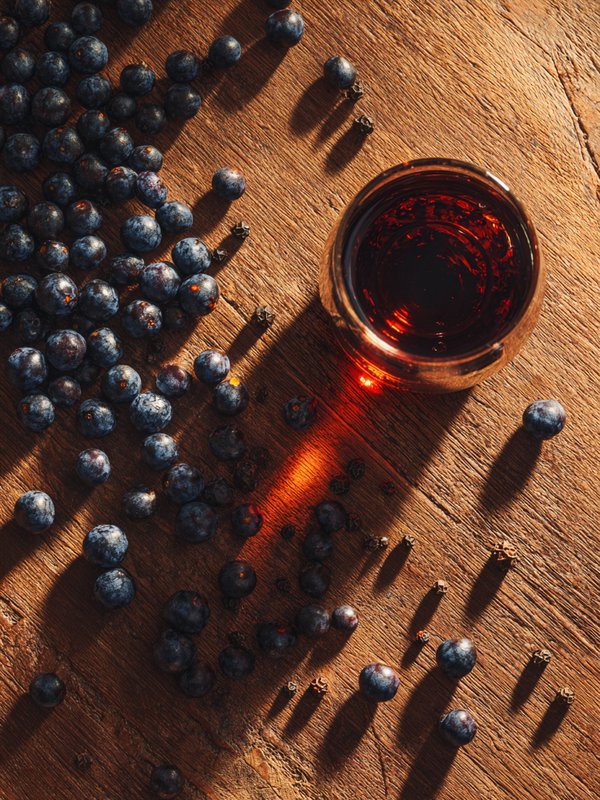
Bilberry Wine is an alcoholic beverage whose aroma is led by 3-ethylphenol (must) and p-cymenene (ginger, chili).
What goes with bilberry wine
Worth trying
- Canadian whisky Hidden gem: strong shared aroma (58 molecules), yet no recipe in our collection combines them.
- Japanese whisky Hidden gem: strong shared aroma (59 molecules), yet no recipe in our collection combines them.
A hidden gem is a lead to test, not a proven pairing: strong shared chemistry, but cooks have barely tried it.
Bilberry Wine pairing chart
Scroll sideways to see every column →
| Partner | Shared aroma | Shared molecules | Recipes together | Rank among all pairs |
|---|---|---|---|---|
| canadian whisky | strong | 58 | 0 | top 12% |
| cider | strong | 56 | 0 | top 12% |
| bourbon whisky | strong | 63 | 0 | top 12% |
| japanese whisky | strong | 59 | 0 | top 12% |
| rum | strong | 82 | 0 | top 13% |
| finnish whisky | strong | 58 | 0 | top 13% |
| whisky | strong | 62 | 0 | top 13% |
| blue cheese | strong | 62 | 0 | top 13% |
| passionfruit | strong | 69 | 0 | top 14% |
| apple brandy | strong | 47 | 0 | top 16% |
| brandy | strong | 41 | 0 | top 16% |
| plum brandy | strong | 41 | 0 | top 17% |
| pear brandy | strong | 38 | 0 | top 18% |
| pineapple | strong | 77 | 0 | top 18% |
| cherry brandy | strong | 34 | 0 | top 18% |
| plum | strong | 70 | 0 | top 18% |
| anise brandy | strong | 33 | 0 | top 19% |
| armagnac brandy | strong | 33 | 0 | top 19% |
| raspberry brandy | strong | 32 | 0 | top 19% |
| blackberry brandy | strong | 33 | 0 | top 19% |
Ordered by pairing score. Shared aroma: how much of their aroma chemistry overlaps (strong, moderate or low against all ingredient pairs). Rank: where the pair sits among random ingredient pairs on CompKitchen. Shared molecules counts every molecule the two have in common, not only aroma ones. Each partner links to a side-by-side comparison.
Bilberry Wine flavor profile
Bilberry Wine carries 139 flavor molecules in our data, 114 of them volatile enough to smell and 53 of them key food odorants, the molecules shown to drive food aroma. The aromas that lead its profile, strongest measured first: 3-ethylphenol (must), p-cymenene (ginger, chili), 1,1,6-trimethyl-1,2-dihydronaphthalene (kerosene, petrol) and o-cymene (ginger, chili).
Why bilberry wine pairs the way it does
Bilberry Wine's pairing hooks are hexyl acetate (fruity, apple), which 10 of its 10 best partners also carry but only 14% of all ingredients do; and isoamyl acetate (banana, pear), which 10 of its 10 best partners also carry but only 16% of all ingredients do. Partners that share them, like canadian whisky, cider and bourbon whisky, share more with bilberry wine than the background chemistry most foods carry.
How cooks use bilberry wine
Key aroma molecules in bilberry wine
Scroll sideways to see every column →
| Molecule | Smells like | Why it matters |
|---|---|---|
| 3-ethylphenol | must | In 9 of 861 ingredients; a key food odorant. |
| p-cymenene | ginger, chili | In 2 of 861 ingredients; a key food odorant. |
| 1,1,6-trimethyl-1,2-dihydronaphthalene | kerosene, petrol, petrol-like | In 6 of 861 ingredients. |
| o-cymene | ginger, chili | In 9 of 861 ingredients. |
| isoamyl lactate | fruity, creamy, nutty | In 16 of 861 ingredients. Shared with rum and apple brandy. |
| 1-octen-3-one | mushroom, metallic, earthy | In 67 of 861 ingredients; a key food odorant. Shared with cider and passionfruit. |
| ethyl isobutyrate | fruity, ethereal, sweet | In 62 of 861 ingredients; a key food odorant. Shared with canadian whisky, bourbon whisky and japanese whisky. |
| whiskey lactone | coconut, woody, sweet | In 17 of 861 ingredients. Shared with bourbon whisky and rum. |
Ordered by measured strength in bilberry wine (concentration against odour threshold) where studies report it, then by how rare the molecule is across foods. Smell words are each molecule's own published description. Key food odorants are the molecules shown to drive food aroma (Dunkel et al. 2014).
Does it go with what you have?
ButterUntested
No recipe in our pairing index uses both, strong shared aroma, top 28% of pairs. They share ethyl octanoate (fruity, wine). Compare →
LemonUntested
No recipe in our pairing index uses both, moderate shared aroma, bottom 39% of pairs. They share 1-octen-3-ol (mushroom, earthy). Compare →
GarlicUntested
No recipe in our pairing index uses both, low shared aroma, bottom 32% of pairs. Compare →
SugarUntested
No recipe in our pairing index uses both, low shared aroma, bottom 29% of pairs. Compare →
ChiliUntested
No recipe in our pairing index uses both, strong shared aroma, top 44% of pairs. They share ethyl isobutyrate (fruity, ethereal). Compare →
GingerUntested
No recipe in our pairing index uses both, moderate shared aroma, bottom 50% of pairs. They share 1-octen-3-one (mushroom, metallic). Compare →
Bilberry Wine pairing questions
What makes bilberry wine smell like bilberry wine?
Its leading aroma molecules are 3-ethylphenol (must), p-cymenene (ginger, chili) and 1,1,6-trimethyl-1,2-dihydronaphthalene (kerosene, petrol), out of the 114 aroma molecules on record for it.
What's a good substitute for bilberry wine?
The closest molecular substitutes for bilberry wine are rose wine, champagne, strawberry wine — ingredients that share the highest fraction of bilberry wine's flavor compounds.
Is bilberry wine vegan, gluten-free, or kosher?
Bilberry Wine is vegan and is gluten-free, dairy-free, nut-free, kosher.
The science in full
All 139 molecules on record
66 of 139 are distinctive to bilberry wine (in under 10% of foods). Ordered by measured impact in bilberry wine, then by how distinctive the molecule is.
287 research papers on bilberry wine
- Plant iridoids: Chemistry, dietary sources and potential health benefits. · 2025
- Inter- and intra-varietal clonal differences influence the aroma compound profiles of wines analyzed by GC–MS and GC-IMS · 2024
- Use of Non-Saccharomyces Yeast Co-Fermentation with Saccharomyces cerevisiae to Improve the Polyphenol and Volatile Aroma Compound Contents in Nanfeng Tangerine Wines. · 2022
- Evaluation of Anthocyanin Profile and Color in Sweet Cherry Wine: Effect of Sinapic Acid and Grape Tannins during Aging. · 2021
- Authentication using volatile composition : a proof-of-concept study on the volatile profiles of fourteen queensland ciders 'MDPI AG' · 2021
Explore more: pair it · find substitutes · discover novel pairings · get this data via the API · how we score pairs