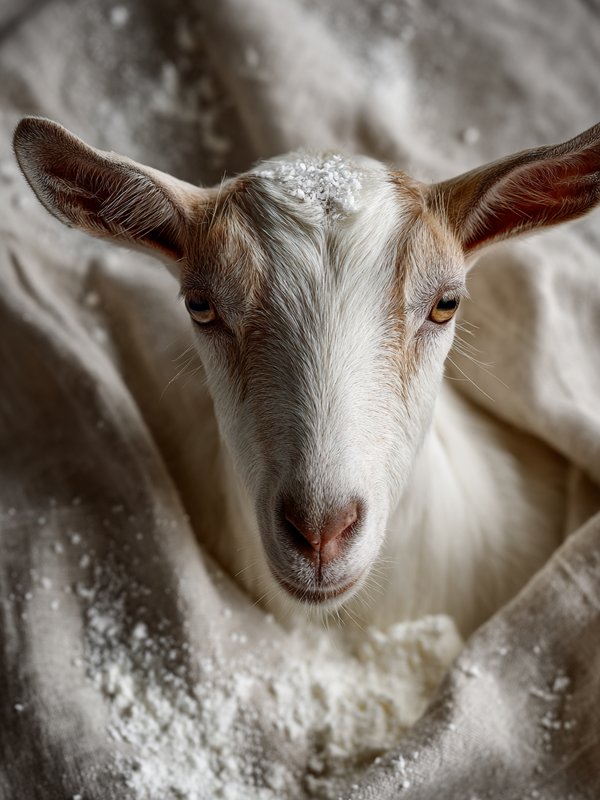
Goat Milk is a dairy whose aroma is led by 4-ethyloctanoic acid (goaty, mutton) and 2-decenal (fatty, fried). Cooks pair it most with flour, sugar and egg. By shared aroma its closest partners are egg, butter and goat cheese.
What goes with goat milk
The classics
- Flour: cooked together in 7 recipes, though they share little aroma: this one is a cooking habit more than a chemical match.
- Sugar: cooked together in 7 recipes, though they share little aroma: this one is a cooking habit more than a chemical match.
- Egg: cooked together in 5 recipes, with moderate shared aroma, including 2,4-decadienal (seaweed).
- Honey: cooked together in 4 recipes, though they share little aroma: this one is a cooking habit more than a chemical match.
- Butter: cooked together in 3 recipes, with moderate shared aroma, including ethyl octanoate (fruity, wine).
Goat Milk pairing chart
Scroll sideways to see every column →
| Partner | Shared aroma | Shared molecules | Recipes together | Rank among all pairs |
|---|---|---|---|---|
| honey | low | 22 | 4 | top 20% |
| yogurt | moderate | 18 | 2 | top 25% |
| butter | moderate | 23 | 3 | top 26% |
| olive | low | 22 | 3 | top 30% |
| cheese | low | 26 | 2 | top 30% |
| vanilla | low | 14 | 2 | top 30% |
| goat cheese | moderate | 16 | 1 | top 30% |
| fig | low | 22 | 1 | top 31% |
| egg | moderate | 15 | 5 | top 32% |
| champagne | moderate | 15 | 1 | top 34% |
| pepper | low | 21 | 2 | top 35% |
| raspberry | low | 17 | 1 | top 37% |
| flour | low | 0 | 7 | top 37% |
| blackberry | moderate | 26 | 1 | top 37% |
| cream | low | 10 | 1 | top 37% |
| sugar | low | 5 | 7 | top 38% |
| soy sauce | low | 8 | 1 | top 38% |
| strawberry | low | 24 | 1 | top 39% |
| swiss cheese | moderate | 19 | 0 | top 39% |
| cheddar cheese | moderate | 24 | 0 | top 39% |
Ordered by pairing score. Shared aroma: how much of their aroma chemistry overlaps (strong, moderate or low against all ingredient pairs). Rank: where the pair sits among random ingredient pairs on CompKitchen. Shared molecules counts every molecule the two have in common, not only aroma ones. Each partner links to a side-by-side comparison.
Goat Milk flavor profile
Goat Milk carries 46 flavor molecules in our data, 44 of them volatile enough to smell and 22 of them key food odorants, the molecules shown to drive food aroma. The aromas that lead its profile, strongest measured first: 4-ethyloctanoic acid (goaty, mutton), 3-methylindole (fecal, animal), 2-decenal (fatty, fried) and 2,4-decadienal (seaweed).
Why goat milk pairs the way it does
Goat Milk's pairing hooks are acetoin (butter, cream), which 8 of its 10 best partners also carry but only 14% of all ingredients do; and ethyl caproate (fruity, apple peel), which 7 of its 10 best partners also carry but only 16% of all ingredients do. Partners that share them, like honey, yogurt and butter, share more with goat milk than the background chemistry most foods carry.
How cooks use goat milk
Key aroma molecules in goat milk
Scroll sideways to see every column →
| Molecule | Smells like | Why it matters |
|---|---|---|
| 4-ethyloctanoic acid | goaty, mutton, waxy | In 7 of 861 ingredients; a key food odorant. Shared with cheese and goat cheese. |
| 3-methylindole | fecal, animal, mothball | In 30 of 861 ingredients; a key food odorant. Shared with butter and cheese. |
| 2-decenal | fatty, fried, tallow | In 52 of 861 ingredients. Shared with butter, olive and cheese. |
| 2,4-decadienal | seaweed | In 81 of 861 ingredients; a key food odorant. Shared with yogurt, olive and egg. |
| 2-methylthiophene | sulfur | In 9 of 861 ingredients. |
| 4-methyloctanoic acid | goaty, muttony, waxy | In 13 of 861 ingredients; a key food odorant. Shared with goat cheese. |
| heptanol | herb | In 14 of 861 ingredients. |
| hexanol | green, fruity, grassy | In 29 of 861 ingredients; a key food odorant. Shared with olive. |
Ordered by measured strength in goat milk (concentration against odour threshold) where studies report it, then by how rare the molecule is across foods. Smell words are each molecule's own published description. Key food odorants are the molecules shown to drive food aroma (Dunkel et al. 2014).
Does it go with what you have?
ButterSometimes
Cooked together in 3 recipes, moderate shared aroma, top 26% of pairs. They share ethyl octanoate (fruity, wine). Compare →
LemonSometimes
Cooked together in 1 recipe, low shared aroma, top 42% of pairs. Compare →
GarlicUntested
No recipe in our pairing index uses both, low shared aroma, bottom 24% of pairs. Compare →
SugarSometimes
Cooked together in 7 recipes, low shared aroma, top 38% of pairs. Compare →
ChiliSometimes
Cooked together in 1 recipe, low shared aroma, top 48% of pairs. Compare →
GingerSometimes
Cooked together in 1 recipe, low shared aroma, top 49% of pairs. Compare →
Goat Milk pairing questions
What makes goat milk smell like goat milk?
Its leading aroma molecules are 4-ethyloctanoic acid (goaty, mutton), 3-methylindole (fecal, animal) and 2-decenal (fatty, fried), out of the 44 aroma molecules on record for it.
What's a good substitute for goat milk?
The closest molecular substitutes for goat milk are yogurt, egg, oyster — ingredients that share the highest fraction of goat milk's flavor compounds.
Is goat milk vegan, gluten-free, or kosher?
Goat Milk is vegetarian (not vegan) and is gluten-free, nut-free, kosher, halal. Allergen tags: milk.
The science in full
All 46 molecules on record
22 of 46 are distinctive to goat milk (in under 10% of foods). Ordered by measured impact in goat milk, then by how distinctive the molecule is.
148 research papers on goat milk
- Characterization of the different volatile organic compounds in human and ruminant milk using electronic nose analysis and headspace gas chromatography-mass spectrometry. · 2026
- Evaluation of the Fermentation Profiles and Quality Attributes of Yogurts Made from Cow, Goat, and Mixed Milk. · 2026
- Investigation of the Prevalence of Toxoplasma gondii in Meat, Meat Organs, Milk, Dairy Products and Eggs in Different Animals, in Iran. Veterinary medicine and science · 2025
- A Systematic Review on Microbial Profiling Techniques in Goat Milk: Implications for Probiotics and Shelf-Life. International journal of molecular sciences · 2025
- Astral-DIA proteomics: Identification of differential proteins in sheep, goat, and cow milk. International journal of biological macromolecules · 2024
Explore more: pair it · find substitutes · discover novel pairings · get this data via the API · how we score pairs