Lemon Balm
Alkane notes from heneicosane; saffron and herbal from safranal. Cooks pair it most with sugar 21 recipes, peppermint 11 and pepper 10.
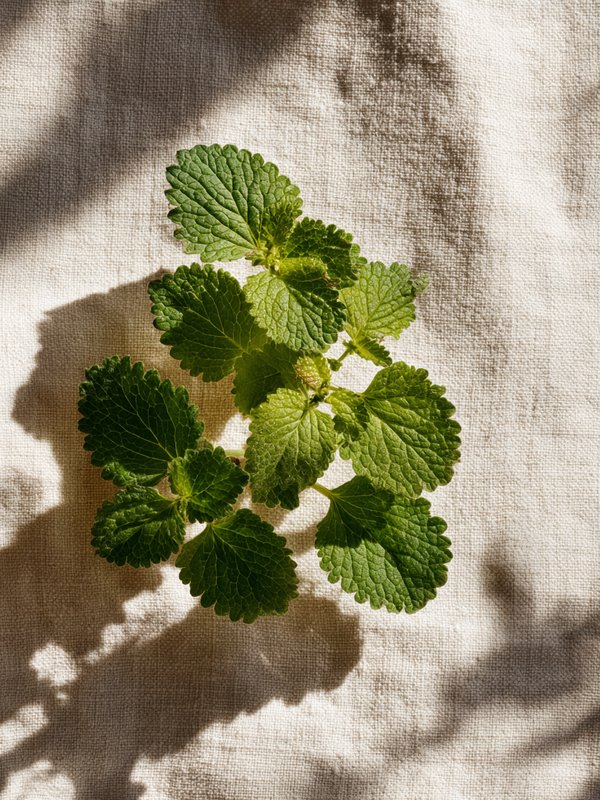
Lemon Balm is a herb whose aroma is led by heneicosane (alkane) and safranal (saffron, herbal). Cooks pair it most with sugar, peppermint and pepper. By shared aroma its closest partners are allspice, arrowroot and lemon grass.
What goes with lemon balm
The classics
- Sugar: cooked together in 21 recipes, though they share little aroma: this one is a cooking habit more than a chemical match.
- Peppermint: cooked together in 11 recipes, with strong shared aroma, including myrcene (balsamic, herbaceous).
- Pepper: cooked together in 10 recipes, with strong shared aroma, including methyleugenol (clove, spice).
- Egg: cooked together in 9 recipes, though they share little aroma: this one is a cooking habit more than a chemical match.
- Butter: cooked together in 8 recipes, with moderate shared aroma, including linalool (floral, citrus).
Worth trying
- Allspice Hidden gem: shares 228 flavor molecules with lemon balm, more than sugar's 30, yet only 1 recipe in our collection combines them.
- Winter savory Hidden gem: shares 216 flavor molecules with lemon balm, more than sugar's 30, yet no recipe in our collection combines them.
- Angelica: a top 7% pair that only 4 recipes in our collection use.
- Thyme: a top 7% pair that only 5 recipes in our collection use.
A hidden gem is a lead to test, not a proven pairing: strong shared chemistry, but cooks have barely tried it.
Lemon Balm pairing chart
Scroll sideways to see every column →
| Partner | Shared aroma | Shared molecules | Recipes together | Rank among all pairs |
|---|---|---|---|---|
| peppermint | strong | 225 | 11 | top 5% |
| angelica | strong | 209 | 4 | top 7% |
| thyme | strong | 226 | 5 | top 7% |
| lemon verbena | strong | 198 | 2 | top 8% |
| parsley | strong | 224 | 6 | top 8% |
| cinnamon | strong | 225 | 5 | top 9% |
| mint | moderate | 105 | 7 | top 10% |
| pepper | strong | 242 | 10 | top 10% |
| chive | strong | 204 | 5 | top 10% |
| basil | strong | 238 | 3 | top 10% |
| ginger | strong | 238 | 3 | top 10% |
| lime | strong | 218 | 2 | top 11% |
| fennel | strong | 219 | 2 | top 12% |
| saffron | strong | 208 | 2 | top 12% |
| lettuce | strong | 207 | 3 | top 12% |
| lemon grass | strong | 213 | 1 | top 12% |
| allspice | strong | 228 | 1 | top 12% |
| clove | strong | 224 | 3 | top 12% |
| nutmeg | strong | 225 | 2 | top 13% |
| lingonberry | strong | 202 | 1 | top 13% |
Ordered by pairing score. Shared aroma: how much of their aroma chemistry overlaps (strong, moderate or low against all ingredient pairs). Rank: where the pair sits among random ingredient pairs on CompKitchen. Shared molecules counts every molecule the two have in common, not only aroma ones. Each partner links to a side-by-side comparison.
Lemon Balm flavor profile
Lemon Balm carries 278 flavor molecules in our data, 151 of them volatile enough to smell and 43 of them key food odorants, the molecules shown to drive food aroma. The aromas that lead its profile, strongest measured first: heneicosane (alkane), safranal (saffron, herbal), citronellal (fat) and eicosane (alkane).
Why lemon balm pairs the way it does
Lemon Balm's pairing hooks are myrcene (balsamic, herbaceous), which 8 of its 10 best partners also carry but only 19% of all ingredients do; and alpha-terpineol (lilac, floral), which 5 of its 10 best partners also carry but only 17% of all ingredients do. Partners that share them, like peppermint, angelica and thyme, share more with lemon balm than the background chemistry most foods carry. Partners that share little aroma, like sugar and egg, pair through cooking habit instead: 21 and 9 recipes respectively.
How cooks use lemon balm
Key aroma molecules in lemon balm
Scroll sideways to see every column →
| Molecule | Smells like | Why it matters |
|---|---|---|
| heneicosane | alkane | In 16 of 861 ingredients. |
| safranal | saffron, herbal, spicy | In 19 of 861 ingredients. |
| citronellal | fat | In 35 of 861 ingredients. Shared with cinnamon and pepper. |
| eicosane | alkane | In 15 of 861 ingredients. |
| nonadecane | alkane | In 22 of 861 ingredients. Shared with pepper. |
| hexadecane | alkane | In 26 of 861 ingredients. Shared with thyme and pepper. |
| isopulegol | minty, cooling, herbal | In 31 of 861 ingredients. Shared with peppermint, angelica and mint. |
| heptadecane | alkane | In 19 of 861 ingredients. Shared with thyme and pepper. |
Ordered by measured strength in lemon balm (concentration against odour threshold) where studies report it, then by how rare the molecule is across foods. Smell words are each molecule's own published description. Key food odorants are the molecules shown to drive food aroma (Dunkel et al. 2014).
Does it go with what you have?
ButterClassic
Cooked together in 8 recipes, moderate shared aroma, top 36% of pairs. They share linalool (floral, citrus). Compare →
GarlicSometimes
Cooked together in 7 recipes, strong shared aroma, top 17% of pairs. They share linalool (floral, citrus). Compare →
SugarHabit
Cooked together in 21 recipes, low shared aroma, top 29% of pairs. Compare →
ChiliWorth trying
Cooked together in 1 recipe, moderate shared aroma, top 26% of pairs. They share myrcene (balsamic, herbaceous). Compare →
GingerWorth trying
Cooked together in 3 recipes, strong shared aroma, top 10% of pairs. They share myrcene (balsamic, herbaceous). Compare →
Lemon Balm pairing questions
What makes lemon balm smell like lemon balm?
Its leading aroma molecules are heneicosane (alkane), safranal (saffron, herbal) and citronellal (fat), out of the 151 aroma molecules on record for it.
What's a good substitute for lemon balm?
The closest molecular substitutes for lemon balm are linden, allspice, eggplant — ingredients that share the highest fraction of lemon balm's flavor compounds.
Is lemon balm vegan, gluten-free, or kosher?
Lemon Balm is vegan and is gluten-free, dairy-free, nut-free, kosher, halal.
The science in full
Scientific name: Melissa officinalis. Wikidata Q148396 (CC0)
All 278 molecules on record
65 of 278 are distinctive to lemon balm (in under 10% of foods). Ordered by measured impact in lemon balm, then by how distinctive the molecule is.
1,304 research papers on lemon balm
- Cardamom and lemon balm nanoemulsion as a natural antimicrobial strategy against Listeria monocytogenes in Turkey meat. International journal of food microbiology · 2026
- From wild plant to functional ingredient: phytochemical insights and neuroprotective activity of Melissa officinalis subsp. altissima. · 2026
- Properties of Plant Extracts from Adriatic Maritime Zone for Innovative Food and Packaging Applications: Insights into Bioactive Profiles, Protective Effects, Antioxidant Potentials and Antimicrobial Activity. · 2025
- Characterization of Microcapsules Obtained from Lemon Balm Extract (Melissa officinalis L.) by the Ionic Gelation Process. · 2025
- Efficacy of an Herbal Vaginal Tablet Containing Oregano and Lemon Balm on Bacterial Vaginosis in Comparison to Metronidazole: a non-inferiority triple-blind active-controlled trial. · 2025
Explore more: pair it · find substitutes · discover novel pairings · get this data via the API · how we score pairs