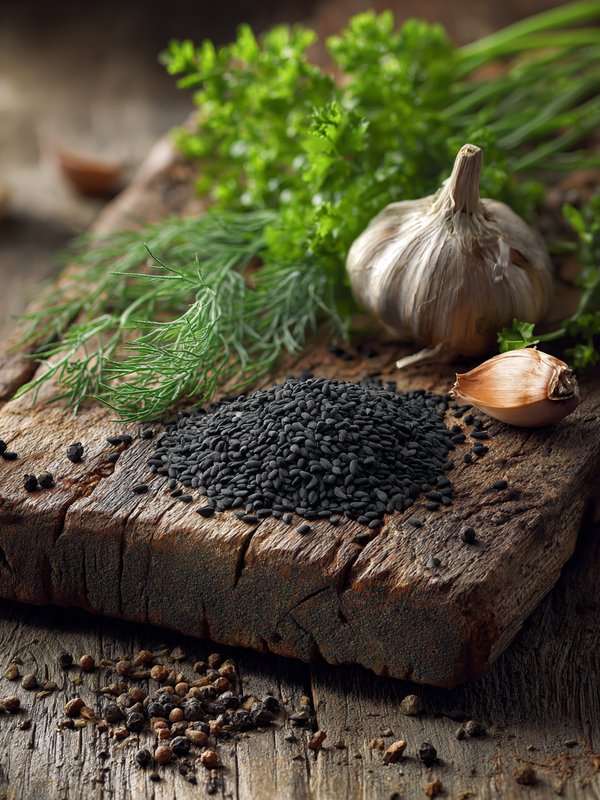
Nigella Seed is a seed whose aroma is led by octen-3-ol (mushroom, earthy) and 4-methoxybenzaldehyde (sweet, anise). Cooks pair it most with olive, onion and cumin. By shared aroma its closest partners are carom seed, mace and fennel.
What goes with nigella seed
The classics
- Olive: cooked together in 33 recipes, though they share little aroma: this one is a cooking habit more than a chemical match.
- Onion: cooked together in 31 recipes, though they share little aroma: this one is a cooking habit more than a chemical match.
- Cumin: cooked together in 28 recipes, with moderate shared aroma, including 4-methoxybenzaldehyde (sweet, anise).
- Coriander: cooked together in 24 recipes, though they share little aroma: this one is a cooking habit more than a chemical match.
- Turmeric: cooked together in 23 recipes, though they share little aroma: this one is a cooking habit more than a chemical match.
Nigella Seed pairing chart
Scroll sideways to see every column →
| Partner | Shared aroma | Shared molecules | Recipes together | Rank among all pairs |
|---|---|---|---|---|
| cumin | moderate | 18 | 28 | top 13% |
| turmeric | low | 11 | 23 | top 15% |
| fenugreek | low | 0 | 10 | top 16% |
| asafoetida | moderate | 8 | 4 | top 16% |
| fennel | moderate | 19 | 13 | top 16% |
| ginger | low | 16 | 20 | top 17% |
| coriander | low | 17 | 24 | top 18% |
| laurel | moderate | 20 | 3 | top 22% |
| tomato | low | 13 | 16 | top 22% |
| cardamom | low | 14 | 7 | top 25% |
| mint | low | 12 | 5 | top 26% |
| potato | low | 6 | 9 | top 26% |
| clove | low | 11 | 6 | top 26% |
| cinnamon | moderate | 17 | 9 | top 27% |
| carom seed | moderate | 17 | 1 | top 27% |
| olive | low | 5 | 33 | top 27% |
| pepper | low | 19 | 14 | top 29% |
| tamarind | low | 8 | 7 | top 29% |
| lime | low | 14 | 6 | top 31% |
| saffron | low | 13 | 5 | top 31% |
Ordered by pairing score. Shared aroma: how much of their aroma chemistry overlaps (strong, moderate or low against all ingredient pairs). Rank: where the pair sits among random ingredient pairs on CompKitchen. Shared molecules counts every molecule the two have in common, not only aroma ones. Each partner links to a side-by-side comparison.
Nigella Seed flavor profile
Nigella Seed carries 38 flavor molecules in our data, 26 of them volatile enough to smell and 13 of them key food odorants, the molecules shown to drive food aroma. The aromas that lead its profile, strongest measured first: octen-3-ol (mushroom, earthy), 4-methoxybenzaldehyde (sweet, anise), beta-cymene (eucalyptus, chemical) and longifolene (fir needle, medical).
Why nigella seed pairs the way it does
Nigella Seed's pairing hooks are beta-pinene (pine, resin), which 9 of its 10 best partners also carry but only 17% of all ingredients do; and myrcene (balsamic, herbaceous), which 9 of its 10 best partners also carry but only 19% of all ingredients do. Partners that share them, like cumin, turmeric and asafoetida, share more with nigella seed than the background chemistry most foods carry. Partners that share little aroma, like olive and onion, pair through cooking habit instead: 33 and 31 recipes respectively.
How cooks use nigella seed
Key aroma molecules in nigella seed
Scroll sideways to see every column →
| Molecule | Smells like | Why it matters |
|---|---|---|
| octen-3-ol | mushroom, earthy, green | In 5 of 861 ingredients; a key food odorant. |
| 4-methoxybenzaldehyde | sweet, anise, floral | In 27 of 861 ingredients; a key food odorant. Shared with cumin and fennel. |
| beta-cymene | eucalyptus, chemical | In 6 of 861 ingredients. |
| longifolene | fir needle, medical, rose | In 16 of 861 ingredients. |
| myristicin | spice, warm, balsamic | In 22 of 861 ingredients; a key food odorant. Shared with fennel and coriander. |
| decane | alkane | In 9 of 861 ingredients. Shared with laurel. |
| estragole | anise, licorice, sweet | In 43 of 861 ingredients; a key food odorant. Shared with cumin, fennel and ginger. |
| p-cymene | solvent, gasoline, citrus | In 91 of 861 ingredients. Shared with cumin, turmeric and asafoetida. |
Ordered by measured strength in nigella seed (concentration against odour threshold) where studies report it, then by how rare the molecule is across foods. Smell words are each molecule's own published description. Key food odorants are the molecules shown to drive food aroma (Dunkel et al. 2014).
Does it go with what you have?
ButterHabit
Cooked together in 14 recipes, low shared aroma, top 38% of pairs. Compare →
LemonHabit
Cooked together in 8 recipes, low shared aroma, top 34% of pairs. Compare →
GarlicHabit
Cooked together in 16 recipes, low shared aroma, top 33% of pairs. Compare →
SugarHabit
Cooked together in 20 recipes, low shared aroma, top 39% of pairs. Compare →
ChiliSometimes
Cooked together in 7 recipes, low shared aroma, top 33% of pairs. Compare →
GingerHabit
Cooked together in 20 recipes, low shared aroma, top 17% of pairs. Compare →
Nigella Seed pairing questions
What makes nigella seed smell like nigella seed?
Its leading aroma molecules are octen-3-ol (mushroom, earthy), 4-methoxybenzaldehyde (sweet, anise) and beta-cymene (eucalyptus, chemical), out of the 26 aroma molecules on record for it.
What's a good substitute for nigella seed?
The closest molecular substitutes for nigella seed are za'atar, carom seed, summer savory — ingredients that share the highest fraction of nigella seed's flavor compounds.
Is nigella seed vegan, gluten-free, or kosher?
Nigella Seed is vegan and is gluten-free, dairy-free, nut-free, kosher, halal.
The science in full
All 38 molecules on record
29 of 38 are distinctive to nigella seed (in under 10% of foods). Ordered by measured impact in nigella seed, then by how distinctive the molecule is.
101 research papers on nigella seed
- Dietary Nigella sativa nanoparticles enhance broiler growth performance, antioxidant capacity, immunity, gene expression modulation, and cecal microbiota during high ambient temperatures. · 2025
- Microwave pretreatment effects on the aroma precursors, sensory characteristics and flavor profiles of fragrant rapeseed oil. · 2024
- Antioxidant activity, physico-chemical properties, and bioactive compounds of Nigella sativa seeds and oil impacted by microwave processing technique. · 2024
- Identification, validation and quantification of thymoquinone in conjunction with assessment of bioactive possessions and GC-MS profiling of pharmaceutically valuable crop Nigella (Nigella sativa L.) varieties. · 2024
- Investigation of aroma characteristics of seven Chinese commercial sunflower seed oils using a combination of descriptive Analysis, GC-quadrupole-MS, and GC-Orbitrap-MS · 2023
Explore more: pair it · find substitutes · discover novel pairings · get this data via the API · how we score pairs