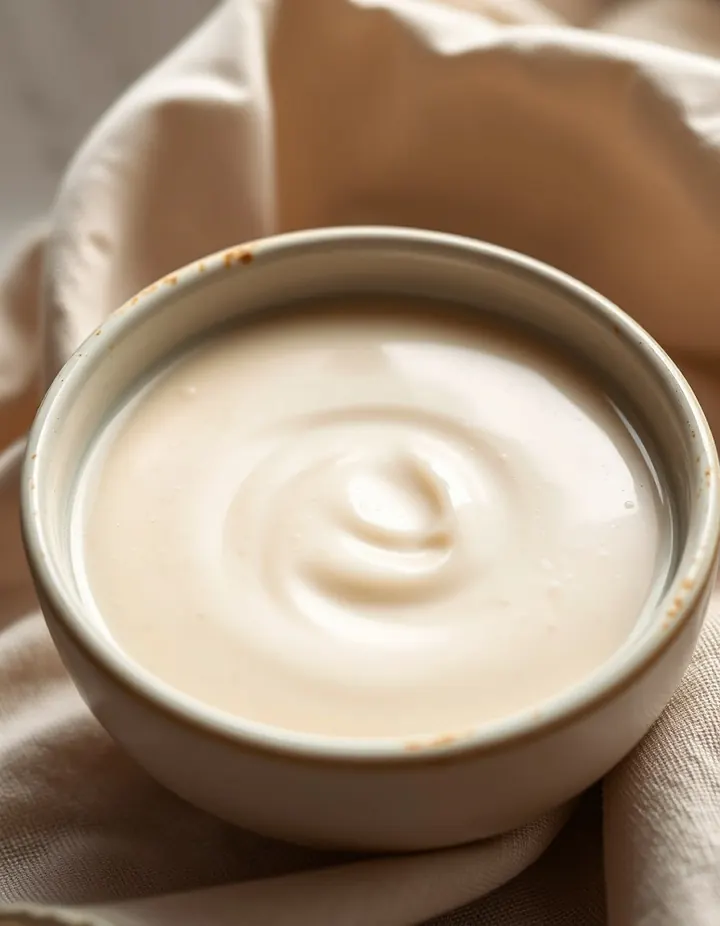
Why it works: Wheat and milk are a kitchen classic. They rank in the top 6% of all ingredient pairs, and cooks put them together in 2,418 recipes. Both carry (e,z)-2,6-nonadienal, which smells cucumber, melon. The science ↓
Peptonised Milk Gruel
Ingredients
Directions
Make the gruel
Mix the flour or arrowroot with the cold water until smooth.
Heat the mixture, stirring constantly, until it boils briskly for several minutes.
Add the cold milk to the hot gruel.
Strain into a small pitcher or jar.
Peptonize and chill
Immediately add the contents of one peptonising tube and mix well.
Let it stand in a warm place or hot-water bath for twenty minutes.
Transfer to a clean quart bottle.
Place on ice.
Transcribed from a scanned cookbook and modernised for today's kitchens. Where the book gave no heat or time, or said "a moderate oven", the temperatures and times here may be modern equivalents rather than the book's own figures.
Photo for illustrative purposes only · Contact us to use it
Explore the science
The flavor team
The pairs that carry this dish. Each one is judged two ways: how much their aromas overlap, and how often cooks already put them together.
-
Wheat + milktop 6% of all pairsSmell alikemoderateCooked together2,418 recipes
Shared aroma: (e,z)-2,6-nonadienal (cucumber, melon).
Ranks compare each pair with 20,000 random ingredient pairs on CompKitchen. How we score pairs
What each ingredient does
- Wheat flour or arrowroot
- Starch that thickens the water and milk into a smooth gruel as it boils.
- Milk
- Provides the body, mild sweetness and fat of the gruel base.
- Peptonising tube
- Enzyme preparation that partly breaks down milk proteins, giving a predigested, thinner texture.
The step that matters
Boil the flour mixture briskly before adding milk. Starch granules only swell and thicken fully when heated to boiling, and boiling for several minutes cooks off the raw flour taste. Adding milk to a weakly heated mixture leaves the gruel thin and pasty.
“What each ingredient does” and “The step that matters” were written by Claude from this recipe’s own method and reviewed in samples by CompKitchen.
The free Flavor Lab newsletter: one surprising pairing a week and the molecular reason it works, in 60 seconds. No spam, unsubscribe anytime.
Prefer an account? Create a free account to save pairings and unlock the full chemistry.