Why it works: Clove and pepper match in chemistry and in kitchens. They rank in the top 5% of all ingredient pairs, and cooks put them together in 17,451 recipes. Both carry ethyl octanoate, which smells fruity, wine. The science ↓
Collared Beef
Ingredients
Directions
Cure
Rub the thin flank thoroughly with coarse sea salt and a little saltpetre.
Let it drain overnight.
Wash the beef.
Cut out the gristle.
Remove the outer and inner skin.
Finely pound a little clove.
Mix it with salt, black pepper, and sugar.
Rub this mixture into the beef.
Let the beef remain in the pickle for a week.
Turn and baste it every day.
Roll and cook
Take it out of the pickle.
Roll it up tightly.
Bandage it with strong cloth strips.
Tie with tape.
Place the rolled beef into cold water.
Simmer for five to six hours.
Press and serve
Place it between boards.
Press with heavy weights until completely cold.
Slice and serve cold.
Trim the ends before serving whole.
Transcribed from a scanned cookbook and modernised for today's kitchens. Where the book gave no heat or time, or said "a moderate oven", the temperatures and times here may be modern equivalents rather than the book's own figures.
Explore the science
The flavor team
The pairs that carry this dish. Each one is judged two ways: how much their aromas overlap, and how often cooks already put them together.
-
Clove + peppertop 5% of all pairsSmell alikestrongCooked together17,451 recipes
Shared aroma: ethyl octanoate (fruity, wine).
-
Beef + peppertop 10% of all pairsSmell alikemoderateCooked together18,971 recipes
Shared aroma: 2-isopropyl-3-methoxypyrazine (earthy, pea).
-
Beef + clovetop 18% of all pairsSmell alikemoderateCooked together5,462 recipes
Shared aroma: cuminaldehyde (Spicy, cumin).
-
Clove + sugartop 26% of all pairsSmell alikelowCooked together17,182 recipes
Shared aroma: 1-penten-3-one (fish, pungent).
-
Pepper + sugartop 32% of all pairsSmell alikelowCooked together19,401 recipes
Shared aroma: 2-nonenal (fatty, green).
Clove and sugar barely smell alike, yet cooks put them together in 17,182 recipes: they work on texture and structure more than aroma.
Ranks compare each pair with 20,000 random ingredient pairs on CompKitchen. How we score pairs
What each ingredient does
- Thin flank beef
- Forms the main meat that is cured, rolled, and cooked into a sliceable joint.
- Coarse sea salt
- Draws out moisture and seasons the meat during the curing process.
- Saltpetre
- Helps preserve the cured colour and flavour of the meat during the long pickle.
- Sugar
- Balances the saltiness and softens the savour of the cured beef.
The step that matters
Pressing until completely cold. Pressing while the beef cools firmly binds the rolled layers and gives a compact, sliceable texture. Releasing pressure too early can leave the joint loose and crumbly.
Swap the clove
How well each one fits the dish's main ingredients (beef, pepper, sugar):
- Cinnamonfits better
- Rosemaryfits about as well
- Nutmegfits about as well
- Clovethe original
Fit is the average pairing score against beef, pepper, sugar. Candidates are from the same food group and used in at least 100 recipes.
“What each ingredient does” and “The step that matters” were written by Claude from this recipe’s own method and reviewed in samples by CompKitchen.
You might also like
 Roast Beef211 recipes
 Beef Loaf175 recipes
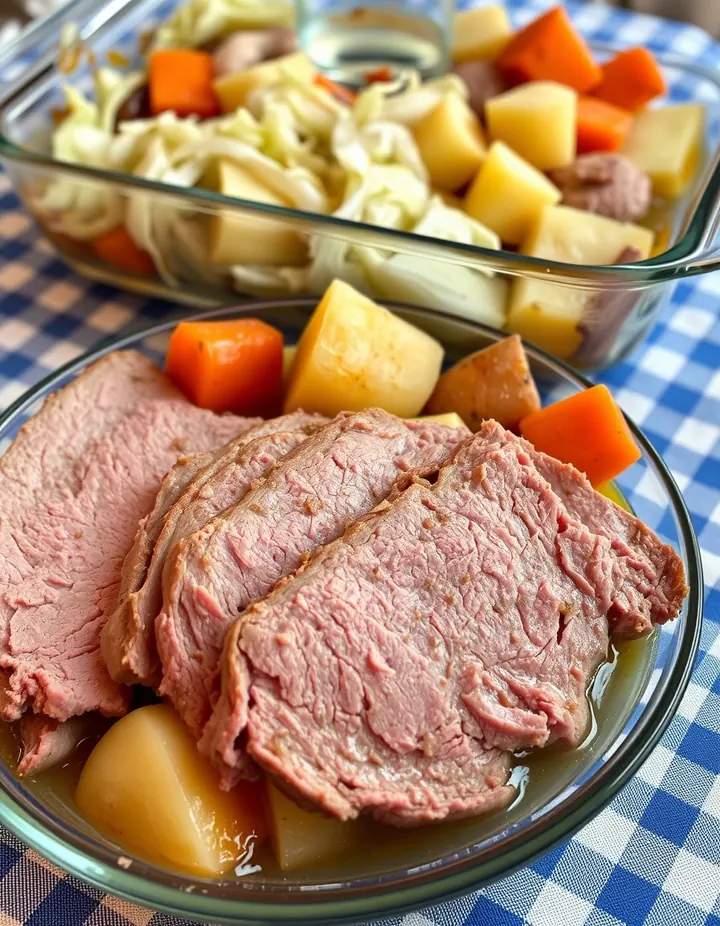 Corned Beef87 recipes
 Beef Broth67 recipes
The free Flavor Lab newsletter: one surprising pairing a week and the molecular reason it works, in 60 seconds. No spam, unsubscribe anytime.
Prefer an account? Create a free account to save pairings and unlock the full chemistry.