Why it works: Wheat and milk are a kitchen classic. They rank in the top 6% of all ingredient pairs, and cooks put them together in 2,418 recipes. Both carry (e,z)-2,6-nonadienal, which smells cucumber, melon. The science ↓
Flour-ball
Ingredients
Directions
Make the flour ball
Tie the flour tightly in a strong pudding bag.
Place the bag in a saucepan of water and boil for 2 hours.
When cool, remove the cloth and cut away the soft outer covering.
Grate the hard, baked interior into a powder.
Use the thickener
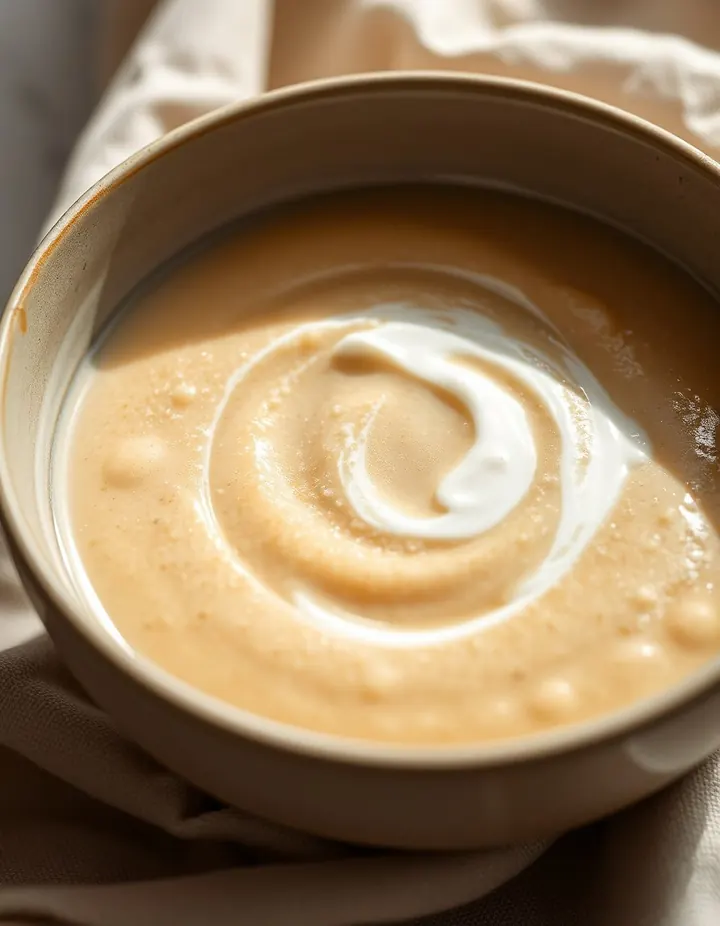
To use, mix the required powder with 1 tablespoon of milk to form a smooth paste.
Add a second tablespoon of milk, mixing until creamy.
Stir this mixture into the total quantity of liquid for your meal.
Transcribed from a scanned cookbook and modernised for today's kitchens. Where the book gave no heat or time, or said "a moderate oven", the temperatures and times here may be modern equivalents rather than the book's own figures.
Explore the science
The flavor team
The pairs that carry this dish. Each one is judged two ways: how much their aromas overlap, and how often cooks already put them together.
-
Wheat + milktop 6% of all pairsSmell alikemoderateCooked together2,418 recipes
Shared aroma: (e,z)-2,6-nonadienal (cucumber, melon).
-
Wheat + flourtop 12% of all pairsSmell alikemoderateCooked together4,373 recipes
Shared aroma: isobutyraldehyde (malty, green).
-
Flour + milktop 14% of all pairsSmell alikelowCooked together78,219 recipes
Shared aroma: isobutyraldehyde (malty, green).
Flour and milk barely smell alike, yet cooks put them together in 78,219 recipes: they work on texture and structure more than aroma.
Ranks compare each pair with 20,000 random ingredient pairs on CompKitchen. How we score pairs
What each ingredient does
- Wheat flour
- Forms the dry starch and protein mass that is cooked into the thickening powder.
- Milk
- Wets the grated powder into a smooth paste so it disperses without lumps.
The step that matters
Mix the powder into a smooth paste before adding the rest of the milk. Starch clumps when it meets liquid unless it is first wetted into a paste. Adding the powder directly to the full liquid can leave lumps, so it should be blended with a small amount of milk first.
“What each ingredient does” and “The step that matters” were written by Claude from this recipe’s own method and reviewed in samples by CompKitchen.
You might also like
 Wheat Gruel6 recipes
 Tomato Soup526 recipes
 Brown Bread461 recipes
 Mutton Broth292 recipes
The free Flavor Lab newsletter: one surprising pairing a week and the molecular reason it works, in 60 seconds. No spam, unsubscribe anytime.
Prefer an account? Create a free account to save pairings and unlock the full chemistry.