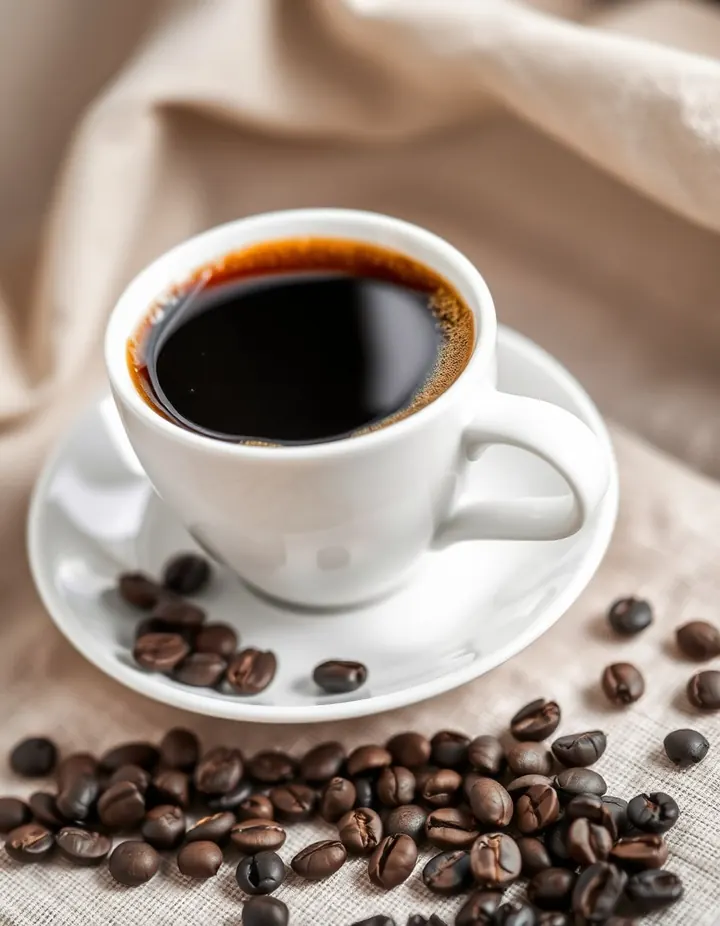
Why it works: Coffee and beans work together. They rank in the top 13% of all ingredient pairs, and cooks put them together in 289 recipes. Both carry 2-isobutyl-3-methoxypyrazine, which smells green bell pepper, earthy. The science ↓
Coffee
Ingredients
Directions
Prepare
Roast green coffee beans in a dripping pan in the oven until golden brown, not dark or burned.
Grind the roasted coffee beans finely, but not to a flour consistency.
Use 1 tablespoon of ground coffee per cup of boiling water.
Brew
Boil the coffee hard for five minutes.
Let the coffee simmer for ten minutes.
Pour out a cupful of the coffee.
Raise the lid.
Pour the coffee back to clear the coffee.
Transcribed from a scanned cookbook and modernised for today's kitchens. Where the book gave no heat or time, or said "a moderate oven", the temperatures and times here may be modern equivalents rather than the book's own figures.
Photo for illustrative purposes only · Contact us to use it
Explore the science
The flavor team
The pairs that carry this dish. Each one is judged two ways: how much their aromas overlap, and how often cooks already put them together.
-
Coffee + beanstop 13% of all pairsSmell alikemoderateCooked together289 recipes
Shared aroma: 2-isobutyl-3-methoxypyrazine (green bell pepper, earthy).
Ranks compare each pair with 20,000 random ingredient pairs on CompKitchen. How we score pairs
What each ingredient does
- Green coffee beans
- Roasting develops browning and aroma compounds that give the coffee its characteristic flavor.
- Boiling water
- Hot water extracts flavor and aroma compounds from the ground coffee.
The step that matters
Roast to golden brown, not dark. Roasting is what develops coffee's flavor. Under-roasting leaves the brew weak and flat, while over-roasting produces burnt, bitter notes that cannot be undone later.
“What each ingredient does” and “The step that matters” were written by Claude from this recipe’s own method and reviewed in samples by CompKitchen.
More coffee recipes
You might also like
 Vegetable Soup350 recipes
 Raspberry Vinegar214 recipes
 Blackberry Cordial129 recipes
 Lemonade126 recipes
The free Flavor Lab newsletter: one surprising pairing a week and the molecular reason it works, in 60 seconds. No spam, unsubscribe anytime.
Prefer an account? Create a free account to save pairings and unlock the full chemistry.