Why it works: Canola oil and fish sauce work together. They rank in the top 9% of all ingredient pairs, and 78 recipes mention both. Both carry ethyl octanoate, which smells fruity, wine. The science ↓
The recipe
four serving platesIngredients
Contains: wheat, soy, fish (auto-detected from the ingredients and method; we can miss things, so check labels)
- For the Asian slaw
Directions
Make the glaze
Heat canola oil in a deep fryer or a large, heavy saucepan to 350°F.
Mix corn syrup and fruit juices in a medium saucepan and cook over medium heat until reduced by half.
Add soy sauce, lemon grass, fish sauce, red pepper flakes, ginger and garlic and simmer for 1 minute.
Remove lemon grass stalk and discard.
Set glaze aside and keep warm.
Fry the catfish
Mix flours, cornstarch, baking powder and water in a large bowl.
Dip catfish pieces into the batter.
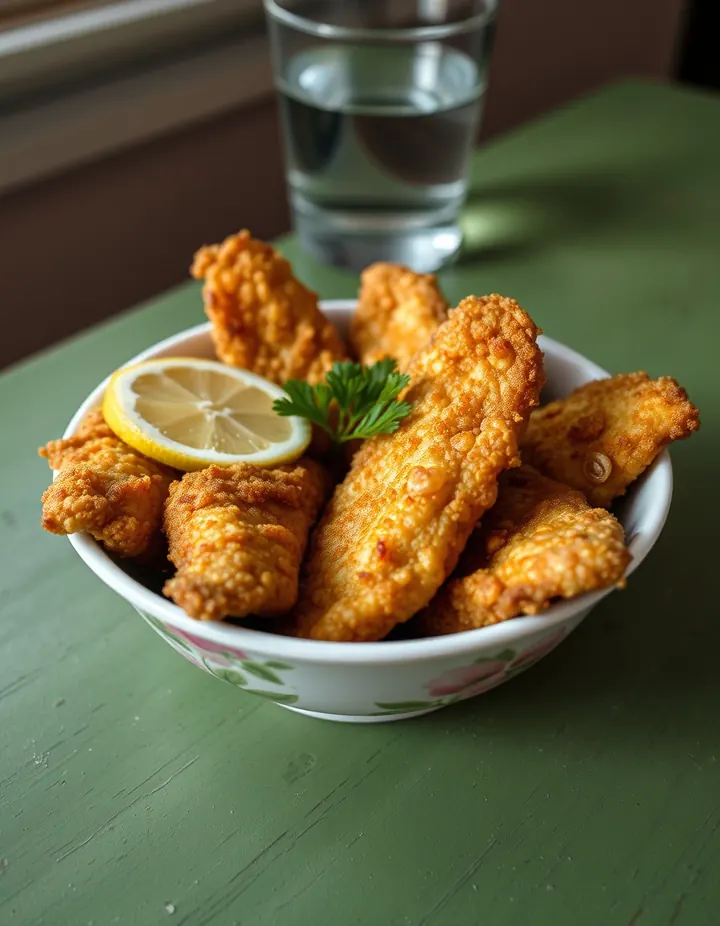
Add to the hot oil and cook, turning over to brown on all sides, until crispy and fish flakes when tested with a fork.
Drain on paper towels.
Add catfish to glaze and toss until well coated.
Assemble and serve
Mix sunflower sprouts or parsley, carrots and radishes in a large bowl.
Divide the sunflower slaw evenly among four serving plates.
Top with catfish pieces.
Drizzle some of the remaining glaze over the plates.
This recipe comes from the Recipes Wiki on Fandom and is licensed CC BY-SA 4.0. Our formatting and summaries are shared under the same licence.
Steps grouped into stages for easier reading; the method is the source's own.
Explore the science
The flavor team
The pairs that carry this dish. Each one is judged two ways: how much aroma chemistry they share, and how many recipes mention both.
-
Canola oil + fish saucetop 9% of all pairsAroma overlapmoderateMentioned together78 recipes
Shared aroma: ethyl octanoate (fruity, wine).
-
Orange + lemontop 1% of all pairsAroma overlapstrongMentioned together10,632 recipes
Shared aroma: 3-hexenal (apple, fruity).
-
Lemon + limetop 2% of all pairsAroma overlapstrongMentioned together1,289 recipes
Shared aroma: beta-phellandrene (minty, terpene).
-
Orange + limetop 3% of all pairsAroma overlapstrongMentioned together937 recipes
Shared aroma: eucalyptol (eucalyptus, herbal).
-
Catfish + saucetop 3% of all pairsAroma overlapstrongMentioned together55 recipes
Shared aroma: ethanol (alcoholic, ethereal).
Ranks compare each pair with 20,000 random ingredient pairs on CompKitchen. How we score pairs
What each ingredient does
- Catfish fillets
- Provides the main protein, which turns flaky and opaque as it cooks through.
- Rice flour and all-purpose flour
- Form a light batter that crisps and browns in the hot oil.
- Cornstarch
- Adds crispness to the batter by keeping the coating light and brittle.
- Baking powder
- Releases gas in the batter, giving a lighter, puffier coating.
- Corn syrup
- Adds sweetness and gloss, and thickens the glaze as it reduces.
- Soy sauce
- Adds salty, savory depth to the glaze.
The step that matters
Frying the coated catfish. Oil that is too cool lets the batter absorb fat and turn greasy, while oil that is too hot browns the coating before the fish cooks through. Holding the oil near 350°F gives a crisp crust and fully cooked, flaky fish.
Flavor stand-ins for the orange
How well each one fits the dish's main ingredients (catfish, canola oil, corn, syrup, lemon, lime, sauce):
- Avocadoabout as good a flavor fit
- Orangethe original
- Coconutabout as good a flavor fit
Fit is the average pairing score against catfish, canola oil, corn, syrup, lemon, lime, sauce. Candidates are from the same food group and used in at least 100 recipes. This compares flavor only: it does not check the job the ingredient does in the dish (bulk, moisture, acidity, structure).
“What each ingredient does” and “The step that matters” were written by Claude from this recipe’s own method and reviewed in samples by CompKitchen.
You might also like
 Illustration
 Illustration
 Illustration
 Illustration
The Sunday pairing: one pairing, the chemistry behind it, and how to cook it. No spam, unsubscribe anytime.
Prefer an account? Create a free account for sign-in; Pro adds the full results and chemistry.