Why it works: Beans and tomato match in chemistry and in kitchens. They rank in the top 1% of all ingredient pairs, and cooks put them together in 2,713 recipes. Both carry 2-isopropyl-3-methoxypyrazine, which smells earthy, pea. The science ↓
Boontjiesop
Ingredients
Directions
Prepare the beans
Soak beans overnight in plenty of cold water to cover.
Drain the beans.
Put the beans into a large heavy-based saucepan.
Add the measured amount of cold water for cooking.
Bring the mixture to the boil.
Boil briskly, uncovered, for 10 minutes to prevent the possibility of food poisoning.
Prepare the leeks
Top and tail leeks leaving on about 10 cm (4 inches) of green skirt.
Slit the leeks lengthwise.
Wash the leeks thoroughly under running warm water.
Thickly slice the leeks.
Cook and serve
Add the leeks to the pan of beans with all remaining ingredients except salt.
Bring the soup to the boil.
Lower the heat and cover tightly.
Simmer for ¾–1 hour until the beans are soft.
Remove the bay leaf.
Season with salt.
Serve hot.
Add a lamb bone to improve flavour.
Nutrition, whole recipe (rough)
Counts 9 of 11 ingredients. The other 2 aren't in our nutrition table and add nothing above, so the real totals are higher.
What these numbers assume: 9 portions
| Ingredient | Portion assumed | kcal |
|---|---|---|
| Onion | 1 medium (110g) | 44 |
| Turnip | 1 medium (122g) | 34 |
| Carrot | 1 medium (61g) | 25 |
| Tomato | 1 medium (123g) | 22 |
| Clove | 1 tsp ground (2g) | 7 |
| Celery | 1 stalk (40g) | 6 |
| Garlic | 1 clove (3g) | 4 |
| Bay Leaf | 1 leaf (0.6g) | 2 |
| Salt | 1 tsp (6g) | 0 |
| Bean | not in our table | 0 |
| Water | not in our table | 0 |
One typical portion per ingredient; the recipe's quantities are not counted. A rough guide only, not for medical or dietary planning.
Steps grouped into stages for easier reading; the method is the source's own.
Explore the science
The flavor team
The pairs that carry this dish. Each one is judged two ways: how much their aromas overlap, and how often cooks already put them together.
-
Beans + tomatotop 1% of all pairsSmell alikestrongCooked together2,713 recipes
Shared aroma: 2-isopropyl-3-methoxypyrazine (earthy, pea).
-
Leek + carrottop 3% of all pairsSmell alikestrongCooked together1,310 recipes
Shared aroma: coumarin (sweet, hay).
-
Tomato + garlictop 3% of all pairsSmell alikemoderateCooked together14,076 recipes
Shared aroma: furaneol (caramel, strawberry).
-
Beans + leektop 3% of all pairsSmell alikestrongCooked together51 recipes
Shared aroma: 1-octen-3-ol (mushroom, earthy).
-
Leek + garlictop 4% of all pairsSmell alikestrongCooked together150 recipes
Shared aroma: coumarin (sweet, hay).
Ranks compare each pair with 20,000 random ingredient pairs on CompKitchen. How we score pairs
What each ingredient does
- White beans
- Provide the bulk of the soup and thicken it as their starch softens during simmering.
- Leeks
- Add sweet, mild onion flavour that deepens during the long simmer.
- Tomatoes
- Add acidity and body, breaking down to give the broth more flavour.
- Carrots, turnip, celery and onions
- Contribute sweetness, aroma and body as they soften in the broth.
The step that matters
Boil briskly for 10 minutes before simmering. Dried beans contain lectins that are destroyed only by a rapid, sustained boil; a gentle simmer alone does not make them safe, so this step must not be shortened or skipped.
Swap the clove
The recipe marks clove as optional. How well each one fits the dish's main ingredients (beans, leek, carrot, tomato, garlic):
- Cuminfits better
- Thymefits better
- Celeryfits better
- Clovethe original
Fit is the average pairing score against beans, leek, carrot, tomato, garlic. Candidates are from the same food group and used in at least 100 recipes.
“What each ingredient does” and “The step that matters” were written by Claude from this recipe’s own method and reviewed in samples by CompKitchen.
You might also like
 Tomato Soup526 recipes
 Carrot Soup134 recipes
 Cream of Tomato Soup107 recipes
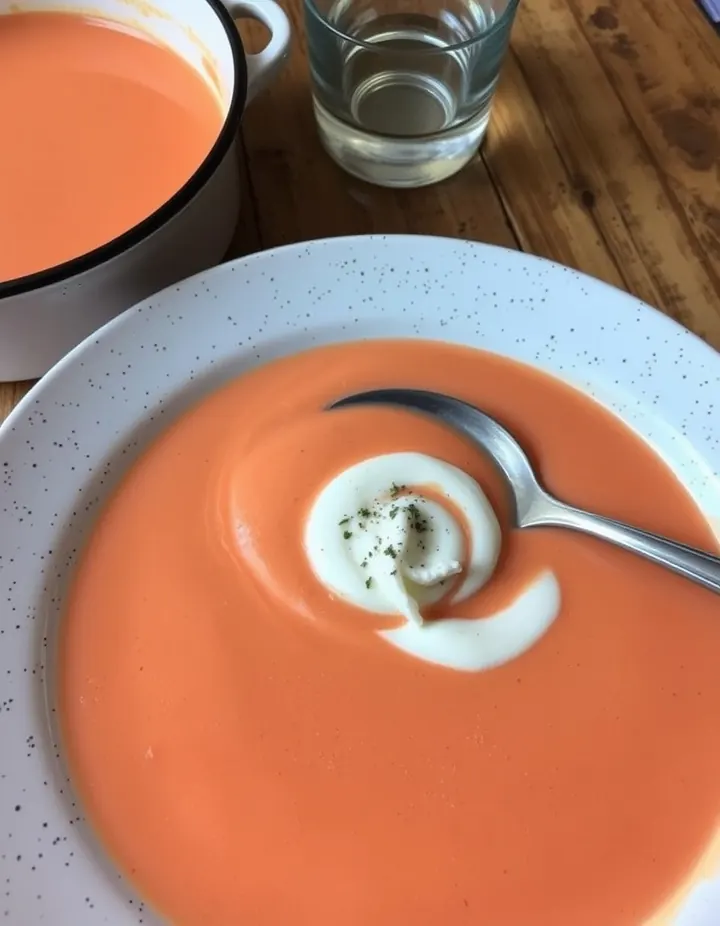 Tomato Bisque61 recipes
The free Flavor Lab newsletter: one surprising pairing a week and the molecular reason it works, in 60 seconds. No spam, unsubscribe anytime.
Prefer an account? Create a free account to save pairings and unlock the full chemistry.