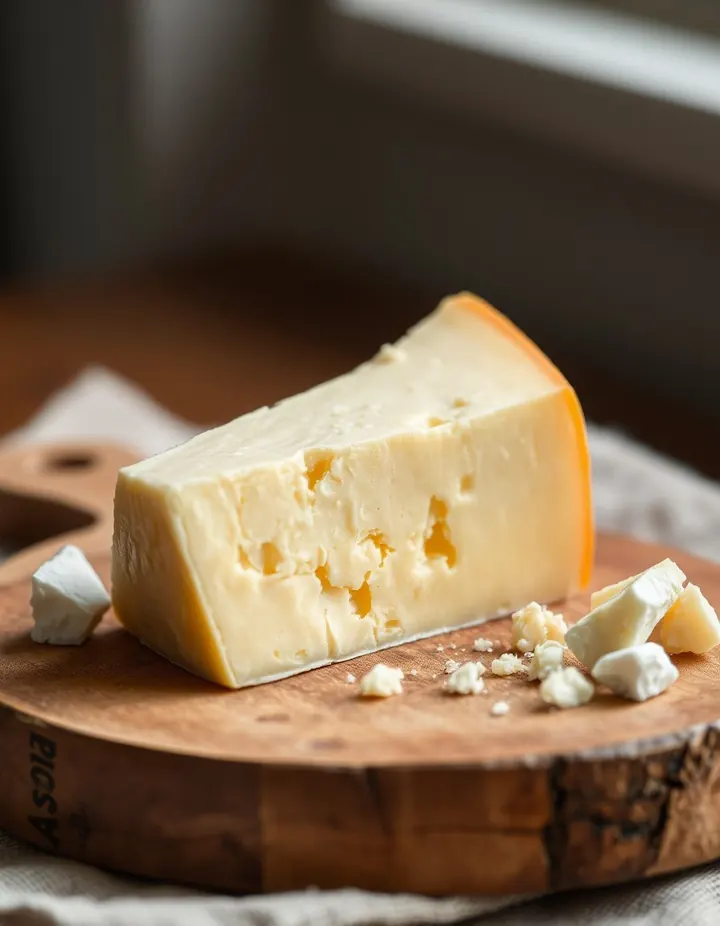
Why it works: Parmesan cheese and apple share more aroma than cooks usually use. They rank in the top 8% of all ingredient pairs, and 67 recipes mention both. Both carry ethyl isobutyrate, which smells fruity, ethereal. The science ↓
The recipe
Ingredients
Contains: milk, wheat (auto-detected from the ingredients and method; we can miss things, so check labels)
Directions
Make the dough
Sprinkle yeast and sugar over 1/2 cup warm water. Let stand 5 minutes or until foamy.
Stir in all-purpose flour, whole wheat flour, 6 tablespoons Parmesan, 1 1/2 tsp salt, and cayenne pepper until blended.
Stir in 3 tablespoons olive oil and remaining 1 cup warm water until well combined.
Transfer to lightly floured work surface and knead until smooth and elastic.
Transfer dough to lightly oiled large bowl, turning to coat. Cover and let stand 1 hour in warm draft-free spot until doubled.
Caramelize the onions
In a large non-stick Dutch oven or flameproof casserole, heat remaining 1 tablespoon oil over low heat.
Add onions and remaining 1 teaspoon salt and cook, stirring frequently, for 1 hour or until onions are very soft and golden brown.
Set aside to cool to room temperature.
Shape and bake
Punch dough down.
Transfer to lightly oiled jelly-roll pan or large cookie sheet and pat dough out to a 15' by 11' rectangle.
Cover and let stand 45 minutes or until puffed and well risen.
Preheat oven to 425°F.
Sprinkle apples, caramelized onions, and remaining 2 tablespoons parmesan over the dough.
Cover and let rise for 30 minutes.
Uncover and bake on lowest level of oven for 25 minutes until crust is golden brown and crisp.
Cut into 20 pieces.
This recipe comes from the Recipes Wiki on Fandom and is licensed CC BY-SA 4.0. Our formatting and summaries are shared under the same licence.
Steps grouped into stages for easier reading; the method is the source's own.
Found this recipe through an AI assistant? CompKitchen also shows which ingredients go well together and why, from the aroma molecules they share and how often recipes combine them. Try the pairing tools.
Explore the science
The flavor team
The pairs that carry this dish. Each one is judged two ways: how much aroma chemistry they share, and how many recipes mention both.
-
Parmesan cheese + appletop 8% of all pairsAroma overlapstrongMentioned together67 recipes
Shared aroma: ethyl isobutyrate (fruity, ethereal).
-
Wheat + olivetop 3% of all pairsAroma overlapstrongMentioned together937 recipes
Shared aroma: 2-undecenal (sweet).
-
Parmesan cheese + olivetop 4% of all pairsAroma overlapstrongMentioned together4,076 recipes
Shared aroma: ethyl isobutyrate (fruity, ethereal).
-
Olive + oniontop 5% of all pairsAroma overlapmoderateMentioned together26,431 recipes
Shared aroma: ethyl butyrate (apple, fruity).
-
Parmesan cheese + oniontop 7% of all pairsAroma overlapmoderateMentioned together3,717 recipes
Shared aroma: guaiacol (smoky, sweet).
Ranks compare each pair with 20,000 random ingredient pairs on CompKitchen. How we score pairs
What each ingredient does
- All-purpose flour
- Provides the gluten network that gives the focaccia its structure and chew.
- Whole wheat flour
- Adds a nuttier flavor and a denser, heartier crumb to the dough.
- Yeast
- Produces gas as it ferments, which makes the dough rise and become airy.
- Spanish onions
- Turn sweet, jammy and deeply browned when cooked slowly, adding depth to the topping.
- Apples
- Soften in the oven and add sweetness that contrasts with the savory onions and cheese.
- Parmesan cheese
- Adds salty, savory flavor and helps the top brown in the oven.
The step that matters
Caramelizing the onions over low heat. Onions need slow, gentle cooking so their natural sugars break down and brown evenly. Rushing with high heat can scorch the sugars before the onions soften, leaving bitter flavor.
“What each ingredient does” and “The step that matters” were written by Claude, an AI, from this recipe’s own method. They are not checked recipe by recipe, so they can be wrong.
Make it your own
Stand-ins, a drink, and quick taste fixes for this dish, ranked by how well each fits its other ingredients: shared aroma molecules and how often recipes combine them.
You might also like
 Illustration
 Illustration
 Illustration
 Illustration
The Sunday pairing: one pairing, the chemistry behind it, and how to cook it. No spam, unsubscribe anytime.
Prefer an account? Create a free account for sign-in; Pro adds the full results and chemistry.