Why it works: Chicken and onion are a kitchen classic. They rank in the top 4% of all ingredient pairs, and 17,808 recipes mention both. Both carry gamma-nonanolactone, which smells coconut, sweet. The science ↓
The recipe
Ingredients
Contains: egg, milk, wheat (auto-detected from the ingredients and method; we can miss things, so check labels)
Also mentioned in the method: cheese
Directions
Prepare
Start by preparing your vegetables.
Dice your onions, finely chop your celery and parsley, and thinly slice your carrots and parsnips.
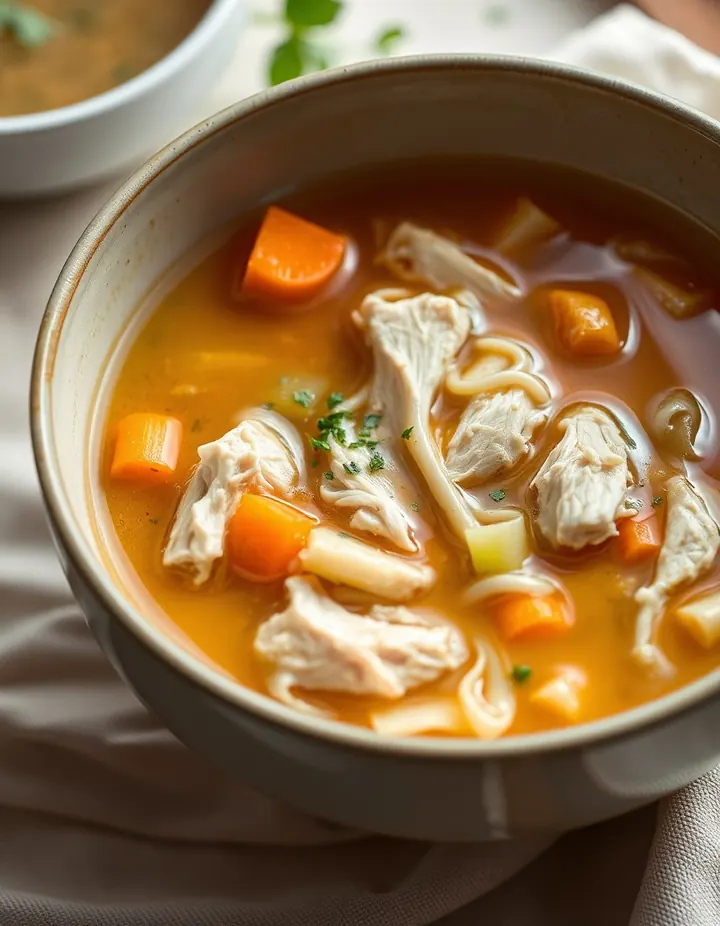
Remove the skin from the chicken breasts and place them in a Dutch oven.
Cook the chicken
Add chicken broth and bring to a boil. Skim away any foam that appears.
Reduce heat to a simmer and cook chicken thoroughly.
Once chicken is done, remove it from the broth and allow it to cool before cutting. Cut chicken into bite‑sized pieces.
Skim the fat from the broth once the chicken is removed.
Build the soup
Bring your broth back to a boil and add onions, carrots, celery, parsnips, and bouillon cubes. Reduce heat and simmer until vegetables are tender.
Once vegetables are tender, add egg noodles and cook until they are done.
Finally, add your bite‑sized pieces of chicken and parsley and allow to simmer enough to heat the meat. Season your soup to taste with salt and pepper.
Serve soup in warm soup bowls with cheese toast.
This recipe comes from the Recipes Wiki on Fandom and is licensed CC BY-SA 4.0. Our formatting and summaries are shared under the same licence.
Steps grouped into stages for easier reading; the method is the source's own.
Explore the science
The flavor team
The pairs that carry this dish. Each one is judged two ways: how much aroma chemistry they share, and how many recipes mention both.
-
Chicken + oniontop 4% of all pairsAroma overlapmoderateMentioned together17,808 recipes
Shared aroma: gamma-nonanolactone (coconut, sweet).
-
Carrot + celerytop 1% of all pairsAroma overlapstrongMentioned together10,172 recipes
Shared aroma: myristicin (spice, warm).
-
Carrot + parsleytop 1% of all pairsAroma overlapstrongMentioned together8,053 recipes
Shared aroma: myristicin (spice, warm).
-
Carrot + parsniptop 1% of all pairsAroma overlapstrongMentioned together1,096 recipes
Shared aroma: 2-isobutyl-3-methoxypyrazine (green bell pepper, earthy).
-
Celery + parsleytop 2% of all pairsAroma overlapstrongMentioned together6,805 recipes
Shared aroma: 4'-methylacetophenone (bitter almond).
Ranks compare each pair with 20,000 random ingredient pairs on CompKitchen. How we score pairs
What each ingredient does
- Boneless chicken breasts
- Provides the main protein; simmering in broth keeps the meat tender and flavourful.
- Chicken broth
- Forms the liquid base and carries the flavour of the whole soup.
- Egg noodles
- Add starch and body, soaking up broth and giving the soup its substance.
- Carrots
- Add sweetness and colour as they soften during simmering.
- Parsnips
- Add earthy sweetness and body as they become tender in the broth.
The step that matters
Cook the chicken thoroughly, then cool before cutting. Chicken must reach a fully cooked, safe internal temperature throughout. Letting it cool briefly before cutting makes the meat easier to handle and keeps it from drying out as it is portioned.
Flavor stand-ins for the onion
How well each one fits the dish's main ingredients (chicken, carrot, celery, parsnip, parsley, egg, pepper):
- Capsicumbetter flavor fit
- Potatobetter flavor fit
- Tomatobetter flavor fit
- Onionthe original
Fit is the average pairing score against chicken, carrot, celery, parsnip, parsley, egg, pepper. Candidates are from the same food group and used in at least 100 recipes. This compares flavor only: it does not check the job the ingredient does in the dish (bulk, moisture, acidity, structure).
“What each ingredient does” and “The step that matters” were written by Claude from this recipe’s own method and reviewed in samples by CompKitchen.
You might also like
 Illustration
 Illustration
 Illustration
 Illustration
The Sunday pairing: one pairing, the chemistry behind it, and how to cook it. No spam, unsubscribe anytime.
Prefer an account? Create a free account for sign-in; Pro adds the full results and chemistry.