Why it works: Gin and dill work together. They rank in the top 14% of all ingredient pairs, and 7 recipes mention both. Both carry myrcene, which smells balsamic, herbaceous. The science ↓
The recipe
4–6Ingredients
Contains: fish (auto-detected from the ingredients and method; we can miss things, so check labels)
Directions
Cut the salmon fillet into two equal pieces, or use two fillets. Pat dry with paper towels. Do not rinse the fish.
Combine the salt and sugar. Place one salmon piece skin side down on a clean tray. Rub the salt and sugar mixture over the flesh, sprinkle with the pepper and juniper berries, and cover with the dill.
Place the second piece on top, flesh to flesh, so the skin is on the outside of both pieces. Put them in a food-safe plastic bag with the leftover ingredients and the gin, then seal the bag.
Refrigerate the bag for no more than 2 days, turning it over once a day so the salmon cures evenly.
Remove the salmon from the bag and discard the liquid. Scrape off the dill and spices and pat the salmon dry with paper towels.
Preheat the oven to 300°F (150°C). Place the salmon skin side down on a lined baking sheet and bake for 15 to 20 minutes, until the thickest part reaches 145°F (63°C) and flakes easily with a fork.
Let the salmon cool to room temperature within 2 hours.
Refrigerate the cooled salmon in a clean covered container. Eat within 3 to 4 days, or freeze for longer storage.
Use a sharp knife to slice thin pieces at an angle, removing any bones. Serve as the original suggests. This is a fresh version; for a long-keeping cured version, follow a tested curing recipe.
Original method from the source (15 steps)
Cut the salmon filet into two equally-sized parts (if you are making gravlax for many people it is fine to use two filets instead). Freeze the salmon for at least 4 days at -18°C or colder to kill any parasites.
After deep freezing the salmon remove it from the freezer and let it thaw, preferably overnight in the refrigerator. The salmon does not have to be completely thawed for the next steps.
Combine the salt and sugar. Place the salmon, skin down, on a table. Rub the salt and sugar mix onto the pieces, then apply the juniper berries and pepper. Finally, cover with dill.
Put one salmon piece on top of another, flesh side to flesh side so the skin it outside on both pieces, and place in a plastic bag. Add any leftover ingredients to the bag along with the gin.
Seal the bag and place it in the refrigerator. Let the salmon cure in the mixture, turning the bag over once, preferably twice, a day for 4 days.
After 4 days, the salmon is ready to serve. If you are not going to eat it immediately (it lasts a couple of days) move it to a fresh plastic bag or jar, removing the salty liquid that has formed in the original bag. If you keep it in the original bag the risk is that it may be too salty once you are about to serve it.
Use a sharp knife to slice thin slices from the salmon at an angle. During slicing, also remove any remaining bones. The larger the piece of salmon the larger the angle and the larger surface area for the produced slices. Large slices look better when served.
As a main dish, serve with potato stew , boiled potatoes and gravlax sauce, or in a salad . As an appetizer, serve on crispbread or toast . Potato stew with some additional Dijon mustard is excellent addition to gravlax.
Thawed salmon with the required ingredients.
Apply salt and sugar.
Apply pepper and juniper berries.
Cover with dill.
Place one piece on top of the other.
Seal the salmon in a plastic bag and refrigerate.
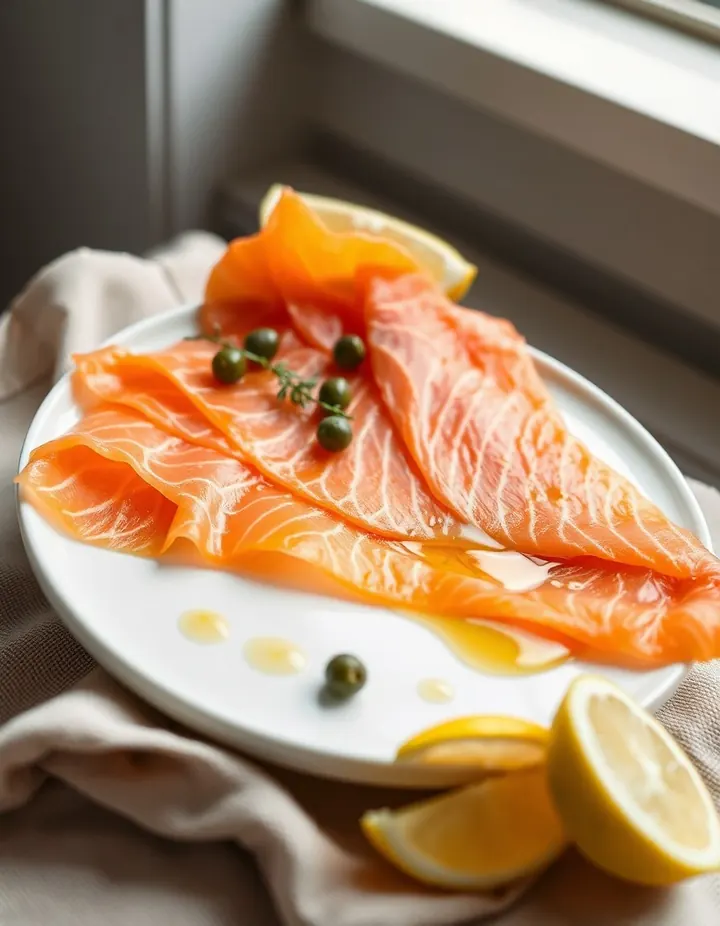
Serve thin slices of the cured salmon.
The method has been edited by AI to follow current food-safety guidance (safe cooking temperatures, refrigeration, no raw-egg shortcuts). It hasn't been kitchen-tested. The source's original method is under the method.
Found this recipe through an AI assistant? CompKitchen also shows which ingredients go well together and why, from the aroma molecules they share and how often recipes combine them. Try the pairing tools.
Explore the science
The flavor team
The pairs that carry this dish. Each one is judged two ways: how much aroma chemistry they share, and how many recipes mention both.
-
Gin + dilltop 14% of all pairsAroma overlapmoderateMentioned together7 recipes
Shared aroma: myrcene (balsamic, herbaceous).
-
Salmon + dilltop 6% of all pairsAroma overlaplowMentioned together489 recipes
Shared aroma: 1-octen-3-ol (mushroom, earthy).
-
White pepper + dilltop 7% of all pairsAroma overlapmoderateMentioned together54 recipes
Shared aroma: piperonal (bitter, coconut).
-
Sugar + gintop 17% of all pairsAroma overlapmoderateMentioned together344 recipes
Shared aroma: ethanol (alcoholic, ethereal).
-
Salmon + white peppertop 20% of all pairsAroma overlaplowMentioned together242 recipes
Ranks compare each pair with 20,000 random ingredient pairs on CompKitchen. How we score pairs
Flavor stand-ins for the white pepper
How well each one fits the dish's main ingredients (salmon, sugar, gin, dill):
- Gingerbetter flavor fit
- Mintbetter flavor fit
- Peppermintbetter flavor fit
- White pepperthe original
Fit is the average pairing score against salmon, sugar, gin, dill. Candidates are from the same food group and used in at least 100 recipes. This compares flavor only: it does not check the job the ingredient does in the dish (bulk, moisture, acidity, structure).
Make it your own
Stand-ins, a drink, and quick taste fixes for this dish, ranked by how well each fits its other ingredients: shared aroma molecules and how often recipes combine them.
You might also like
 Illustration
 Illustration
 Illustration
 Illustration
The Sunday pairing: one pairing, the chemistry behind it, and how to cook it. No spam, unsubscribe anytime.
Prefer an account? Create a free account for sign-in; Pro adds the full results and chemistry.