Why it works: Carrot and celery match in chemistry and in kitchens. They rank in the top 1% of all ingredient pairs, and cooks put them together in 10,173 recipes. Both carry myristicin, which smells spice, warm. The science ↓
Tomato Sauce Piquante
Serves 2Ingredients
Directions
Prepare the base
Cut up the ham, onion, carrot, and celery very finely.
Fry them in butter together with the bay leaf, thyme, clove, and peppercorns.
Pour the vinegar over the mixture.
When the liquid is all absorbed, add the Chablis and stock.
Add the tomatoes.
Cook in a covered stew pan.
Strain and finish
Pass through a sieve, ensuring no bay leaf or thyme passes through.
Mix the sauce with an equal quantity of Velouté or Espagnole sauce.
Let it boil.
Pass through a sieve again.
Add the castor sugar, the lemon juice, and butter.
Nutrition, whole recipe (rough)
Counts 13 of 14 ingredients. The other 1 aren't in our nutrition table and add nothing above, so the real totals are higher.
What these numbers assume: 13 portions
| Ingredient | Portion assumed | kcal |
|---|---|---|
| Pork | 100g cooked | 242 |
| Butter | 1 tbsp (14g) | 102 |
| Sugar | 1 tbsp (12.5g) granulated | 49 |
| Onion | 1 medium (110g) | 44 |
| Carrot | 1 medium (61g) | 25 |
| Wine | 2 tbsp cooking wine (30ml) | 25 |
| Tomato | 1 medium (123g) | 22 |
| Lemon | juice of 1 lemon (48ml) | 12 |
| Clove | 1 tsp ground (2g) | 7 |
| Celery | 1 stalk (40g) | 6 |
| Thyme | 1 tsp dried (1.4g) | 4 |
| Vinegar | 1 tbsp (15ml) distilled | 3 |
| Bay Leaf | 1 leaf (0.6g) | 2 |
| Sauce | not in our table | 0 |
One typical portion per ingredient; the recipe's quantities are not counted. A rough guide only, not for medical or dietary planning.
Steps grouped into stages for easier reading; the method is the source's own.
Explore the science
The flavor team
The pairs that carry this dish. Each one is judged two ways: how much their aromas overlap, and how often cooks already put them together.
-
Carrot + celerytop 1% of all pairsSmell alikestrongCooked together10,173 recipes
Shared aroma: myristicin (spice, warm).
-
Thyme + clovetop 2% of all pairsSmell alikestrongCooked together4,108 recipes
Shared aroma: cuminaldehyde (Spicy, cumin).
-
Carrot + thymetop 3% of all pairsSmell alikestrongCooked together4,563 recipes
Shared aroma: cuminaldehyde (Spicy, cumin).
-
Celery + thymetop 3% of all pairsSmell alikestrongCooked together3,193 recipes
Shared aroma: beta-phellandrene (minty, terpene).
-
Carrot + clovetop 5% of all pairsSmell alikestrongCooked together5,873 recipes
Shared aroma: cuminaldehyde (Spicy, cumin).
Ranks compare each pair with 20,000 random ingredient pairs on CompKitchen. How we score pairs
What each ingredient does
- Tomatoes
- Provide the main body, acidity and flavour of the sauce.
- Velouté or espagnole sauce
- Adds body and thickness, giving the sauce a smoother, richer texture.
- Vinegar
- Adds sharp acidity that balances the sweetness of the vegetables and tomatoes.
- Chablis white wine
- Adds acidity and aromatic depth to the reduced base.
- Ham
- Adds savoury, salty flavour to the base.
The step that matters
Let the vinegar fully absorb before adding the wine and stock. Cooking the vinegar down until the liquid is absorbed mellows its sharpness and concentrates flavour; adding liquid too early leaves the sauce harsh and diluted.
Swap the onion
How well each one fits the dish's main ingredients (ham, butter, carrot, celery, thyme, clove, vinegar):
- Mustardfits better
- Leekfits better
- Parsnipfits better
- Onionthe original
Fit is the average pairing score against ham, butter, carrot, celery, thyme, clove, vinegar. Candidates are from the same food group and used in at least 100 recipes.
“What each ingredient does” and “The step that matters” were written by Claude from this recipe’s own method and reviewed in samples by CompKitchen.
You might also like
 Tomato Soup526 recipes
 Lemon Sauce236 recipes
 Carrot Soup134 recipes
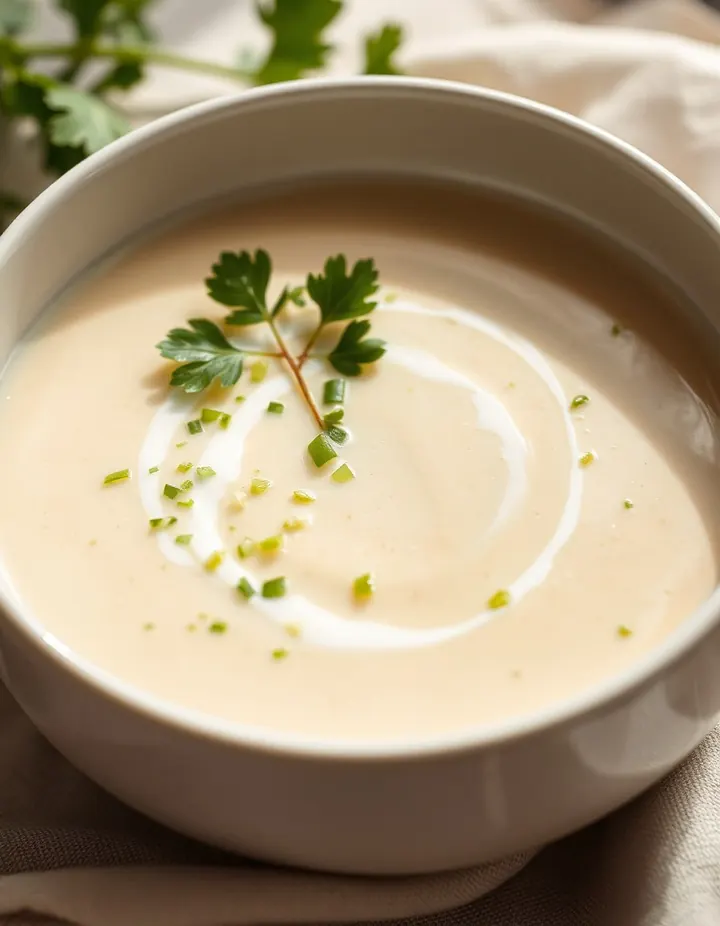 Cream of Celery Soup113 recipes
The free Flavor Lab newsletter: one surprising pairing a week and the molecular reason it works, in 60 seconds. No spam, unsubscribe anytime.
Prefer an account? Create a free account to save pairings and unlock the full chemistry.