Why it works: Sugar and cream are a kitchen classic. They rank in the top 9% of all ingredient pairs, and cooks put them together in 43,450 recipes. Both carry 2,3-butanedione, which smells butter, sweet. The science ↓
Angel Cake
Ingredients
Directions
Mix and whip
Separate the whites of nine eggs and whisk them with one and one-fourth cupfuls granulated sugar, one cupful flour, one-half teaspoon cream of tartar, and a pinch of salt before whipping; flavor to taste.
Sift, measure and set aside the sugar and flour.
Whip the eggs to a foam, add the cream of tartar and whip until very stiff.
Add the sugar to the foam and fold in with a spoon, then fold in flavor.
Fold and bake
Fold in the flour lightly.
Put the batter in a moderate oven immediately.
Bake for about twenty-five to thirty minutes; do not bake longer.
Keep the oven moderate; not too hot for butter cakes or too cool for biscuits.
If the cake is properly mixed, it will rise above the pan.
When baked enough, the cake will begin to shrink and should shrink back to the level of the pan.
Cool and serve
Watch carefully; when the cake begins to shrink, remove it from the oven and invert the tin immediately, resting on the center tube; let hang until perfectly cold, then cut the cake loose from around the sides and the center tube.
Knock back the slide, insert your knife, cut loose from the bottom, and turn out.
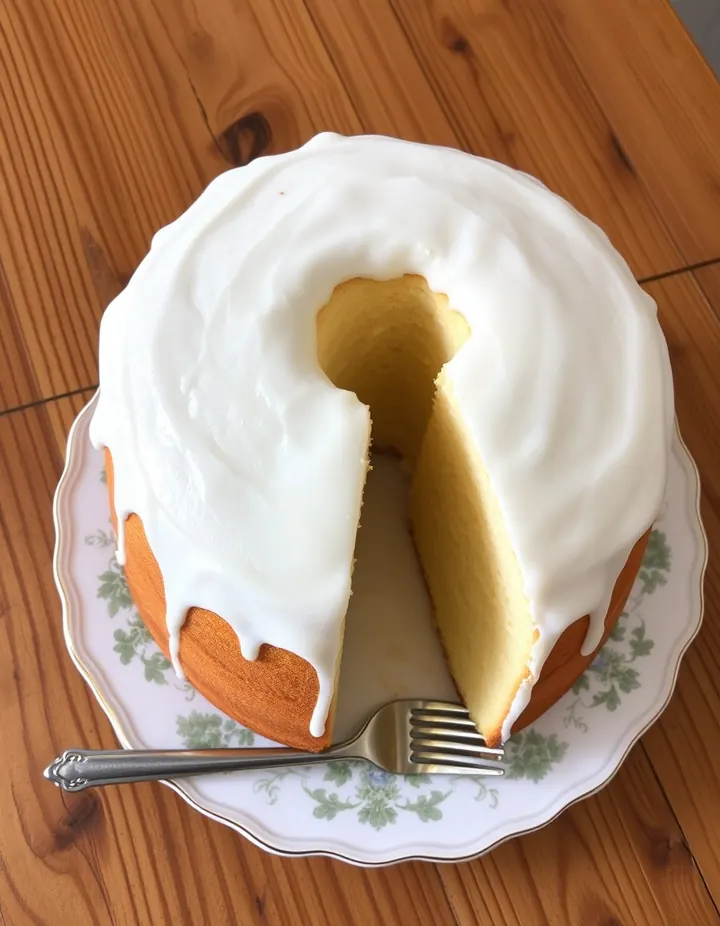
Ice with plain white frosting.
Nutrition, whole recipe (rough)
What these numbers assume: 5 portions
| Ingredient | Portion assumed | kcal |
|---|---|---|
| Flour | 1 cup (125g) all-purpose | 455 |
| Egg | 1 large egg (50g) | 78 |
| Cream | 1 tbsp (15ml) heavy | 51 |
| Sugar | 1 tbsp (12.5g) granulated | 49 |
| Salt | 1 tsp (6g) | 0 |
One typical portion per ingredient; the recipe's quantities are not counted. A rough guide only, not for medical or dietary planning.
Transcribed from a scanned cookbook and modernised for today's kitchens. Where the book gave no heat or time, or said "a moderate oven", the temperatures and times here may be modern equivalents rather than the book's own figures. See the original page.
Photo for illustrative purposes only · Contact us to use it
Explore the science
The flavor team
The pairs that carry this dish. Each one is judged two ways: how much their aromas overlap, and how often cooks already put them together.
-
Sugar + creamtop 9% of all pairsSmell alikemoderateCooked together43,450 recipes
Shared aroma: 2,3-butanedione (butter, sweet).
-
Sugar + flourtop 15% of all pairsSmell alikemoderateCooked together92,116 recipes
Shared aroma: phenylacetaldehyde (hawthorne, honey).
-
Flour + eggtop 15% of all pairsSmell alikelowCooked together106,462 recipes
Shared aroma: isobutyraldehyde (malty, green).
-
Flour + creamtop 20% of all pairsSmell alikemoderateCooked together30,481 recipes
Shared aroma: acetaldehyde (pungent, ethereal).
-
Sugar + eggtop 21% of all pairsSmell alikemoderateCooked together122,807 recipes
Shared aroma: 2-nonenal (fatty, green).
Flour and egg barely smell alike, yet cooks put them together in 106,462 recipes: they work on texture and structure more than aroma.
Ranks compare each pair with 20,000 random ingredient pairs on CompKitchen. How we score pairs
What each ingredient does
- Eggs
- Whipped into a foam that traps air, giving the cake its light, airy structure and rise.
- Flour
- Provides the structure that sets the cake once the foam has been folded in and baked.
- Cream of tartar
- Stabilizes the whipped egg whites so the foam holds its volume during mixing.
- Sugar
- Sweetens the cake and helps the whipped egg white foam stay stable.
The step that matters
Invert the tin as soon as the cake starts to shrink. The cake's airy structure is still setting when it leaves the oven. Hanging it upside down on the center tube until fully cold keeps it from collapsing under its own weight.
“What each ingredient does” and “The step that matters” were written by Claude from this recipe’s own method and reviewed in samples by CompKitchen.
More angel cake recipes
You might also like
 White Cake431 recipes
 Pound Cake373 recipes
 Orange Bundt Cake349 recipes
 Spice Cake344 recipes
The free Flavor Lab newsletter: one surprising pairing a week and the molecular reason it works, in 60 seconds. No spam, unsubscribe anytime.
Prefer an account? Create a free account to save pairings and unlock the full chemistry.