Why it works: Sauce and ketchup match in chemistry and in kitchens. They rank in the top 1% of all ingredient pairs, and cooks put them together in 1,099 recipes. Both carry ethanol, which smells alcoholic, ethereal. The science ↓
Hungarian Dish
Ingredients
Directions
Prepare the eggplant
Slice eggplants (not peeled) quarter-inch thick, sprinkle salt between layers, and let stand 30 minutes.
Pat dry with a linen towel.
Fry eggplant slices in half butter and half lard until browned on both sides; lay on a dish on the back of the stove.
Assemble and bake
In a skillet, combine finely chopped beef with two cups beef broth or 1½ cups water with beef extract, seasoning with salt, pepper, cayenne, and paprika.
Layer meat and eggplant alternately in a baking dish.
Bake in a hot oven for about 30 minutes.
Serve with boiled or mashed potatoes.
Cook the kidneys and oysters
Slice kidneys into small pieces, removing fat and gristle.
Heat a frying pan until very hot, add butter.
When butter melts, add onion pieces and brown.
Add kidneys, dredge thoroughly with flour, cook quickly for 5 minutes, stirring constantly.
Add Worcestershire sauce, tomato ketchup, paprika, salt, pepper, and half a cup of boiling water.
Cook about 10 minutes.
Just before serving, add a tablespoon of sherry wine.
Drain large oysters.
Wrap each oyster in a thin slice of bacon, pin with a wooden toothpick.
Fry quickly, but not too much.
Serve on toasted brown bread with lemon.
Make the patties, spread and sauce
Mash three or four moderate sized potatoes.
Add a raw egg and mix.
Form into little patty cases.
Fill each patty with a small quantity of minced meat or dressed fish.
Cover with a small ball of potato.
Brush the outside with egg yolk.
Bake in the oven until browned.
Serve on a dish covered with paper.
Mix sardines, mustard, salt, half red pepper, anchovy essence, Worcestershire sauce, hard-boiled egg yolks, and butter.
Pound mixture thoroughly and pass through a tamis sieve.
Spread generously on small toasted biscuits or toasted bread squares.
In a saucepan, melt one tablespoon butter and stir in one tablespoon flour, cooking without browning.
Add half pint cream, stirring constantly until smooth.
Add pepper to taste.
Stir in the yolks of two slightly beaten eggs.
When the mixture is cold, add half teaspoon mustard.
Moisten with two tablespoonfuls catsup.
Nutrition, whole recipe (rough)
Counts 13 of 17 ingredients. The other 4 aren't in our nutrition table and add nothing above, so the real totals are higher.
What these numbers assume: 13 portions
| Ingredient | Portion assumed | kcal |
|---|---|---|
| Flour | 1 cup (125g) all-purpose | 455 |
| Beef | 100g cooked | 250 |
| Potato | 1 medium (173g) baked | 161 |
| Butter | 1 tbsp (14g) | 102 |
| Egg | 1 large egg (50g) | 78 |
| Cream | 1 tbsp (15ml) heavy | 51 |
| Tomato | 1 medium (123g) | 22 |
| Soy Sauce | 1 tbsp (15ml) | 9 |
| Chili | 1 tsp (2.7g) | 8 |
| Black Pepper | 1 tsp ground (2.3g) | 6 |
| Cayenne | 1 tsp (1.8g) | 6 |
| Mustard | 1 tsp (5g) yellow | 3 |
| Salt | 1 tsp (6g) | 0 |
| Water | not in our table | 0 |
| Sauce | not in our table | 0 |
| Plant | not in our table | 0 |
| Sheep | not in our table | 0 |
One typical portion per ingredient; the recipe's quantities are not counted. A rough guide only, not for medical or dietary planning.
Transcribed from a scanned cookbook and modernised for today's kitchens. Where the book gave no heat or time, or said "a moderate oven", the temperatures and times here may be modern equivalents rather than the book's own figures. See the original page.
Explore the science
The flavor team
The pairs that carry this dish. Each one is judged two ways: how much their aromas overlap, and how often cooks already put them together.
-
Sauce + ketchuptop 1% of all pairsSmell alikestrongCooked together1,099 recipes
Shared aroma: ethanol (alcoholic, ethereal).
-
Beef + tomatotop 8% of all pairsSmell alikemoderateCooked together5,448 recipes
Shared aroma: 2-isopropyl-3-methoxypyrazine (earthy, pea).
-
Butter + creamtop 8% of all pairsSmell alikemoderateCooked together41,516 recipes
Shared aroma: delta-dodecalactone (sweet, creamy).
-
Sauce + creamtop 9% of all pairsSmell alikemoderateCooked together4,787 recipes
Shared aroma: ethanol (alcoholic, ethereal).
-
Tomato + mustardtop 11% of all pairsSmell alikemoderateCooked together2,482 recipes
Shared aroma: 2-isopropyl-3-methoxypyrazine (earthy, pea).
Ranks compare each pair with 20,000 random ingredient pairs on CompKitchen. How we score pairs
What each ingredient does
- Eggplant (in the method)
- Forms the layers and, once fried, gives a browned, tender texture that holds moisture.
- Beef
- Provides the main savoury filling, which browns and sets as it bakes between the eggplant layers.
- Flour
- Coats the kidneys so the cooking juices thicken into a light sauce.
- Butter
- Adds richness and browning when frying, and forms the base of the cream sauce.
- Egg yolks
- Bind and enrich the potato patties and thicken the cream sauce.
The step that matters
Salting and drying the eggplant. Salting draws out moisture and patting the slices dry keeps them from steaming in the pan, so they brown instead of turning soft and watery.
Swap the tomato
How well each one fits the dish's main ingredients (beef, sauce, ketchup, mustard, butter, cream, egg):
- Horseradishfits better
- Shallotfits better
- Chivefits better
- Tomatothe original
Fit is the average pairing score against beef, sauce, ketchup, mustard, butter, cream, egg. Candidates are from the same food group and used in at least 100 recipes.
“What each ingredient does” and “The step that matters” were written by Claude from this recipe’s own method and reviewed in samples by CompKitchen.
You might also like
 Tomato Soup526 recipes
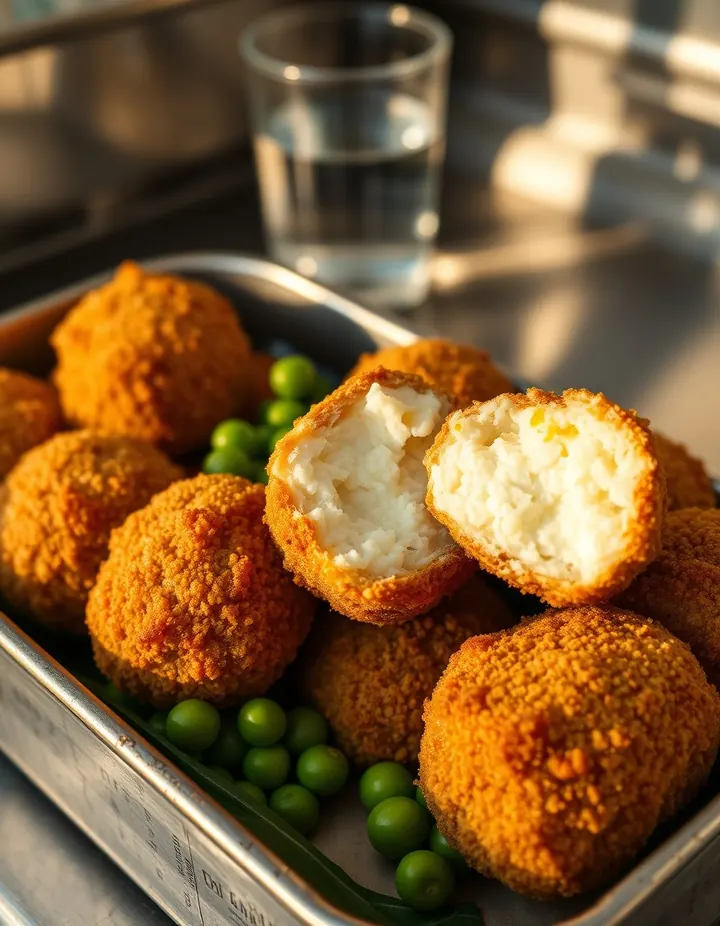 Potato Croquettes255 recipes
 Roast Beef211 recipes
 Beef Loaf175 recipes
The free Flavor Lab newsletter: one surprising pairing a week and the molecular reason it works, in 60 seconds. No spam, unsubscribe anytime.
Prefer an account? Create a free account to save pairings and unlock the full chemistry.