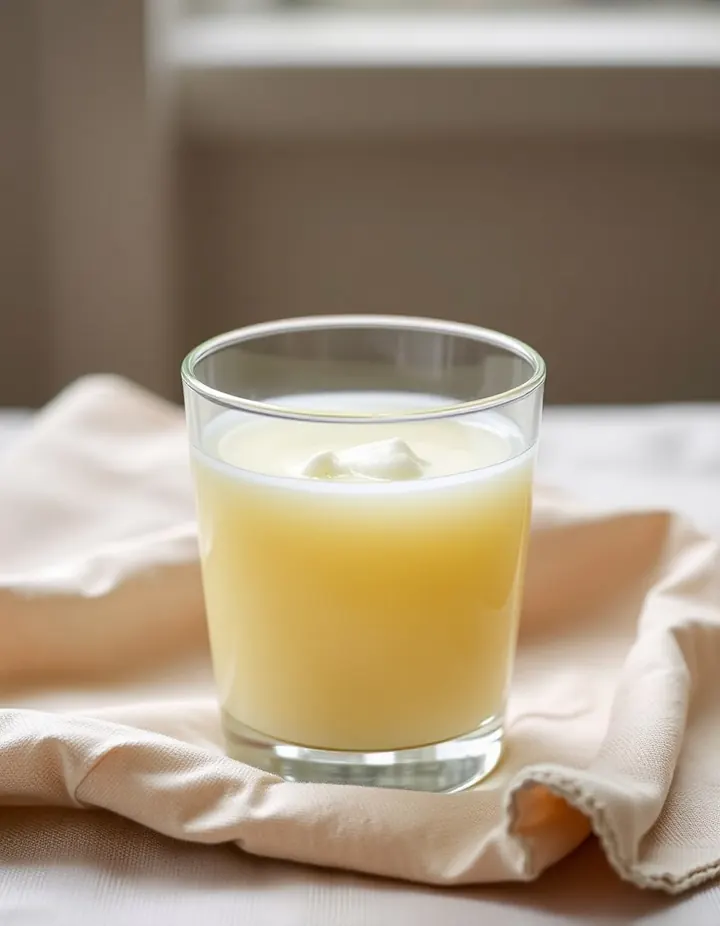
 Illustration
Why it works: Milk and white wine match in chemistry and in kitchens. They rank in the top 8% of all ingredient pairs, and 916 recipes mention both. Both carry ethyl octanoate, which smells fruity. The science ↓
The recipe
Ingredients
Contains: milk (auto-detected from the ingredients and method; we can miss things, so check labels)
Directions
Bring the pint of milk to a boil in a clean saucepan over medium heat, stirring so it does not scorch.
Add a glass or two of white wine. Cider may be used instead, or half as much vinegar as wine.
Return the pan to the heat and bring the mixture just to a boil again.
Remove from the heat and let it stand about 10 to 15 minutes, until the curds settle. The liquid above them should look clear and pale yellow.
Pour off the clear whey through a fine strainer or cheesecloth, leaving the curds behind.
Sweeten the warm whey with sugar to taste, stirring until dissolved.
Serve warm. To keep it warm, pour it into a clean bottle or thermos wrapped in a towel, and drink it within 2 hours.
Refrigerate any leftover whey within 2 hours. Use within 3 to 4 days, and reheat to 165°F (74°C) before drinking.
Original text from the book (3 steps)
Make a pint of milk boil; put to it a glass or two of white wine; put it on the fire till it just boils again; then set it on one side till the curd has settled; pour off the clear whey, and sweeten it as you like.
Cider is often substituted for wine, or half the quantity of vinegar that we have ordered wine.
Obs.--When there is no fire in the sick room, this may be put hot into a bottle, and laid between the bed and mattress; it will keep warm several hours.
From a scanned old cookbook. The method has been rewritten by AI to follow current food-safety guidance (safe cooking temperatures, refrigeration, no raw-egg shortcuts). It hasn't been kitchen-tested. The original text is under the method. See the original page.
Found this recipe through an AI assistant? CompKitchen also shows which ingredients go well together and why, from the aroma molecules they share and how often recipes combine them. Try the pairing tools.
The picture is an illustration, not a photo of this recipe · Contact us to use it
Explore the science
The flavor team
The pairs that carry this dish. Each one is judged two ways: how much aroma chemistry they share, and how many recipes mention both.
-
Milk + white winetop 8% of all pairsAroma overlapstrongMentioned together916 recipes
Shared aroma: ethyl octanoate (fruity).
-
Milk + sugartop 9% of all pairsAroma overlaplowMentioned together77,855 recipes
Shared aroma: 2-nonenal (fatty, green).
-
White wine + sugartop 19% of all pairsAroma overlaplowMentioned together2,382 recipes
Shared aroma: beta-damascenone (apple, rose).
Milk and sugar share little aroma chemistry, yet 77,855 recipes mention both: they likely work on texture and structure more than aroma.
Ranks compare each pair with 20,000 random ingredient pairs on CompKitchen. How we score pairs
Make it your own
Stand-ins, a drink, and quick taste fixes for this dish, ranked by how well each fits its other ingredients: shared aroma molecules and how often recipes combine them.
The Sunday pairing: one pairing, the chemistry behind it, and how to cook it. No spam, unsubscribe anytime.
Prefer an account? Create a free account for sign-in; Pro adds the full results and chemistry.