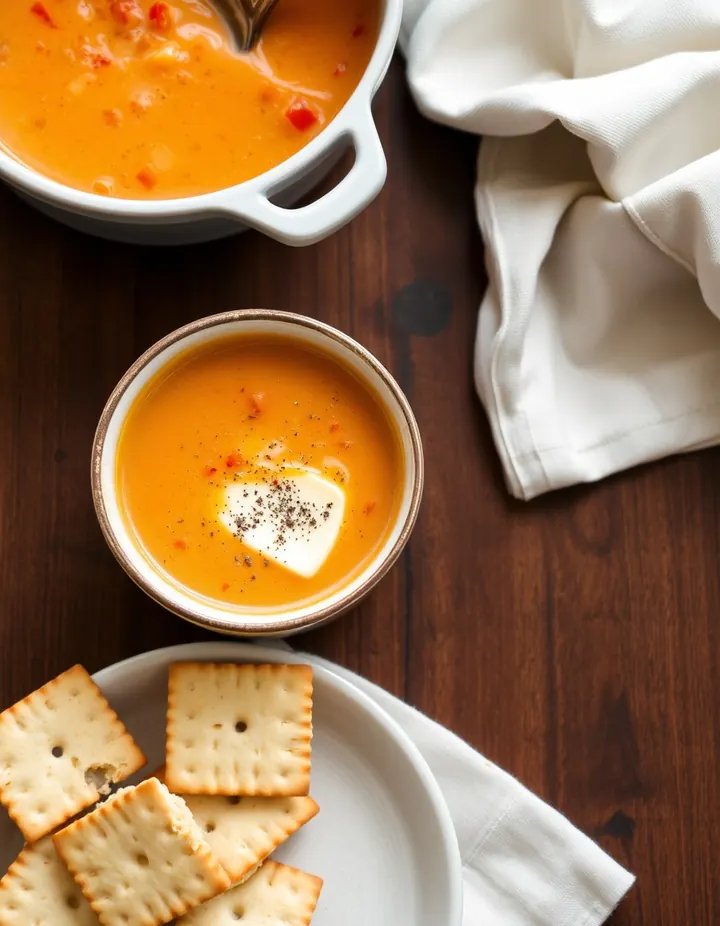
 Illustration
Why it works: Tomato and pepper match in chemistry and in kitchens. They rank in the top 4% of all ingredient pairs, and 17,913 recipes mention both. Both carry 2-isopropyl-3-methoxypyrazine, which smells earthy, pea. The science ↓
The recipe
Ingredients
Contains: milk, shellfish (auto-detected from the ingredients and method; we can miss things, so check labels)
Also mentioned in the method: milk, butter, cream, oyster
Directions
Prepare the base
Combine one quart of tomatoes, one quart of water, and one quart of milk in a pot.
Add butter, salt, and pepper to taste.
Cook the tomatoes thoroughly in the water, letting the milk scald over the water to prevent scorching.
Add the saleratus
When the tomatoes are done, add one-half teaspoonful of saleratus, which will cause a violent effervescence.
Place the vessel in a pan before adding the saleratus to prevent waste.
Finish the soup
When the commotion has ceased, add the milk and seasoning.
Use more milk than water, and cream instead of butter, if desired.
Transcribed from a scanned cookbook and modernised for today's kitchens. Where the book gave no heat or time, or said "a moderate oven", the temperatures and times here may be modern equivalents rather than the book's own figures. See the original page.
The picture is an illustration, not a photo of this recipe · Contact us to use it
Explore the science
The flavor team
The pairs that carry this dish. Each one is judged two ways: how much aroma chemistry they share, and how many recipes mention both.
-
Tomato + peppertop 4% of all pairsAroma overlapstrongMentioned together17,913 recipes
Shared aroma: 2-isopropyl-3-methoxypyrazine (earthy, pea).
Ranks compare each pair with 20,000 random ingredient pairs on CompKitchen. How we score pairs
What each ingredient does
- Tomatoes
- Form the body and bright acidic flavor of the soup.
- Water
- Provides the cooking liquid that softens the tomatoes and thins the soup.
- Saleratus
- Reacts with the tomato acid, releasing gas that foams the soup and neutralizes some acidity.
The step that matters
Adding the saleratus to the hot tomatoes. Saleratus reacts with the acid in the tomatoes and releases carbon dioxide rapidly, so the mixture foams up and can boil over. Using a larger pan beneath the pot prevents spills and waste.
“What each ingredient does” and “The step that matters” were written by Claude from this recipe’s own method and reviewed in samples by CompKitchen.
You might also like
 Illustration
 Illustration
 Illustration
 Illustration
The Sunday pairing: one pairing, the chemistry behind it, and how to cook it. No spam, unsubscribe anytime.
Prefer an account? Create a free account for sign-in; Pro adds the full results and chemistry.