Why it works: Lemon and pepper match in chemistry and in kitchens. They rank in the top 3% of all ingredient pairs, and cooks put them together in 27,047 recipes. Both carry trans-2-nonenal, which smells cardboard, fatty. The science ↓
To Dress Turtle
Ingredients
Directions
Prepare the turtle
Kill the turtle at night in winter or in the morning in summer. Hang it by the hind fins, cut off the head, and let it bleed well.
Separate the bottom shell from the top, taking care not to break the gall bladder; remove and discard the gall bladder.
Place the liver in a bowl of water. Empty the guts and lay them in water; if there are eggs, put them in water as well. Use a separate bowl of water for each part.
Cut all the flesh from the bottom shell and lay it in water. Break the shell in two, wash it clean, and put it in a pot. Pour enough water to cover it, add one pound of middling bacon or flitch of bacon, and four chopped onions. Set the pot on the fire to boil.
Open the guts, cleanse them, remove the inside skin, and put them in the pot with the shell. Boil steadily for three hours, adding water if it boils away too much.
Wash the top shell, cover it, and set it aside.
Parboil the fins, clean them by removing all black skin, and put them in water. Cut the flesh taken from the bottom and top shell into small pieces. Cut the fins in two, lay them with the flesh in a dish, sprinkle some salt over, and cover.
Make the stew
When the shell and contents are done, take out the bacon, scrape the shell clean, and strain the liquor. Put about one quart of the liquor back into the pot; reserve the rest for soup. Pick out the guts, cut them into small pieces, and add them with the strained bits into the gravy. Add the fins cut into pieces and as much of the flesh as remains.
Add one bottle of white wine, cayenne pepper, salt to taste, one gill of mushroom catsup, one gill of lemon pickle, mace, nutmegs, and cloves to the mixture. Mix two large spoonfuls of flour with one pound and a quarter of butter, and add thyme, parsley, marjoram, and savory tied in bunches. Stew all together until the flesh and fins are tender.
Finish and bake
Wash out the top shell, put a puff paste around the brim, sprinkle pepper and salt over the shell, and remove the herbs from the stew. If the gravy is not thick enough, add a little flour and fill the shell.
If the turtle has no eggs, boil six new laid eggs for ten minutes, cool them in cold water briefly, peel, cut in two, and place them on the turtle.
Make a rich forcemeat, fry the balls nicely, and put them in the shell. Set the shell in a dripping pan with something under the sides to keep it steady. Heat the oven as for bread and bake until nicely browned.
Fry the liver and serve hot.
Nutrition, whole recipe (rough)
Counts 11 of 12 ingredients. The other 1 aren't in our nutrition table and add nothing above, so the real totals are higher.
What these numbers assume: 11 portions
| Ingredient | Portion assumed | kcal |
|---|---|---|
| Flour | 1 cup (125g) all-purpose | 455 |
| Onion | 1 medium (110g) | 44 |
| Wine | 2 tbsp cooking wine (30ml) | 25 |
| Mushroom | 1/2 cup sliced (35g) | 15 |
| Lemon | juice of 1 lemon (48ml) | 12 |
| Clove | 1 tsp ground (2g) | 7 |
| Cayenne | 1 tsp (1.8g) | 6 |
| Black Pepper | 1 tsp ground (2.3g) | 6 |
| Thyme | 1 tsp dried (1.4g) | 4 |
| Parsley | 1 tbsp chopped fresh (3.8g) | 1 |
| Salt | 1 tsp (6g) | 0 |
| Mace | not in our table | 0 |
One typical portion per ingredient; the recipe's quantities are not counted. A rough guide only, not for medical or dietary planning.
Transcribed from a scanned cookbook and modernised for today's kitchens. Where the book gave no heat or time, or said "a moderate oven", the temperatures and times here may be modern equivalents rather than the book's own figures. See the original page.
Explore the science
The flavor team
The pairs that carry this dish. Each one is judged two ways: how much their aromas overlap, and how often cooks already put them together.
-
Lemon + peppertop 3% of all pairsSmell alikestrongCooked together27,047 recipes
Shared aroma: trans-2-nonenal (cardboard, fatty).
-
Pepper + clovetop 5% of all pairsSmell alikestrongCooked together17,451 recipes
Shared aroma: ethyl octanoate (fruity, wine).
-
Mushroom + white winetop 5% of all pairsSmell alikemoderateCooked together1,765 recipes
Shared aroma: ethyl octanoate (fruity).
-
Mace + clovetop 6% of all pairsSmell alikelowCooked together8,400 recipes
Shared aroma: methyleugenol (clove, spice).
-
Lemon + clovetop 10% of all pairsSmell alikestrongCooked together8,150 recipes
Shared aroma: eucalyptol (eucalyptus, herbal).
Ranks compare each pair with 20,000 random ingredient pairs on CompKitchen. How we score pairs
What each ingredient does
- Turtle flesh and fins (in the method)
- Forms the main body of the stew, becoming tender through long simmering.
- Flour
- Thickens the gravy so it holds together around the meat.
- Butter (in the method)
- Adds richness and fat that rounds out the gravy's flavour.
- White wine
- Adds acidity and depth to the gravy.
- Eggs (in the method)
- Adds richness and a set, firm texture when boiled and placed on the dish.
- Middling bacon
- Lends smoky, salty fat to the broth during the long boil.
The step that matters
Thickening the gravy with flour. Flour mixed into the gravy must be fully blended before it goes in, or it forms lumps. Stirring it in with butter and gently cooking it lets the starch swell evenly and thicken the sauce smoothly.
Swap the mace
How well each one fits the dish's main ingredients (mushroom, lemon, onion, white wine, flour, pepper, clove):
- Thymefits better
- Marjoramfits better
- Parsleyfits better
- Macethe original
Fit is the average pairing score against mushroom, lemon, onion, white wine, flour, pepper, clove. Candidates are from the same food group and used in at least 100 recipes.
“What each ingredient does” and “The step that matters” were written by Claude from this recipe’s own method and reviewed in samples by CompKitchen.
You might also like
 Lemon Sauce236 recipes
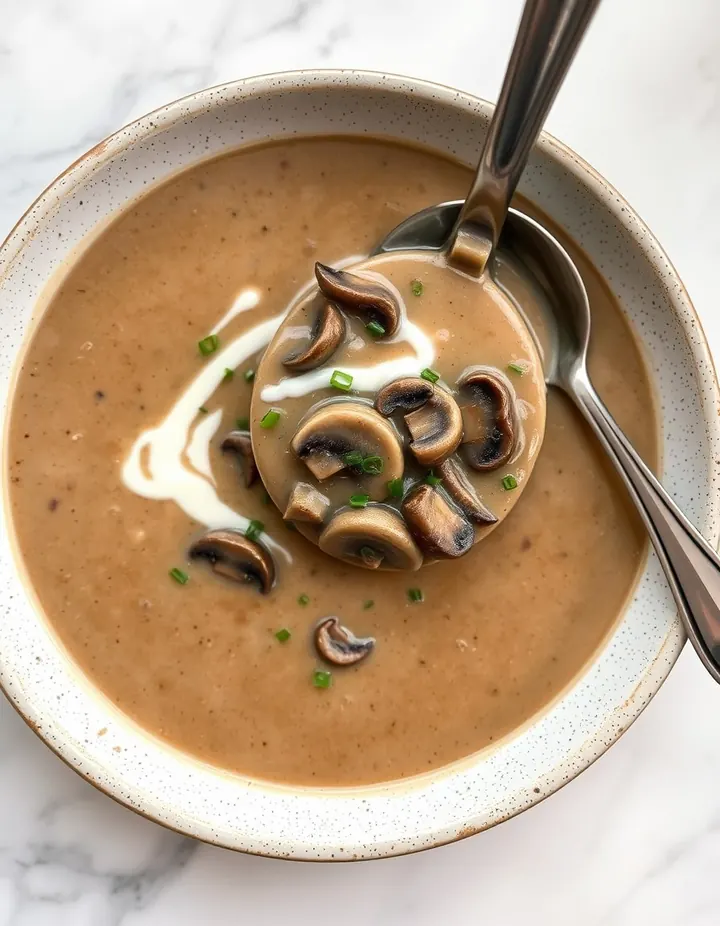 Mushroom Soup60 recipes
 Tomato Soup526 recipes
 Brown Bread461 recipes
The free Flavor Lab newsletter: one surprising pairing a week and the molecular reason it works, in 60 seconds. No spam, unsubscribe anytime.
Prefer an account? Create a free account to save pairings and unlock the full chemistry.