Why it works: Apple and cinnamon are a kitchen classic. They rank in the top 4% of all ingredient pairs, and cooks put them together in 5,598 recipes. Both carry methyl cinnamate, which smells strawberry. The science ↓
Apples Fried with Onions
Ingredients
Directions
Fry the onions
Peel onions and slice.
Fry onions in fat until a rich brown.
Drain onions on soft brown paper.
Fry unpared quarters of apple in the fat left from the onions.
Arrange apples in a border on a platter.
Fill center with the fried onions and serve hot.
Fry the apple quarters
Quarter and core five apples without paring.
Put apples into a frying pan and melt beef drippings in it.
When hot, lay a layer of apples skin side down.
Sprinkle the layer with brown sugar.
When nearly done, turn the apples and brown them.
Place the apples on a platter and sprinkle with sugar.
Set the platter in a hot oven and continue frying apples one layer at a time.
Quarter and core five apples without paring.
Put apples into a frying pan with one cup of sugar, one tablespoon of butter, and three tablespoons of water.
Let the mixture melt and lay the apples with the skin up.
Cover and fry slowly until brown.
Make the batter and fry apple fritters
Mix and sift one and one-third cups of flour, two teaspoons of baking powder, and one-fourth teaspoon of salt.
Add gradually, while stirring constantly, two-thirds of a cup of milk and one egg well beaten.
Wipe, core, pare, and cut two medium sized sour apples into eighths.
Slice the eighths and stir them into the batter.
Drop the batter by the spoonful into hot deep fat.
Fry until delicately browned.
Drain on brown paper.
Sprinkle with powdered sugar.
Pare and core four tart apples.
Cut the apples into one-fourth inch slices across the apple.
Sprinkle the slices with two tablespoons of lemon juice and powdered sugar.
Add two well beaten yolks to one-half cup of milk.
Mix and beat into the flour until smooth.
Add one tablespoon of melted butter or olive oil.
Cut in the well beaten whites of two eggs.
Drain the apples.
Dip the apples into the batter.
Fry in deep fat.
When cooked, drain on brown paper.
Sprinkle with powdered sugar before serving.
Make the ring fritters
Mix one cup of sweet milk, one egg, one teaspoon of baking powder, one-fourth teaspoon of salt, and one-half cup of chopped apples.
Add flour to make a batter stiff enough to drop heavily from the spoon.
Fry in deep fat.
Core and pare four apples.
Cut the apples into slices one-third inch thick, leaving the hole in the center.
Sprinkle the slices with sugar, lemon juice, and cinnamon.
Dip each slice in fritter batter.
Fry in deep fat.
Drain on brown paper.
Sprinkle with sugar.
Nutrition, whole recipe (rough)
Counts 9 of 10 ingredients. The other 1 aren't in our nutrition table and add nothing above, so the real totals are higher.
What these numbers assume: 9 portions
| Ingredient | Portion assumed | kcal |
|---|---|---|
| Flour | 1 cup (125g) all-purpose | 455 |
| Milk | 1 cup (244ml) whole | 149 |
| Butter | 1 tbsp (14g) | 102 |
| Apple | 1 medium (182g) | 95 |
| Egg | 1 large egg (50g) | 78 |
| Sugar | 1 tbsp (12.5g) granulated | 49 |
| Lemon | juice of 1 lemon (48ml) | 12 |
| Cinnamon | 1 tsp ground (2.6g) | 6 |
| Salt | 1 tsp (6g) | 0 |
| Water | not in our table | 0 |
One typical portion per ingredient; the recipe's quantities are not counted. A rough guide only, not for medical or dietary planning.
Transcribed from a scanned cookbook and modernised for today's kitchens. Where the book gave no heat or time, or said "a moderate oven", the temperatures and times here may be modern equivalents rather than the book's own figures. See the original page.
Explore the science
The flavor team
The pairs that carry this dish. Each one is judged two ways: how much their aromas overlap, and how often cooks already put them together.
-
Apple + cinnamontop 4% of all pairsSmell alikemoderateCooked together5,598 recipes
Shared aroma: methyl cinnamate (strawberry).
-
Lemon + cinnamontop 7% of all pairsSmell alikestrongCooked together7,950 recipes
Shared aroma: beta-phellandrene (minty, terpene).
-
Butter + milktop 7% of all pairsSmell alikemoderateCooked together81,283 recipes
Shared aroma: (z)-4-heptenal (biscuit, cream).
-
Flour + cinnamontop 9% of all pairsSmell alikemoderateCooked together17,341 recipes
Shared aroma: isobutyraldehyde (malty, green).
-
Milk + cinnamontop 10% of all pairsSmell alikemoderateCooked together12,655 recipes
Shared aroma: cuminaldehyde (Spicy, cumin).
Ranks compare each pair with 20,000 random ingredient pairs on CompKitchen. How we score pairs
What each ingredient does
- Flour
- Forms the structure of the batter that holds the fritters together.
- Baking powder
- Releases gas in the batter so the fritters puff and turn light.
- Egg
- Binds the batter and adds richness and structure as it cooks.
- Butter
- Adds fat for flavour and browning in the pan.
- Sugar
- Sweetens the apples and helps them caramelise and brown.
- Apples
- Provide the main fruit body, softening as they cook.
The step that matters
Fry the onions until a rich brown. Sugars and proteins in onions brown slowly; pale or underdone onions stay sharp and soft, while over-high heat scorches them before the centre cooks.
Swap the apple
How well each one fits the dish's main ingredients (sugar, butter, flour, lemon, milk, egg, cinnamon):
- Vanillafits better
- Raisinfits better
- Figfits better
- Applethe original
Fit is the average pairing score against sugar, butter, flour, lemon, milk, egg, cinnamon. Candidates are from the same food group and used in at least 100 recipes.
“What each ingredient does” and “The step that matters” were written by Claude from this recipe’s own method and reviewed in samples by CompKitchen.
You might also like
 Lemon Sauce236 recipes
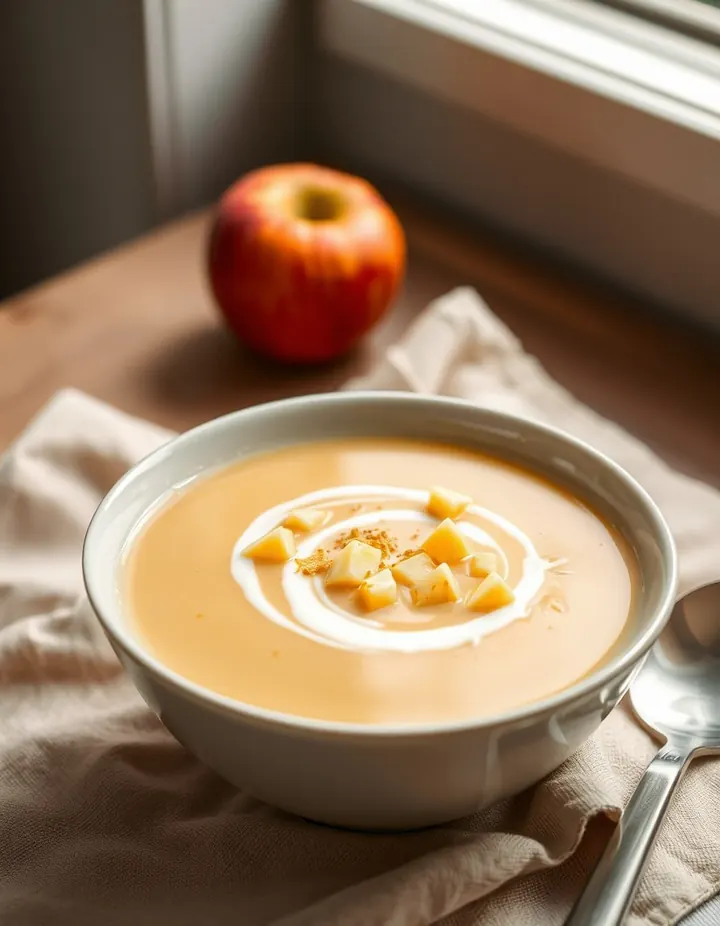 Apple Soup33 recipes
 Tomato Soup526 recipes
 Brown Bread461 recipes
The free Flavor Lab newsletter: one surprising pairing a week and the molecular reason it works, in 60 seconds. No spam, unsubscribe anytime.
Prefer an account? Create a free account to save pairings and unlock the full chemistry.