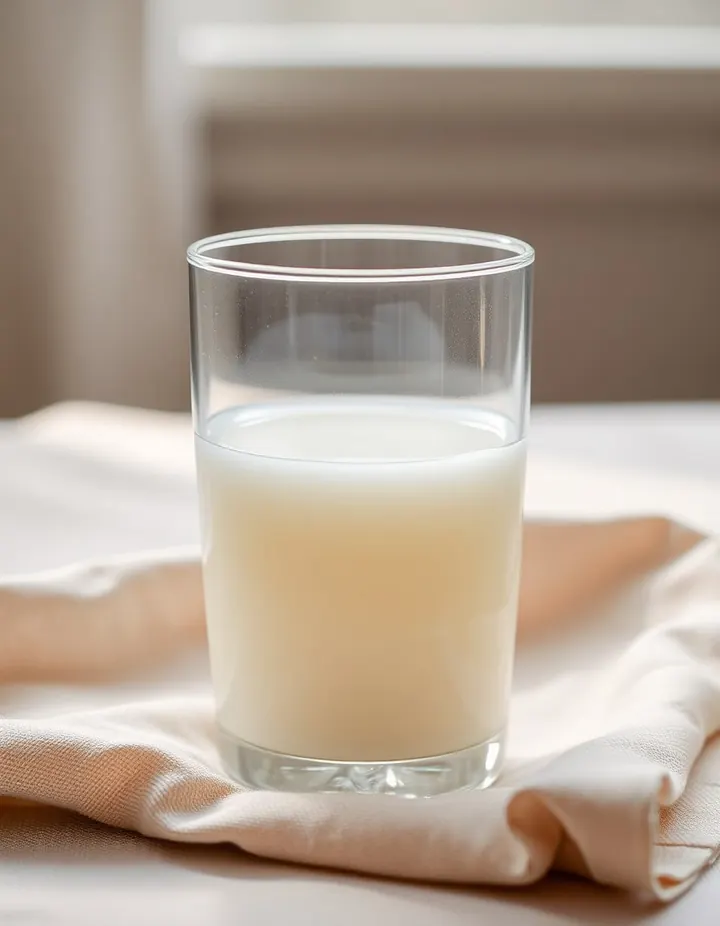
Why it works: Milk and wheat are a kitchen classic. They rank in the top 6% of all ingredient pairs, and cooks put them together in 2,418 recipes. Both carry (e,z)-2,6-nonadienal, which smells cucumber, melon. The science ↓
Rice Water
Ingredients
Directions
Prepare the rice water
Take two ounces of rice and two quarts of water.
Boil for an hour and a half.
Add sugar and nutmeg to taste; optionally add salt.
Make the thickened mixture
Mix half an ounce of wheat flour, half an ounce of malt flour, seven and a quarter grains of bicarbonate of potash, and an ounce of water.
Add five ounces of fresh milk and put the mixture on a gentle fire.
When it begins to thicken, take it from the fire.
Stir for five minutes.
Heat and stir again until it becomes quite fluid.
Finally boil for a short time.
Finish and rest
Filter through a sieve to separate the bran; it is then ready for use.
Keep for twenty-four hours.
Nutrition, whole recipe (rough)
Counts 3 of 5 ingredients. The other 2 aren't in our nutrition table and add nothing above, so the real totals are higher.
What these numbers assume: 3 portions
| Ingredient | Portion assumed | kcal |
|---|---|---|
| Flour | 1 cup (125g) all-purpose | 455 |
| Milk | 1 cup (244ml) whole | 149 |
| Nutmeg | 1 tsp ground (2.2g) | 12 |
| Wheat | not in our table | 0 |
| Water | not in our table | 0 |
One typical portion per ingredient; the recipe's quantities are not counted. A rough guide only, not for medical or dietary planning.
Transcribed from a scanned cookbook and modernised for today's kitchens. Where the book gave no heat or time, or said "a moderate oven", the temperatures and times here may be modern equivalents rather than the book's own figures. See the original page.
Photo for illustrative purposes only · Contact us to use it
Explore the science
The flavor team
The pairs that carry this dish. Each one is judged two ways: how much their aromas overlap, and how often cooks already put them together.
-
Milk + wheattop 6% of all pairsSmell alikemoderateCooked together2,418 recipes
Shared aroma: (e,z)-2,6-nonadienal (cucumber, melon).
-
Flour + nutmegtop 8% of all pairsSmell alikemoderateCooked together18,623 recipes
Shared aroma: isobutyraldehyde (malty, green).
-
Wheat + nutmegtop 9% of all pairsSmell alikestrongCooked together359 recipes
Shared aroma: alpha-pinene (pine, turpentine).
-
Wheat + flourtop 12% of all pairsSmell alikemoderateCooked together4,373 recipes
Shared aroma: isobutyraldehyde (malty, green).
-
Milk + flourtop 14% of all pairsSmell alikelowCooked together78,219 recipes
Shared aroma: isobutyraldehyde (malty, green).
Milk and flour barely smell alike, yet cooks put them together in 78,219 recipes: they work on texture and structure more than aroma.
Ranks compare each pair with 20,000 random ingredient pairs on CompKitchen. How we score pairs
What each ingredient does
- Rice (in the method)
- Its starch thickens the water and gives the drink body.
- Wheat flour
- Its starch thickens the milk mixture as it heats.
- Fresh milk
- Adds fat and richness, softening the drink's texture.
- Bicarbonate of potash
- Alkaline salt that changes the mixture's chemistry and helps it loosen when heated.
The step that matters
Heating after thickening. Once the starch has thickened, heating too hard or too long can scorch the milk or break the texture. Gentle heat and steady stirring keep it smooth until it becomes fluid again.
Swap the nutmeg
How well each one fits the dish's main ingredients (milk, wheat, flour):
- Cinnamonfits better
- Nutmegthe original
- Jalapenofits about as well
- Turmericfits about as well
Fit is the average pairing score against milk, wheat, flour. Candidates are from the same food group and used in at least 100 recipes.
“What each ingredient does” and “The step that matters” were written by Claude from this recipe’s own method and reviewed in samples by CompKitchen.
You might also like
 Vegetable Soup350 recipes
 Raspberry Vinegar214 recipes
 Brown Coffee with Egg175 recipes
 Blackberry Cordial129 recipes
The free Flavor Lab newsletter: one surprising pairing a week and the molecular reason it works, in 60 seconds. No spam, unsubscribe anytime.
Prefer an account? Create a free account to save pairings and unlock the full chemistry.