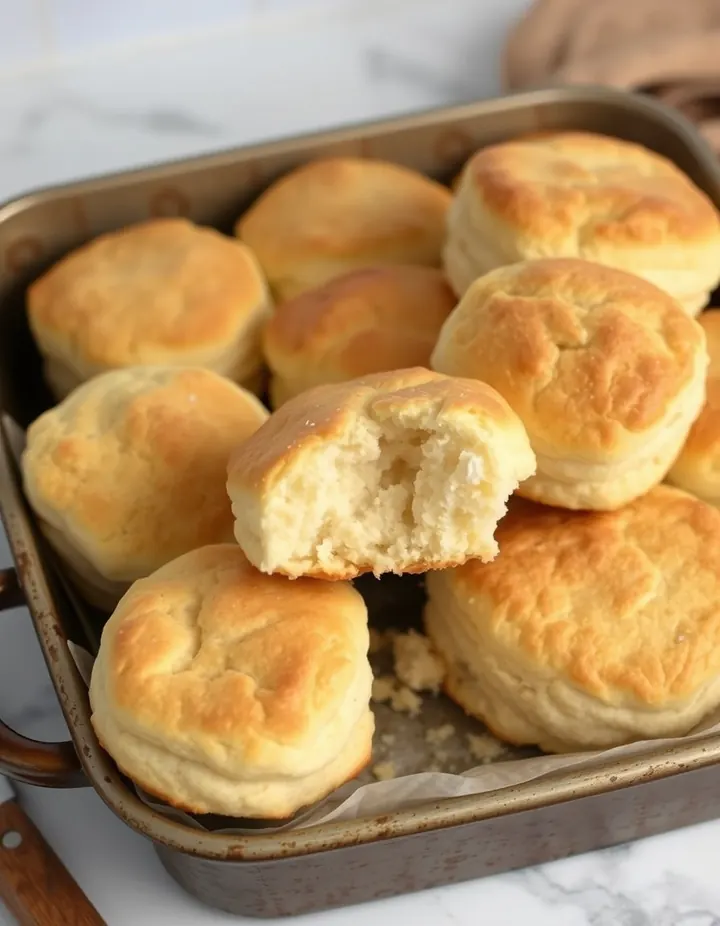
 Illustration
Why it works: Flour and biscuit match in chemistry and in kitchens. They rank in the top 7% of all ingredient pairs, and 871 recipes mention both. Both carry isobutyraldehyde, which smells malty, green. The science ↓
The recipe
Ingredients
Contains: egg, milk, wheat (auto-detected from the ingredients and method; we can miss things, so check labels)
Directions
Make the dough
Sift two quarts of flour into a mixing pan.
Make a hole in the middle of the flour.
Pour in one pint of warm water or new milk, one teaspoonful of salt, and half a cup of melted lard or butter.
Stir in a little flour.
Add half a cupful of yeast.
Stir in as much flour as you can conveniently with your hand.
Let the dough rise overnight.
In the morning, add nearly a teaspoonful of soda and more flour as needed to make a rather soft dough.
Mold the dough for fifteen to twenty minutes, the longer the better.
Let it rise until light again.
Shape and bake
Roll the dough out about half an inch thick.
Cut out biscuits with a biscuit cutter, or shape into little balls with your hands.
Cover and set in a warm place to rise.
When light, bake a light brown in a moderate oven.
Rub a little warm butter or sweet lard on the sides of the biscuits when you place them on the tins, to prevent their sticking together when baked.
Make the egg dough variation
Take a piece of bread dough that will make about as many biscuits as you wish.
Lay it out rather flat in a bowl.
Break into it two eggs, half a cup of sugar, and half a cup of butter.
Mix this thoroughly with enough flour to keep it from sticking to the hands and board.
Knead it well for about fifteen or twenty minutes.
Make into small biscuits.
Place in a greased pan.
Let them rise until about even with the top of the pan.
Bake in a quick oven for about half an hour.
When you bake, take a pint of sponge, one tablespoonful of melted butter, one tablespoonful of sugar, and the white of one egg beaten to a foam.
Let rise until light.
Mold into biscuits.
When light, bake.
Transcribed from a scanned cookbook and modernised for today's kitchens. Where the book gave no heat or time, or said "a moderate oven", the temperatures and times here may be modern equivalents rather than the book's own figures. See the original page.
Found this recipe through an AI assistant? CompKitchen also shows which ingredients go well together and why, from the aroma molecules they share and how often recipes combine them. Try the pairing tools.
The picture is an illustration, not a photo of this recipe · Contact us to use it
Explore the science
The flavor team
The pairs that carry this dish. Each one is judged two ways: how much aroma chemistry they share, and how many recipes mention both.
-
Flour + biscuittop 7% of all pairsAroma overlapstrongMentioned together871 recipes
Shared aroma: isobutyraldehyde (malty, green).
-
Butter + breadtop 3% of all pairsAroma overlapstrongMentioned together27,145 recipes
Shared aroma: delta-decalactone (sweet, creamy).
-
Bread + eggtop 6% of all pairsAroma overlapstrongMentioned together22,584 recipes
Shared aroma: 2-nonenal (fatty, green).
-
Flour + buttertop 6% of all pairsAroma overlaplowMentioned together122,858 recipes
Shared aroma: isobutyraldehyde (malty, green).
-
Sugar + biscuittop 7% of all pairsAroma overlapstrongMentioned together1,873 recipes
Shared aroma: 1-penten-3-one (fish, pungent).
Flour and butter share little aroma chemistry, yet 122,858 recipes mention both: they likely work on texture and structure more than aroma.
Ranks compare each pair with 20,000 random ingredient pairs on CompKitchen. How we score pairs
What each ingredient does
- Flour
- Forms the dough structure that holds the gas bubbles produced during rising.
- Yeast
- Produces gas through fermentation, which makes the dough rise and become light.
- Lard
- Adds fat that tenderises the crumb and keeps the biscuits from sticking.
- Eggs
- Add richness and structure to the enriched dough.
- Sugar
- Feeds the yeast and adds sweetness and browning in the oven.
- Soda
- Reacts to give extra lift and affects the dough's rise and colour.
The step that matters
Letting the dough rise until light. Yeast needs time and warmth to ferment and trap gas in the gluten network. Rising too short leaves biscuits dense, while over-proofing lets the structure collapse.
“What each ingredient does” and “The step that matters” were written by Claude, an AI, from this recipe’s own method. They are not checked recipe by recipe, so they can be wrong.
Make it your own
Stand-ins, a drink, and quick taste fixes for this dish, ranked by how well each fits its other ingredients: shared aroma molecules and how often recipes combine them.
You might also like
 Illustration
 Illustration
 Illustration
 Illustration
The Sunday pairing: one pairing, the chemistry behind it, and how to cook it. No spam, unsubscribe anytime.
Prefer an account? Create a free account for sign-in; Pro adds the full results and chemistry.