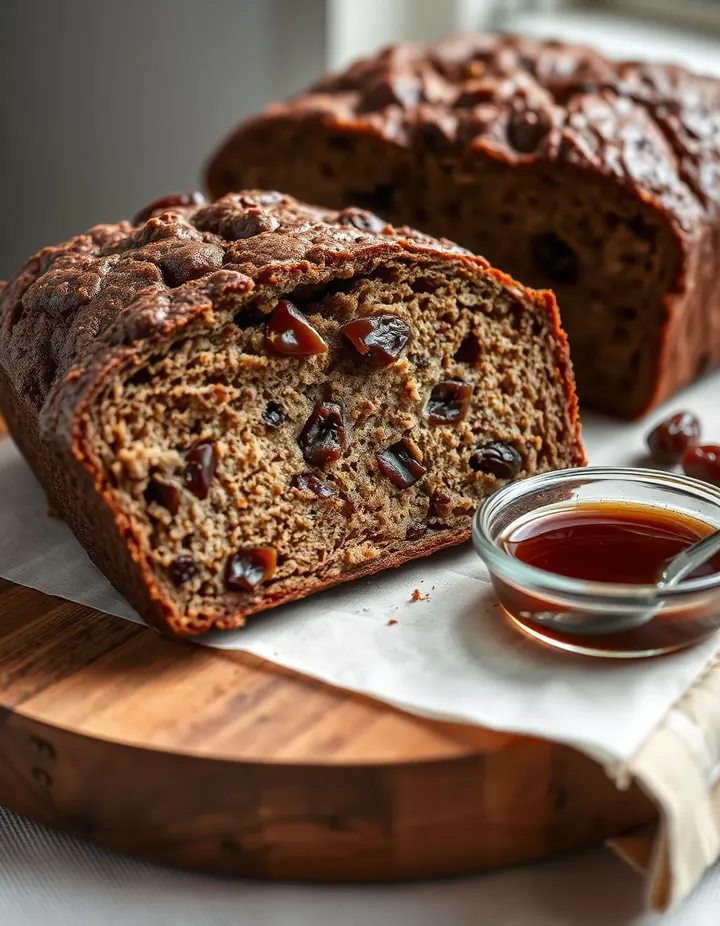
Why it works: Flour and raisin match in chemistry and in kitchens. They rank in the top 1% of all ingredient pairs, and cooks put them together in 9,075 recipes. Both carry isobutyraldehyde, which smells malty, green. The science ↓
Date Bread
Ingredients
Directions
Prepare the dates
Break the dates apart, wash and drain them in a colander, shake them well, set in a warm place to dry.
Stone and chop enough to make a cupful, and knead into a loaf of white bread just before setting to rise for the last time.
Make the batter
Beat the butter and sugar together.
Add the eggs well beaten.
Add a few grains of cardamom.
Add half a cupful of raisins seeded.
Add a tablespoonful of citron cut fine, if liked.
Add the milk and flour.
Mix the ingredients.
Bake
Bake in crusty bread pans or shallow pans, as convenient.
Bake in a crusty bread pan in a good oven, not too quick, from twenty to twenty-five minutes.
Nutrition, whole recipe (rough)
What these numbers assume: 8 portions
| Ingredient | Portion assumed | kcal |
|---|---|---|
| Flour | 1 cup (125g) all-purpose | 455 |
| Milk | 1 cup (244ml) whole | 149 |
| Butter | 1 tbsp (14g) | 102 |
| Egg | 1 large egg (50g) | 78 |
| Grape | 1/2 cup (76g) | 62 |
| Cream | 1 tbsp (15ml) heavy | 51 |
| Sugar | 1 tbsp (12.5g) granulated | 49 |
| Salt | 1 tsp (6g) | 0 |
One typical portion per ingredient; the recipe's quantities are not counted. A rough guide only, not for medical or dietary planning.
Transcribed from a scanned cookbook and modernised for today's kitchens. Where the book gave no heat or time, or said "a moderate oven", the temperatures and times here may be modern equivalents rather than the book's own figures. See the original page.
Photo for illustrative purposes only · Contact us to use it
Explore the science
The flavor team
The pairs that carry this dish. Each one is judged two ways: how much their aromas overlap, and how often cooks already put them together.
-
Flour + raisintop 1% of all pairsSmell alikestrongCooked together9,075 recipes
Shared aroma: isobutyraldehyde (malty, green).
-
Butter + milktop 7% of all pairsSmell alikemoderateCooked together81,283 recipes
Shared aroma: (z)-4-heptenal (biscuit, cream).
-
Butter + creamtop 8% of all pairsSmell alikemoderateCooked together41,516 recipes
Shared aroma: delta-dodecalactone (sweet, creamy).
-
Sugar + creamtop 9% of all pairsSmell alikemoderateCooked together43,450 recipes
Shared aroma: 2,3-butanedione (butter, sweet).
-
Flour + buttertop 12% of all pairsSmell alikelowCooked together124,287 recipes
Shared aroma: isobutyraldehyde (malty, green).
Flour and butter barely smell alike, yet cooks put them together in 124,287 recipes: they work on texture and structure more than aroma.
Ranks compare each pair with 20,000 random ingredient pairs on CompKitchen. How we score pairs
What each ingredient does
- Flour
- Forms the structure of the bread as it sets and bakes.
- Butter
- Adds richness and tenderness to the crumb.
- Eggs
- Bind the batter and add structure and richness.
- Raisins
- Add sweetness and chewy moisture throughout the loaf.
- Cream of tartar
- Reacts with soda to lift the dough and add a slight tang.
The step that matters
Bake in a good oven, not too quick. A moderate oven lets the loaf rise and set through the centre before the crust browns too deeply. A very hot oven can brown or crack the outside while the inside stays doughy.
Swap the raisin
How well each one fits the dish's main ingredients (flour, butter, sugar, cream, milk, egg):
- Vanillafits better
- Raisinthe original
- Coconutfits less well
- Figfits less well
Fit is the average pairing score against flour, butter, sugar, cream, milk, egg. Candidates are from the same food group and used in at least 100 recipes.
“What each ingredient does” and “The step that matters” were written by Claude from this recipe’s own method and reviewed in samples by CompKitchen.
You might also like
 White Cake431 recipes
 Pound Cake373 recipes
 Orange Bundt Cake349 recipes
 Spice Cake344 recipes
The free Flavor Lab newsletter: one surprising pairing a week and the molecular reason it works, in 60 seconds. No spam, unsubscribe anytime.
Prefer an account? Create a free account to save pairings and unlock the full chemistry.