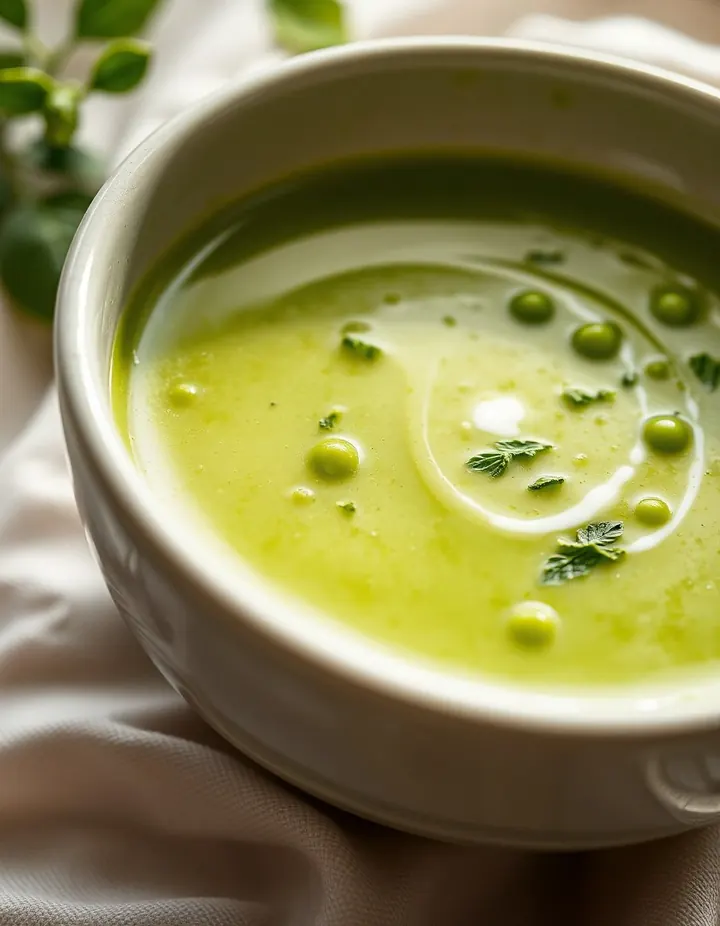
 Illustration
Why it works: Beans and tomato match in chemistry and in kitchens. They rank in the top 2% of all ingredient pairs, and 2,711 recipes mention both. Both carry 2-isopropyl-3-methoxypyrazine, which smells earthy, pea. The science ↓
The recipe
Ingredients
Contains: milk, wheat, tree nuts, shellfish (auto-detected from the ingredients and method; we can miss things, so check labels)
Also mentioned in the method: flour, crackers, chestnut, oyster
Directions
Cook green peas until tender, put ¾ of them through the colander, add water and salt, boil up, thicken with a little flour and butter rubbed together, add the whole peas, heat to boiling and serve.
CREAM AND MILK SOUPS
Cream soups do not necessarily contain cream, though the addition of a little improves their flavor.
The simplest ones consist of milk thickened to the consistency of very thin cream, salt, and a vegetable or some other ingredient. If the vegetable is mashed, or is one that does not break to pieces easily, the milk may be added to it, and the whole brought to the boiling point and thickened. In a few exceptional cases the ingredient may be cooked in the milk; nice tender green corn, for instance.
A richer sauce is made by making a roux of 2 level tablespns. of butter, and 1-1½ level tablespn. flour, with a pint of milk, put together in the regular way for sauces; but you will be surprised to see how much better soups (with few exceptions) are without thickening, being free from the porridgy taste of those thickened a trifle too much.
A little cream with the water in which the vegetable was cooked often gives a finer flavored soup than milk and is no more expensive.
Sour cream makes a delightful as well as wholesome substitute for sweet cream in corn, cabbage, tomato, in fact, nearly all vegetable soups.
_The following is a list of soups in which the general directions are understood when no exceptions are noted. Salt is understood in all._
★ Cream of Asparagus=--Cook tougher parts and rub through colander. Throw cooked tips in last unless desired for some other dish. The very toughest parts only make a nice, delicate flavored soup. This is one which favors cream and water instead of milk.
Cream of Bean=--Lima, common white, or colored. Cook as for water bean soup, rub through colander or leave in broken pieces. Milk, or cream and water, no flour. 1 cup beans to 1½-2 qts. soup.
Cream of Bouillon=--¼-½ cup cream salted and whipped, to each quart bouillon just before serving, either stirred in, or laid on top of each cup in spoonfuls with a leaf of parsley.
★ Cream of Cabbage, or Celery and Tomato=--Cabbage or celery, and tomato soup, with a little heavy cream added.
Cream of Carrot=--1 cup of ground or grated carrot, cooked, 3 pts. milk and water, 1½-2 tablespns. butter, 1¼ tablespn. flour; or, 1 cup strained tomato, ½-¾ cup cream, with water to make 3 pts., and no butter.
Without the tomato, soup may be flavored with onion or celery, and bay leaf, with chopped parsley.
Cream of Celery=--1 pt. finely-sliced celery, stewed, milk and cream added to make 3 pts., 1-1½ tablespn. flour with or without 1 or 2 tablespns. of butter. Do not strain. When soup is thickened, crushed stalks of celery may be steeped in it for 15 m., then removed.
★ Cream of Celery No. 2=--Steep leaves or poor stalks of celery in milk for 15 m., add cream and flour, or flour and butter, to make of the consistency of thin cream. Strain. May add a little celery salt.
Cream of Chestnut=--Mashed boiled chestnuts, milk to thin, cream, plain or whipped, or, milk and butter. May be flavored with celery or onion or both.
★ Cream of Corn=--1 pt. canned or grated corn to 3 pts. rich milk, 1 level tablespn. only, of flour, a very little salt. Do not let soup stand long before serving. A little onion improves the flavor. If fresh corn is used, the milk may be heated in a double boiler, the corn added and cooked 20-30 m., or it may be boiled in a small quantity of water 6-10 m. The cobs may be boiled in the water for 10 m. before and removed; or they may stand in the milk while it is heating and be removed before corn is added.
Fine fresh cracker meal gives a nice flavor to cream of corn soup when used instead of flour for thickening.
A very little strained tomato imparts a delightful flavor and makes a different soup.
Cream of Dried Corn=--Soak corn, grind, add to hot milk, or cream and water. Heat in double boiler 1 hour, add salt, serve. If necessary, thicken a trifle.
Cream of Dried Corn and Carrot=--Add cooked grated carrots to corn and milk in above recipe and heat. Delicious.
Cream of Leek=--Boil sliced leeks to pulp or cook only until tender.
Cream of Lentil=--1 cup lentils cooked and rubbed through colander. 1½-2 qts. soup. No flour. May flavor with celery and onion.
Cream of Onion=--Cook sliced onions in salted water. Do not strain. Nice thickened with tapioca instead of flour.
Cream of Oyster Plant=--Cook sliced oyster plant in water until just tender, not soft; add salt, simmer 5 m. Add cream and more water if necessary. Or, grind oyster plant before cooking. May thicken a trifle.
Cream of Peas, dry=--Canadian, dried green, split or chick; 1 cup to 1½-2 qts. of soup. Cook, rub through colander; milk, or cream and water. No flour. Celery or onion flavor or not.
Cream of Potato, or Sweet Potato=--1½-2 qts. of milk, or cream and water, for each pint of mashed potato. Flavor with onion, celery salt or bay leaf.
Cream of Spinach=--Use a very small proportion of cooked spinach rubbed through a colander, with rich milk, or with cream and the water in which the spinach was boiled. Whipped cream may be added just before serving. Thicken with tapioca sometimes.
Cream of String Beans=--Cook beans in small pieces, add rich milk, thicken with flour or tapioca.
Transcribed from a scanned cookbook and modernised for today's kitchens. Where the book gave no heat or time, or said "a moderate oven", the temperatures and times here may be modern equivalents rather than the book's own figures. See the original page.
The picture is an illustration, not a photo of this recipe · Contact us to use it
Explore the science
The flavor team
The pairs that carry this dish. Each one is judged two ways: how much aroma chemistry they share, and how many recipes mention both.
-
Beans + tomatotop 2% of all pairsAroma overlapstrongMentioned together2,711 recipes
Shared aroma: 2-isopropyl-3-methoxypyrazine (earthy, pea).
-
Beans + lentilstop 3% of all pairsAroma overlapstrongMentioned together135 recipes
Shared aroma: 1-hexanol (resin, flower).
-
Tomato + parsleytop 5% of all pairsAroma overlapstrongMentioned together5,396 recipes
Shared aroma: 4'-methylacetophenone (bitter almond).
-
Tomato + lentilstop 5% of all pairsAroma overlapmoderateMentioned together463 recipes
Shared aroma: 1-hexanol (resin, flower).
-
Lentils + parsleytop 6% of all pairsAroma overlapstrongMentioned together322 recipes
Shared aroma: 1-hexanol (resin, flower).
Ranks compare each pair with 20,000 random ingredient pairs on CompKitchen. How we score pairs
Flavor stand-ins for the parsley
How well each one fits the dish's main ingredients (beans, cream, tomato, lentils, milk):
- Cuminbetter flavor fit
- Celerybetter flavor fit
- Garlicbetter flavor fit
- Parsleythe original
Fit is the average pairing score against beans, cream, tomato, lentils, milk. Candidates are from the same food group and used in at least 100 recipes. This compares flavor only: it does not check the job the ingredient does in the dish (bulk, moisture, acidity, structure).
You might also like
 Illustration
 Illustration
 Illustration
 Illustration
The Sunday pairing: one pairing, the chemistry behind it, and how to cook it. No spam, unsubscribe anytime.
Prefer an account? Create a free account for sign-in; Pro adds the full results and chemistry.