Why it works: Pepper and clove match in chemistry and in kitchens. They rank in the top 5% of all ingredient pairs, and cooks put them together in 17,451 recipes. Both carry ethyl octanoate, which smells fruity, wine. The science ↓
Beef-tea
Ingredients
Directions
_Ingredients._—1 lb. of lean gravy-beef, 1½ pint of water, 1 saltspoonful of salt. _Mode._—Have the meat cut without fat and bone, and choose a nice fleshy piece. Cut it into small pieces about the size of dice, and put it into a clean saucepan. Add the water _cold_ to it; put it on the fire, and bring it to the boiling-point; then skim well. Put in the salt when the water boils, and _simmer_ the beef-tea _gently_ from ½ to ¾ hour, removing any more scum should it appear on the surface. Strain the tea through a hair sieve, and set it by in a cool place. When wanted for use, remove every particle of fat from the top; warm up as much as may be required, adding, if necessary, a little more salt. This preparation is simple beef-tea, and is to be administered to those invalids to whom flavourings and seasonings are not allowed. When the patient is very weak, use double the quantity of meat to the same proportion of water. Should the invalid be able to take the tea prepared in a more palatable manner, it is easy to make it so by following the directions in Soyer’s recipe, which is an admirable one for making savoury beef-tea. Beef-tea is always better when made the day before it is wanted, and then warmed up. It is a good plan to put the tea into a small cup or basin, and to place this basin in a saucepan of boiling water. When the tea is hot, it is ready to serve. _Time._—½ to ¾ hour. _Average cost_, 6_d._ per pint. _Sufficient._—Allow 1 lb. of meat for a pint of _good_ beef-tea.
BEEF-TEA, Baked.
_Ingredients._—1 lb. of fleshy beef, 1 pint of water, ½ saltspoonful of salt. _Mode._—Cut the beef into small square pieces, after trimming off all the fat, and put it into a baking-jar (these jars are sold expressly for the purpose of making soups, gravies, &c., in the oven, and are arranged with tightly-fitting lids), with the above proportion of water and salt; close the jar well, place it in a warm but not hot oven, and bake for 3 or 4 hours. When the oven is very fierce in the day-time, it is a good plan to put the jar in at night, and let it remain till next morning, when the tea will be done. It should be strained, and put by in a cool place until wanted. It may also be flavoured with an onion, a clove, and a few sweet herbs, &c., when the stomach is sufficiently strong to take these. _Time._—3 or 4 hours, or to be left in the oven all night. _Average cost_, 6_d._ per pint. _Sufficient._—Allow 1 lb. of meat for 1 pint of good beef-tea.
BEEF-TEA, Savoury (Soyer’s Recipe).
_Ingredients._—1 lb. of solid beef, 1 oz. of butter, 1 clove, 2 button onions or ½ a large one, 1 saltspoonful of salt, 1 quart of water. _Mode._—Cut the beef into very small dice; put it into a stewpan with the butter, clove, onion, and salt; stir the meat round over the fire for a few minutes until it produces a thin gravy, then add the water, and let it simmer gently from ½ to ¾ of an hour, skimming off every particle of fat. When done, strain it through a sieve, and put it by in a cool place until required. The same, if wanted quite plain, is done by merely omitting the vegetables, salt, and clove; the butter cannot be objectionable, as it is taken out in skimming. _Time._—½ to ¾ hour. _Average cost_, 8_d._ per pint. _Sufficient._—Allow 1 lb. of beef to make 1 pint of good beef-tea.
_Note._—The meat left from beef-tea may be boiled a little longer, and pounded with spices, &c., for potting. It makes a very nice breakfast dish.
BEETROOT, Boiled.
_Ingredients._—Beetroot; boiling water. _Mode._—When large, young, and juicy, this vegetable makes a very excellent addition to winter salads, and may easily be converted into an economical and quickly-made pickle. (_See_ BEETROOT, PICKLED.) Beetroot is more frequently served cold than hot: when the latter mode is preferred, melted butter should be sent to table with it. It may also be stewed with button onions, or boiled and served with roasted onions. Wash the beets thoroughly; but do not prick or break the skin before they are cooked, as they would lose their beautiful colour in boiling. Put them into boiling water, and let them boil until tender, keeping them well covered. If to be served hot, remove the peel quickly, cut the beetroot into thick slices, and send to table melted butter. For salads, pickle, &c., let the root cool, then peel, and cut it into slices. _Time._—Small beetroot, 1½ to 2 hours; large, 2½ to 3 hours. _Average cost_, in full season, 2_d._ each. _Seasonable._—May be had at any time.
BEETROOT, Pickled.
_Ingredients._—Sufficient vinegar to cover the beets, 2 oz. of whole pepper, 2 oz. of allspice to each gallon of vinegar. _Mode._—Wash the beets free from dirt, and be very careful not to prick the outside skin, or they would lose their beautiful colour. Put them into boiling water, let them simmer gently, and when about three parts done, which will be in 1½ hour, take them out and let them cool. Boil the vinegar with pepper and allspice, in the above proportion, for 10 minutes, and when cold, pour it on the beets, which must be peeled and cut into slices about ½ inch thick. Cover with bladder to exclude the air, and in a week they will be fit for use.
BISCUITS, Crisp.
_Ingredients._—1 lb. of flour, the yolk of 1 egg, milk. _Mode._—Mix the flour and the yolk of the egg with sufficient milk to make the whole into a very stiff paste; beat it well, and knead it until it is perfectly smooth. Roll the paste out _very thin_; with a round cutter shape it into small biscuits, and bake them a nice brown in a slow oven from 12 to 18 minutes. _Time._—12 to 18 minutes. _Average cost_, 4_d._ _Seasonable_ at any time.
BISCUITS, Dessert, which may be flavoured with Ground Ginger, Cinnamon, &c.
_Ingredients._—1 lb. of flour, ½ lb. of butter, ½ lb. of sifted sugar, the yolks of 6 eggs, flavouring to taste. _Mode._—Put the butter into a basin; warm it, but do not allow it to oil; then with the hand beat it to a cream. Add the flour by degrees, then the sugar and flavouring, and moisten the whole with the yolks of the eggs, which should previously be well beaten. When all the ingredients are thoroughly incorporated, drop the mixture from a spoon on to a buttered paper, leaving a distance between each cake, for they spread as soon as they begin to get warm. Bake in rather a slow oven from 12 to 18 minutes, and do not let the biscuits acquire too much colour. In making the above quantity, half may be flavoured with ground ginger and the other half with essence of lemon or currants, to make a variety. With whatever the preparation is flavoured, so are the biscuits called, and an endless variety may be made in this manner. _Time._—12 to 18 minutes, or rather longer, in a very slow oven. _Average cost_, 1_s._ 6_d. Sufficient_ to make from 3 to 4 dozen cakes. _Seasonable_ at any time.
BISCUITS, Simple Hard.
_Ingredients._—To every lb. of flour allow 2 oz. of butter, about ½ pint of skimmed milk. _Mode._—Warm the butter in milk until the former is dissolved, and then mix it with the flour into a very stiff paste; beat it with a rolling-pin until the dough looks perfectly smooth. Roll it out thin; cut it with the top of a glass into round biscuits; prick them well, and bake them from 6 to 10 minutes. The above is the proportion of milk which we think would convert the flour into a stiff paste; but should it be found too much, an extra spoonful or two of flour must be put in. These biscuits are very nice for the cheese course. _Time._—6 to 10 minutes. _Seasonable_ at any time.
BLACK-COCK, to Roast.
_Ingredients._—Black-cock, butter, toast. _Mode._—Let these birds hang for a few days, or they will be tough and tasteless, if not well kept. Pluck and draw them, and wipe the insides and outsides with a damp cloth, as washing spoils the flavour. Cut off the heads, and truss them, the same as a roast fowl, cutting off the toes, and scalding and peeling the feet. Trussing them with the head on, as shown in the engraving, is still practised by many cooks, but the former method is now considered the best. Put them down to a brisk fire, well baste them with butter, and serve with a piece of toast under, and a good gravy and bread sauce. After trussing, some cooks cover the breast with vine-leaves and slices of bacon, and then roast them. They should be served in the same manner and with the same accompaniments as with the plainly-roasted birds. _Time._—45 to 50 minutes. _Average cost_, from 5_s._ to 6_s._ the brace; but seldom bought. _Sufficient_,—2 or 3 for a dish. _Seasonable_ from the middle of August to the end of December.
BLACK-COCK, to Carve.
Skilful carving of game undoubtedly adds to the pleasure of the guests at a dinner-table; for game seems pre-eminently to be composed of such delicate limbs and tender flesh that an inapt practitioner appears to more disadvantage when mauling these pretty and favourite dishes, than larger and more robust _pièces de résistance_. This bird is variously served with or without the head on; and, although we do not personally object to the appearance of the head as shown in the woodcut, yet it seems to be more in vogue to serve it without. The carving is not difficult, but should be elegantly and deftly done. Slices from the breast, cut in the direction of the dotted line from 2 to 1, should be taken off, the merrythought displaced, and the leg and wing removed by running the knife along from 3 to 4, reserving the thigh, which is considered a great delicacy, for the most honoured guests, some of whom may also esteem the brains of this bird.
BLANCMANGE (a Supper Dish).
_Ingredients._—1 pint of new milk, 1¼ oz. of isinglass, the rind of ½ lemon, ¼ lb. of loaf sugar, 10 bitter almonds, ½ oz. of sweet almonds, 1 pint of cream. _Mode._—Put the milk into a saucepan, with the isinglass, lemon-rind, and sugar, and let these ingredients stand by the side of the fire until the milk is well flavoured; add the almonds, which should be blanched and pounded in a mortar to a paste, and let the milk just boil up; strain it through a fine sieve or muslin into a jug, add the cream, and stir the mixture occasionally until nearly cold. Let it stand for a few minutes, then pour it into the mould, which should be previously oiled with the purest salad-oil, or dipped in cold water. There will be a sediment at the bottom of the jug, which must not be poured into the mould, as, when turned out, it would very much disfigure the appearance of the blancmange. This blancmange may be made very much richer by using 1½ pint of cream, and melting the isinglass in ½ pint of boiling water. The flavour may also be very much varied by adding bay-leaves, laurel-leaves, or essence of vanilla, instead of the lemon-rind and almonds. Noyeau, Maraschino, Curaçoa, or any favourite liqueur, added in small proportions, very much enhances the flavour of this always favourite dish. In turning it out, just loosen the edges of the blancmange from the mould, place a dish on it, and turn it quickly over: it should come out easily, and the blancmange have a smooth glossy appearance when the mould is oiled, which it frequently has not when it is only dipped in water. It may be garnished as fancy dictates. _Time._—About 1½ hour to steep the lemon-rind and almonds in the milk. _Average cost_, with cream at 1_s._ per pint, 3_s._ 6_d._ _Sufficient_ to fill a quart mould. _Seasonable_ at any time.
BLANCMANGE, Cheap.
_Ingredients._—¼ lb. of sugar, 1 quart of milk, 1½ oz. of isinglass, the rind of ½ lemon, 4 laurel-leaves. _Mode._—Put all the ingredients into a lined saucepan, and boil gently until the isinglass is dissolved; taste it occasionally to ascertain when it is sufficiently flavoured with the laurel-leaves; then take them out, and keep stirring the mixture over the fire for about 10 minutes. Strain it through a fine sieve into a jug, and, when nearly cold, pour it into a well-oiled mould, omitting the sediment at the bottom. Turn it out carefully on a dish, and garnish with preserves, bright jelly, or a compôte of fruit. _Time._—Altogether, ½ hour. _Average cost_, 8_d._ _Sufficient_ to fill a quart mould. _Seasonable_ at any time.
BOUDIN à la REINE (an Entrée; M. Ude’s Recipe).
_Ingredients._—The remains of cold roast fowls, 1 pint of Béchamel, salt and cayenne to taste, egg and bread-crumbs. _Mode._—Take the breasts and nice white meat from the fowls; cut it into small dice of an equal size, and throw them into some good Béchamel (_see_ BÉCHAMEL); season with salt and cayenne, and put the mixture into a dish to cool. When this preparation is quite cold, cut it into 2 equal parts, which should be made into boudins of a long shape, the size of the dish they are intended to be served on; roll them in flour, egg and bread-crumb them, and be careful that the ends are well covered with the crumbs, otherwise they will break in the frying-pan; fry them a nice colour, put them before the fire to drain the greasy moisture from them, and serve with the remainder of the Béchamel poured round: this should be thinned with a little stock. _Time._—10 minutes to fry the boudins. _Average cost_, exclusive of the fowl, 1_s._ 3_d._ _Sufficient_ for 1 entrée.
BRAWN, to make.
_Ingredients._—To a pig’s head weighing 6 lbs. allow 1½ lb. lean beef, 2 tablespoonfuls of salt, 2 teaspoonfuls of pepper, a little cayenne, 6 pounded cloves. _Mode._—Cut off the cheeks and salt them, unless the head be small, when all may be used. After carefully cleaning the head, put it on in sufficient cold water to cover it, with the beef, and skim it just before it boils. A head weighing 6 lbs. will require boiling from 2 to 3 hours. When sufficiently boiled to come off the bones easily, put it into a hot pan, remove the bones, and chop the meat with a sharp knife before the fire, together with the beef. _It is necessary to do this as quickly as possible to prevent the fat settling in it._ Sprinkle in the seasoning, which should have been previously mixed. Stir it well and put it quickly into a brawn-tin if you have one; if not, a cake-tin or mould will answer the purpose, if the meat is well pressed with weights, which must not be removed for several hours. When quite cold, dip the tin into boiling water for a minute or two, and the preparation will turn out and be fit for use. _Time._—From 2 to 3 hours. _Average cost_, for a pig’s head, 4½_d._ per lb. _Seasonable_ from September to March.
_Note._—The liquor in which the head was boiled will make good pea soup, and the fat, if skimmed off and boiled in water, and afterwards poured into cold water, answers the purpose of lard.
Nutrition, whole recipe (rough)
Counts 13 of 15 ingredients. The other 2 aren't in our nutrition table and add nothing above, so the real totals are higher.
What these numbers assume: 13 portions
| Ingredient | Portion assumed | kcal |
|---|---|---|
| Skimmed Milk | 1 cup (244ml) whole | 149 |
| Milk | 1 cup (244ml) whole | 149 |
| Egg | 1 large egg (50g) | 78 |
| Cream | 1 tbsp (15ml) heavy | 51 |
| Onion | 1 medium (110g) | 44 |
| Lemon | juice of 1 lemon (48ml) | 12 |
| Clove | 1 tsp ground (2g) | 7 |
| Almond | 1 almond (1.2g) | 7 |
| Black Pepper | 1 tsp ground (2.3g) | 6 |
| Cinnamon | 1 tsp ground (2.6g) | 6 |
| Cayenne | 1 tsp (1.8g) | 6 |
| Ginger | 1 tsp grated fresh (2g) | 2 |
| Salt | 1 tsp (6g) | 0 |
| Water | not in our table | 0 |
| Cake | not in our table | 0 |
One typical portion per ingredient; the recipe's quantities are not counted. A rough guide only, not for medical or dietary planning.
Transcribed from a scanned cookbook and modernised for today's kitchens. Where the book gave no heat or time, or said "a moderate oven", the temperatures and times here may be modern equivalents rather than the book's own figures. See the original page.
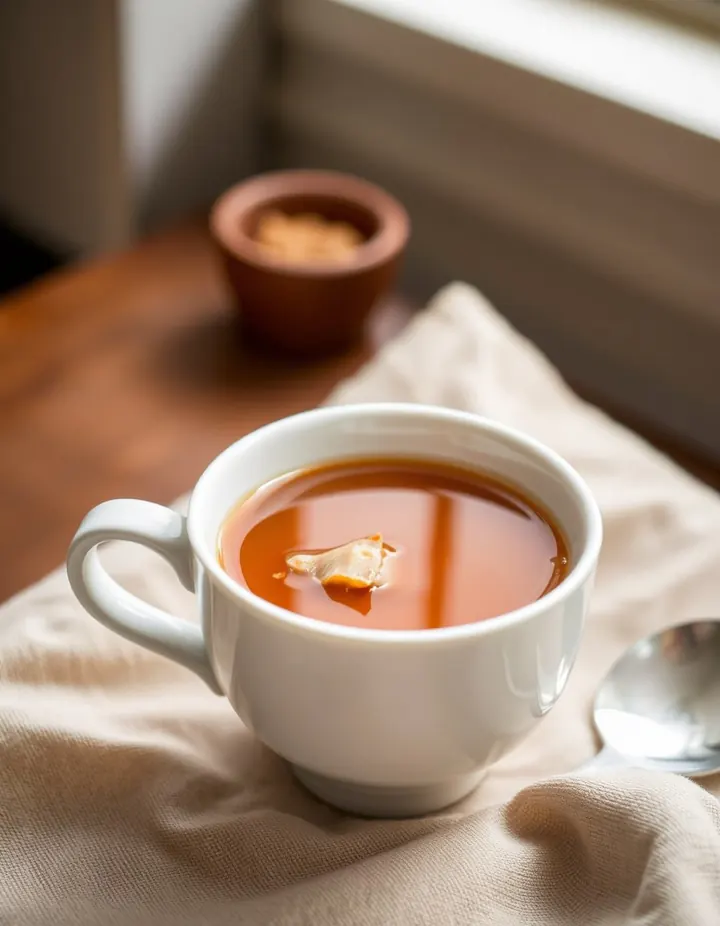
Photo for illustrative purposes only · Contact us to use it
Explore the science
The flavor team
The pairs that carry this dish. Each one is judged two ways: how much their aromas overlap, and how often cooks already put them together.
-
Pepper + clovetop 5% of all pairsSmell alikestrongCooked together17,451 recipes
Shared aroma: ethyl octanoate (fruity, wine).
-
Beef + oniontop 7% of all pairsSmell alikemoderateCooked together17,092 recipes
Shared aroma: 2-isopropyl-3-methoxypyrazine (earthy, pea).
-
Beef + peppertop 10% of all pairsSmell alikemoderateCooked together18,971 recipes
Shared aroma: 2-isopropyl-3-methoxypyrazine (earthy, pea).
-
Tea + milktop 11% of all pairsSmell alikemoderateCooked together738 recipes
Shared aroma: 4-heptenal (creamy, biscuit).
-
Pepper + oniontop 11% of all pairsSmell alikemoderateCooked together68,474 recipes
Shared aroma: 2-isopropyl-3-methoxypyrazine (earthy, pea).
Ranks compare each pair with 20,000 random ingredient pairs on CompKitchen. How we score pairs
Swap the clove
How well each one fits the dish's main ingredients (beef, tea, milk, cream, pepper, onion, egg):
- Nutmegfits better
- Celeryfits better
- Cinnamonfits better
- Clovethe original
Fit is the average pairing score against beef, tea, milk, cream, pepper, onion, egg. Candidates are from the same food group and used in at least 100 recipes.
The free Flavor Lab newsletter: one surprising pairing a week and the molecular reason it works, in 60 seconds. No spam, unsubscribe anytime.
Prefer an account? Create a free account to save pairings and unlock the full chemistry.