Why it works: Cream and sauce are a kitchen classic. They rank in the top 9% of all ingredient pairs, and cooks put them together in 4,787 recipes. Both carry ethanol, which smells alcoholic, ethereal. The science ↓
Egg Wine
Ingredients
Directions
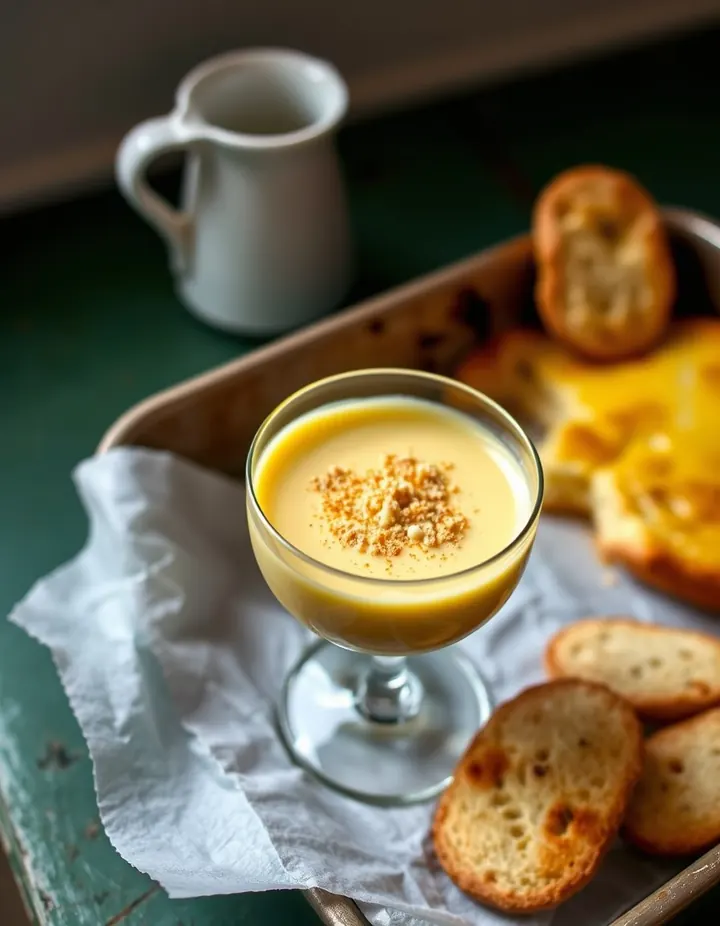
_Ingredients._—1 egg, 1 tablespoonful and ½ glass of cold water, 1 glass of sherry, sugar and grated nutmeg to taste. _Mode._—Beat the egg, mixing with it a tablespoonful of cold water; make the wine-and-water hot, but not boiling; pour it on the egg, stirring all the time. Add sufficient lump sugar to sweeten the mixture, and a little grated nutmeg; put all into a very clean saucepan, set it on a gentle fire, and stir the contents one way until they thicken, but _do not allow them to boil_. Serve in a glass with sippets of toasted bread or plain crisp biscuits. When the egg is not warmed, the mixture will be found easier of digestion, but it is not so pleasant a drink. _Sufficient_ for 1 person.
EGGS, to Boil for Breakfast, Salads, &c.
Eggs for boiling cannot be too fresh, or boiled too soon after they are laid; but rather a longer time should be allowed for boiling a new-laid egg than for one that is three or four days old. Have ready a saucepan of boiling water; put the eggs into it gently with a spoon, letting the spoon touch the bottom of the saucepan before it is withdrawn, that the egg may not fall, and consequently crack. For those who like eggs lightly boiled, 3 minutes will be found sufficient; 3¾ to 4 minutes will be ample time to set the white nicely; and, if liked hard, 6 to 7 minutes will not be found too long. Should the eggs be unusually large, as those of black Spanish fowls sometimes are, allow an extra ½ minute for them. Eggs for salads should be boiled from 10 minutes to ¼ hour, and should be placed in a basin of cold water for a few minutes; they should then be rolled on the table with the hand, and the shell will peel off easily. _Time._—To boil eggs lightly, for invalids or children, 3 minutes; to boil eggs to suit the generality of tastes, 3¾ to 4 minutes; to boil eggs hard, 6 to 7 minutes; for salads, 10 to 15 minutes.
EGGS, Buttered.
_Ingredients._—4 new-laid eggs, 2 oz. of butter. _Mode._—Procure the eggs new-laid if possible; break them into a basin, and beat them well; put the butter into another basin, which place in boiling water, and stir till the butter is melted. Pour that and the eggs into a lined saucepan; hold it over a gentle fire, and, as the mixture begins to warm, pour it two or three times into the basin, and back again, that the two ingredients may be well incorporated. Keep stirring the eggs and butter one way until they are hot, _without boiling_, and serve on hot buttered toast. If the mixture is allowed to boil, it will curdle, and so be entirely spoiled. _Time._—About 5 minutes to make the eggs hot. _Average cost_, 7_d._ _Sufficient._—Allow a slice to each person. _Seasonable_ at any time.
EGGS, to Choose.
In choosing eggs, apply the tongue to the large end of the egg, and, if it feels warm, it is new, and may be relied on as a fresh egg. Another mode of ascertaining their freshness is to hold them before a lighted candle or to the light, and, if the egg looks clear, it will be tolerably good; if thick, it is stale; and if there is a black spot attached to the shell, it is worthless. No egg should be used for culinary purposes with the slightest taint in it, as it will render perfectly useless those with which it has been mixed. Eggs that are purchased, and that cannot be relied on, should always be broken in a cup, and then put into a basin: by this means stale or bad eggs may be easily rejected, without wasting the others.
EGGS, Ducks’.
Ducks’ eggs are usually so strongly flavoured that, plainly boiled, they are not good for eating; they answer, however, very well for various culinary preparations where eggs are required; such as custards, &c. &c. Being so large and highly-flavoured, 1 duck’s egg will go as far as 2 small hen’s eggs, besides making whatever they are mixed with exceedingly rich. They also are admirable when used in puddings.
EGGS, Fried.
_Ingredients._—4 eggs, ¼ lb. of lard, butter or clarified dripping. _Mode._—Place a delicately-clean frying-pan over a gentle fire; put in the fat, and allow it to come to the boiling-point. Break the eggs into cups, slip them into the boiling fat, and let them remain until the whites are delicately set; and, whilst they are frying, ladle a little of the fat over them. Take them up with a slice, drain them for a minute from their greasy moisture, trim them neatly, and serve on slices of fried bacon or ham; or the eggs may be placed in the middle of the dish, with the bacon put round as a garnish. _Time._—2 to 3 minutes. _Average cost_, 1_d._ each; 2_d._ when scarce. _Sufficient_ for 2 persons. _Seasonable_ at any time.
EGGS à la Maître d’Hôtel.
_Ingredients._—¼ lb. of fresh butter, 1 tablespoonful of flour, ½ pint of milk, pepper and salt to taste, 1 tablespoonful of minced parsley, the juice of ½ lemon, 6 eggs. _Mode._—Put the flour and half the butter into a stewpan; stir them over the fire until the mixture thickens; pour in the milk, which should be boiling; add a seasoning of pepper and salt, and simmer the whole for 5 minutes. Put the remainder of the butter into the sauce, and add the minced parsley; then boil the eggs hard, strip off the shell, cut the eggs into quarters, and put them on a dish. Bring the sauce to the boiling-point, add the lemon-juice, pour over the eggs and serve. _Time._—5 minutes to boil the sauce; the eggs, 10 to 15 minutes. _Average cost_, 1_s._ _Sufficient_ for 4 or 5 persons. _Seasonable_ at any time.
EGGS, to Pickle.
_Ingredients._—16 eggs, 1 quart of vinegar, ½ oz. of black pepper, ½ oz. of Jamaica pepper, ½ oz. of ginger. _Mode._—Boil the eggs for 12 minutes, then dip them into cold water, and take off the shells. Put the vinegar, with the pepper and ginger, into a stewpan, and let it simmer for 10 minutes. Now place the eggs in a jar, pour over them the vinegar, &c., boiling hot, and, when cold, tie them down with bladder to exclude the air. This pickle will be ready for use in a month. _Average cost_, for this quantity, 1_s._ 9_d._ _Seasonable._—This should be made about Easter, as at this time eggs are plentiful and cheap. A store of pickled eggs will be found very useful and ornamental in serving with many first and second course dishes.
EGGS AU PLAT, or AU MIROIR, served on the Dish in which they are Cooked.
_Ingredients._—4 eggs, 1 oz. of butter, pepper and salt to taste. _Mode._—Butter a dish rather thickly with good fresh butter; melt it, break the eggs into it the same as for poaching, sprinkle them with white pepper and fine salt, and put the remainder of the butter, cut into very small pieces, on the top of them. Put the dish on a hot plate, or in the oven, or before the fire, and let it remain until the whites become set, but not hard, when serve immediately, placing the dish they were cooked in on another. To hasten the cooking of the eggs, a salamander may be held over them for a minute; but great care must be taken that they are not too much done. This is an exceedingly nice dish, and one very easily prepared for breakfast. _Time._—3 minutes. _Average cost_, 5_d._ _Sufficient_ for 2 persons. _Seasonable_ at any time.
EGGS, Plovers’.
Plovers’ eggs are usually served boiled hard, and sent to table in a napkin, either hot or cold; they may also be shelled, and served the same as eggs à la Tripe, with a good Béchamel sauce, or brown gravy, poured over them. They are also used for decorating salads, the beautiful colour of the white being generally so much admired.
EGGS, Poached.
_Ingredients._—Eggs, water. To every pint of water allow 1 tablespoonful of vinegar. _Mode._—Eggs for poaching should be perfectly fresh, but not quite new-laid; those that are about 36 hours old are the best for the purpose. If quite new-laid, the white is so milky it is almost impossible to set it; and, on the other hand, if the egg be at all stale, it is equally difficult to poach it nicely. Strain some boiling water into a deep clean frying-pan; break the egg into a cup without damaging the yolk, and, when the water boils, remove the pan to the side of the fire, and gently slip the egg into it. Place the pan over a gentle fire, and keep the water simmering until the white looks nicely set, when the egg is ready. Take it up gently with a slice, cut away the ragged edges of the white, and serve either on toasted bread or on slices of ham or bacon, or on spinach, &c. A poached egg should not be overdone, as its appearance and taste will be quite spoiled if the yolk be allowed to harden. When the egg is slipped into the water, the white should be gathered together, to keep it a little in form, or the cup should be turned over it for ½ minute. To poach an egg to perfection is rather a difficult operation; so, for inexperienced cooks, a tin egg-poacher may be purchased, which greatly facilitates this manner of dressing eggs. Our illustration clearly shows what it is: it consists of a tin plate with a handle, with a space for three perforated cups. An egg should be broken into each cup, and the machine then placed in a stewpan of boiling water, which has been previously strained. When the whites of the eggs appear set, they are done, and should then be carefully slipped on to the toast or spinach, or with whatever they are served. In poaching eggs in a frying-pan, never do more than four at a time; and, when a little vinegar is liked mixed with the water in which the eggs are done, use the above proportion. _Time._—2½ to 3½ minutes, according to the size of the egg. _S
EGGS, Poached, with Cream.
_Ingredients._—1 pint of water, 1 teaspoonful of salt, 4 teaspoonfuls of vinegar, 4 fresh eggs, ½ gill of cream, salt, pepper, and pounded sugar to taste, 1 oz. of butter. _Mode._—Put the water, vinegar, and salt into a frying-pan, and break each egg into a separate cup; bring the water, &c., to boil, and slip the eggs gently into it without breaking the yolks. Simmer them from 3 to 4 minutes, but not longer, and, with a slice, lift them out on to a hot dish, and trim the edges. Empty the pan of its contents, put in the cream, add a seasoning to taste of pepper, salt, and pounded sugar; bring the whole to the boiling-point; then add the butter, broken into small pieces; toss the pan round and round till the butter is melted; pour it over the eggs, and serve. To insure the eggs not being spoiled whilst the cream, &c. is preparing, it is a good plan to warm the cream with the butter, &c. before the eggs are poached, so that it may be poured over them immediately after they are dished. _Time._—3 to 4 minutes to poach the eggs, 5 minutes to warm the cream. _Average cost_ for the above quantity, 9_d._ _Sufficient_ for 2 persons. _Seasonable_ at any time.
EGGS, Scotch.
_Ingredients._—6 eggs, 6 tablespoonfuls of forcemeat, hot lard, ½ pint of good brown gravy. _Mode._—Boil the eggs for 10 minutes; strip them from the shells, and cover them with forcemeat, or substitute pounded anchovies for the ham. Fry the eggs a nice brown in boiling lard, drain them before the fire from their greasy moisture, dish them, and pour round from ¼ to ½ pint of good brown gravy. To enhance the appearance of the eggs, they may be rolled in beaten egg and sprinkled with bread-crumbs; but this is scarcely necessary if they are carefully fried. The flavour of the ham or the anchovy in the forcemeat must preponderate, as it should be very relishing. _Time._—10 minutes to boil the eggs, 5 to 7 minutes to fry them. _Average cost_, 1_s._ 4_d._ _Sufficient_ for 3 or 4 persons. _Seasonable_ at any time.
EGGS, Snow, or Œufs à la Neige (a very pretty Supper Dish).
_Ingredients._—4 eggs, ¾ pint of milk, pounded sugar to taste, flavouring of vanilla, lemon-rind, or orange-flower water. _Mode._—Put the milk into a saucepan with sufficient sugar to sweeten it nicely, and the rind of ½ lemon. Let this steep by the side of the fire for ½ hour, when take out the peel; separate the whites from the yolks of the eggs, and whisk the former to a perfectly stiff froth, or until there is no liquid remaining; bring the milk to the boiling-point, drop in the snow a tablespoonful at a time, and keep turning the eggs until sufficiently cooked. Then place them on a glass dish, beat up the yolks of the eggs, stir to them the milk, add a little more sugar, and strain this mixture into a jug; place the jug in a saucepan of boiling water, and stir it one way until the mixture thickens, but do not allow it to boil, or it will curdle. Pour this custard over the eggs, when they should rise to the surface. They make an exceedingly pretty addition to a supper, and should be put in a cold place after being made. When they are flavoured with vanilla or orange-flowered water, it is not necessary to steep the milk. A few drops of the essence of either may be poured into the milk just before the whites are poached. In making the custard, a little more flavouring and sugar should always be added. _Time._—About 2 minutes to poach the whites; 8 minutes to stir the custard. _Average cost_, 8_d._ _Sufficient_ for 4 or 5 persons. _Seasonable_ at any time.
EGGS, to keep Fresh for several Weeks.
Have ready a large saucepan, capable of holding 3 or 4 quarts, full of boiling water. Put the eggs into a cabbage-net, say 20 at a time, and hold them in the water (which must be kept boiling) _for_ 20 _seconds_. Proceed in this manner till you have done as many eggs as you wish to preserve; then pack them away in sawdust. We have tried this method of preserving eggs, and can vouch for its excellence. They will be found, at the end of 2 or 3 months, quite good enough for culinary purposes; and although the white may be a little tougher than that of a new-laid egg, the yolk will be nearly the same. Many persons keep eggs for a long time by smearing the shells with butter or sweet oil: they should then be packed in plenty of bran or sawdust, and the eggs not allowed to touch each other. Eggs for storing should be collected in fine weather, and should not be more than 24 hours old when they are packed away, or their flavour, when used, cannot be relied on. Another simple way of preserving eggs is to immerse them in lime-water soon after they have been laid, and then to put the vessel containing the lime-water in a cellar or cool outhouse. _Seasonable._—The best time for preserving eggs is from April to September.
EGGS, à la Tripe.
_Ingredients._—8 eggs, ¾ pint of Béchamel sauce, dessertspoonful of finely-minced parsley. _Mode._—Boil the eggs hard; put them into cold water, peel them, take out the yolks whole, and shred the whites. Make ¾ pint of Béchamel sauce; add the parsley, and, when the sauce is quite hot, put the yolks of the eggs into the middle of the dish, and the shred whites round them; pour over the sauce, and garnish with leaves of puff-paste or fried croûtons. There is no necessity for putting the eggs into the saucepan with the Béchamel; the sauce, being quite hot, will warm the eggs sufficiently. _Time._—10 minutes to boil the eggs. _Average cost_, 1_s._ _Sufficient_ for 5 or 6 persons. _Seasonable_ at any time.
Nutrition, whole recipe (rough)
Counts 12 of 14 ingredients. The other 2 aren't in our nutrition table and add nothing above, so the real totals are higher.
What these numbers assume: 12 portions
| Ingredient | Portion assumed | kcal |
|---|---|---|
| Flour | 1 cup (125g) all-purpose | 455 |
| Milk | 1 cup (244ml) whole | 149 |
| Egg | 1 large egg (50g) | 78 |
| Eggs | 1 large egg (50g) | 78 |
| Cream | 1 tbsp (15ml) heavy | 51 |
| Wine | 2 tbsp cooking wine (30ml) | 25 |
| Lemon | juice of 1 lemon (48ml) | 12 |
| Nutmeg | 1 tsp ground (2.2g) | 12 |
| Black Pepper | 1 tsp ground (2.3g) | 6 |
| Vinegar | 1 tbsp (15ml) distilled | 3 |
| Parsley | 1 tbsp chopped fresh (3.8g) | 1 |
| Salt | 1 tsp (6g) | 0 |
| Water | not in our table | 0 |
| Sauce | not in our table | 0 |
One typical portion per ingredient; the recipe's quantities are not counted. A rough guide only, not for medical or dietary planning.
Transcribed from a scanned cookbook and modernised for today's kitchens. Where the book gave no heat or time, or said "a moderate oven", the temperatures and times here may be modern equivalents rather than the book's own figures. See the original page.
Photo for illustrative purposes only · Contact us to use it
Explore the science
The flavor team
The pairs that carry this dish. Each one is judged two ways: how much their aromas overlap, and how often cooks already put them together.
-
Cream + saucetop 9% of all pairsSmell alikemoderateCooked together4,787 recipes
Shared aroma: ethanol (alcoholic, ethereal).
-
Vinegar + sherrytop 11% of all pairsSmell alikemoderateCooked together660 recipes
Shared aroma: 4-ethyl-2-methoxyphenol (smoky, clove).
-
Flour + parsleytop 12% of all pairsSmell alikemoderateCooked together16,675 recipes
Shared aroma: isobutyraldehyde (malty, green).
-
Milk + sherrytop 14% of all pairsSmell alikemoderateCooked together1,479 recipes
Shared aroma: 2,3,5-trimethylpyrazine (cocoa, roasted).
-
Flour + milktop 14% of all pairsSmell alikelowCooked together78,219 recipes
Shared aroma: isobutyraldehyde (malty, green).
Flour and milk barely smell alike, yet cooks put them together in 78,219 recipes: they work on texture and structure more than aroma.
Ranks compare each pair with 20,000 random ingredient pairs on CompKitchen. How we score pairs
Swap the parsley
How well each one fits the dish's main ingredients (flour, milk, vinegar, cream, sauce, egg, sherry):
- Nutmegfits better
- Tarragonfits better
- Capersfits better
- Parsleythe original
Fit is the average pairing score against flour, milk, vinegar, cream, sauce, egg, sherry. Candidates are from the same food group and used in at least 100 recipes.
The free Flavor Lab newsletter: one surprising pairing a week and the molecular reason it works, in 60 seconds. No spam, unsubscribe anytime.
Prefer an account? Create a free account to save pairings and unlock the full chemistry.