Why it works: Butter and milk are a kitchen classic. They rank in the top 7% of all ingredient pairs, and cooks put them together in 81,283 recipes. Both carry (z)-4-heptenal, which smells biscuit, cream. The science ↓
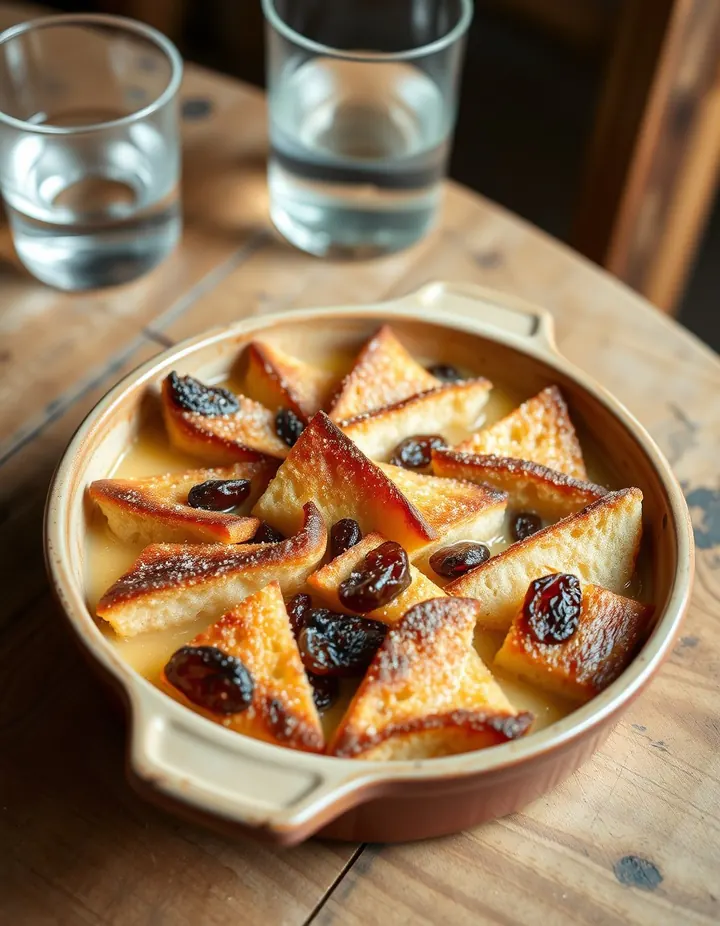
Bread and Butter Pudding
Ingredients
Directions
Prepare
Remove end crusts from bread, cut loaf into one-half-inch slices, spread each slice generously with butter, and arrange in a buttered pudding dish, buttered side down.
Parboil three-fourths cup raisins in boiling water until covered and seeded, and sprinkle between layers of bread.
Make the custard
Beat eggs slightly, add sugar, salt, and milk; strain the mixture.
Pour the strained mixture over the bread; let stand thirty minutes.
Bake and serve
Bake for one hour in a slow oven, covering the dish for the first half-hour.
The top of the pudding should be well browned.
Serve with hard or creamy sauce.
Nutrition, whole recipe (rough)
What these numbers assume: 5 portions
| Ingredient | Portion assumed | kcal |
|---|---|---|
| Milk | 1 cup (244ml) whole | 149 |
| Butter | 1 tbsp (14g) | 102 |
| Egg | 1 large egg (50g) | 78 |
| Sugar | 1 tbsp (12.5g) granulated | 49 |
| Salt | 1 tsp (6g) | 0 |
One typical portion per ingredient; the recipe's quantities are not counted. A rough guide only, not for medical or dietary planning.
Transcribed from a scanned cookbook and modernised for today's kitchens. Where the book gave no heat or time, or said "a moderate oven", the temperatures and times here may be modern equivalents rather than the book's own figures. See the original page.
Photo for illustrative purposes only · Contact us to use it
Explore the science
The flavor team
The pairs that carry this dish. Each one is judged two ways: how much their aromas overlap, and how often cooks already put them together.
-
Butter + milktop 7% of all pairsSmell alikemoderateCooked together81,283 recipes
Shared aroma: (z)-4-heptenal (biscuit, cream).
-
Butter + eggtop 17% of all pairsSmell alikemoderateCooked together118,967 recipes
Shared aroma: decanal (soap, orange peel).
-
Butter + sugartop 17% of all pairsSmell alikemoderateCooked together98,233 recipes
Shared aroma: guaiacol (smoky, sweet).
-
Egg + milktop 18% of all pairsSmell alikemoderateCooked together88,785 recipes
Shared aroma: 2-nonenal (fatty, green).
-
Sugar + milktop 18% of all pairsSmell alikelowCooked together77,875 recipes
Shared aroma: 2-nonenal (fatty, green).
Sugar and milk barely smell alike, yet cooks put them together in 77,875 recipes: they work on texture and structure more than aroma.
Ranks compare each pair with 20,000 random ingredient pairs on CompKitchen. How we score pairs
What each ingredient does
- Eggs
- Set the custard and give the pudding its rich, tender body.
- Milk
- Forms the liquid custard that soaks into the bread and bakes into a soft texture.
- Bread (in the method)
- Absorbs the custard and forms the layered structure of the pudding.
- Butter
- Adds richness and helps the top and bread surfaces brown during baking.
- Sugar
- Adds sweetness and contributes to browning on the top of the pudding.
The step that matters
Covering the dish while baking. Covering the dish for the first half-hour traps moisture so the custard sets gently without drying out. Uncovering it later lets the top brown. Baking too hot or too long can curdle the eggs and make the custard grainy.
“What each ingredient does” and “The step that matters” were written by Claude from this recipe’s own method and reviewed in samples by CompKitchen.
You might also like
 White Cake431 recipes
 Pound Cake373 recipes
 Orange Bundt Cake349 recipes
 Spice Cake344 recipes
The free Flavor Lab newsletter: one surprising pairing a week and the molecular reason it works, in 60 seconds. No spam, unsubscribe anytime.
Prefer an account? Create a free account to save pairings and unlock the full chemistry.