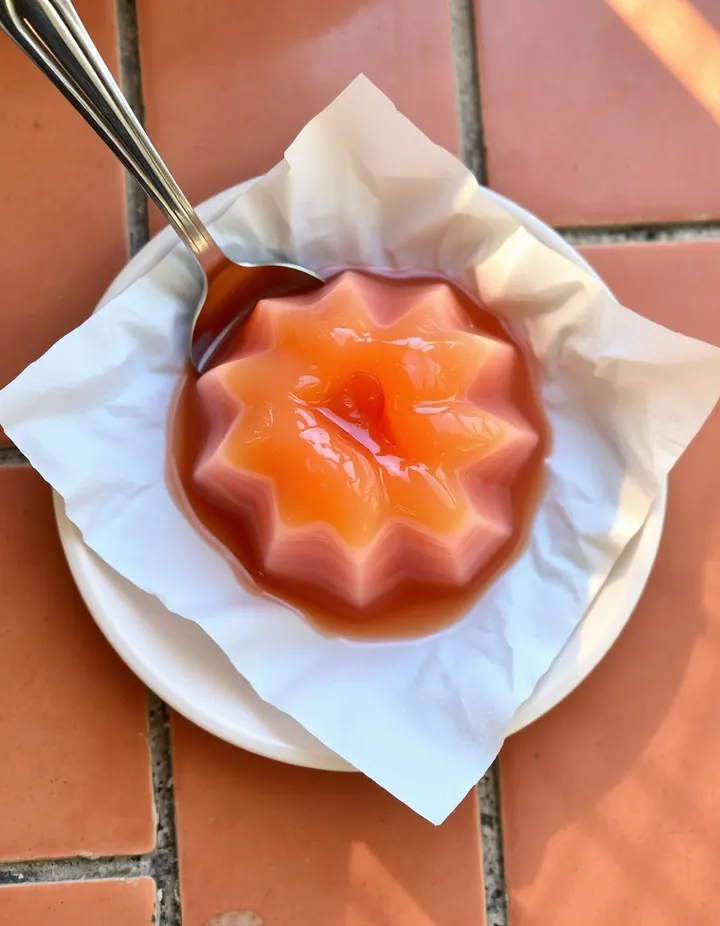
Quince Jelly
Ingredients
Directions
Prepare the fruit
Pare, quarter, core, and weigh ripe quinces.
Throw the quince pieces into the water in which they will be boiled.
Add one pint of water per pound of fruit.
Simmer gently for 3/4 to 1½ hour until the fruit is a little broken but not so long as to redden the juice, which should be very pale.
Turn the whole into a jelly‑bag or strain the liquid through a fine cloth, letting it drain closely without pressure.
Make the jelly
Weigh the juice.
Put the juice into a clean preserving pan.
Boil quickly for twenty minutes.
Take from the fire and stir in sugar until it is entirely dissolved (twelve ounces of sugar per pound of juice, or fourteen ounces if the fruit is very acid).
Keep constantly stirred and thoroughly cleared from scum for ten to twenty minutes longer, or until it jellies strongly when falling from the skimmer.
Pour directly into glasses or moulds.
Alternative finish
If using equal weight of juice and sugar, boil for twenty to thirty minutes.
Transcribed from a scanned cookbook and modernised for today's kitchens. Where the book gave no heat or time, or said "a moderate oven", the temperatures and times here may be modern equivalents rather than the book's own figures. See the original page.
Photo for illustrative purposes only · Contact us to use it
Explore the science
What each ingredient does
- Quinces (in the method)
- Provide the pectin and tart flavour that allow the juice to set into a jelly.
- Sugar
- Sweetens the jelly and helps it set firm when boiled with the juice.
- Water
- Extracts the juice from the fruit during simmering.
The step that matters
Simmering the fruit. Simmering only until the fruit is just broken keeps the juice pale; over-cooking reddens it. Draining without pressure keeps the jelly clear, since squeezing pushes cloudy solids into the juice.
“What each ingredient does” and “The step that matters” were written by Claude from this recipe’s own method and reviewed in samples by CompKitchen.
You might also like
 White Cake431 recipes
 Pound Cake373 recipes
 Orange Bundt Cake349 recipes
 Spice Cake344 recipes
The free Flavor Lab newsletter: one surprising pairing a week and the molecular reason it works, in 60 seconds. No spam, unsubscribe anytime.
Prefer an account? Create a free account to save pairings and unlock the full chemistry.