Why it works: Sugar and raisin are a kitchen classic. They rank in the top 13% of all ingredient pairs, and cooks put them together in 12,481 recipes. Both carry beta-damascenone, which smells apple, rose. The science ↓
Elder Flower Wine
Ingredients
Directions
Prepare the flower liquor
Strip the flowers or blossoms of the elder tree from the stalks.
To every quart of flowers allow one gallon of water and three pounds of white sugar.
Boil and skim the sugar and water.
Pour the hot sugar and water on the flowers.
When cool, mix in some lemon juice and some yeast.
Allow six gallons of the liquor the juice of six lemons, and four or five tablespoonfuls of good yeast stirred in very hard.
Ferment and clarify
Let it ferment for three days in a tub covered with a double blanket.
Strain the wine through a sieve.
Add six whites of eggs beaten to a stiff froth, or an ounce of melted isinglass.
Cask and age
Put the wine into a cask in whose bottom you have laid four or five pounds of the best raisins, stoned.
Stop the cask closely.
Leave the wine in the cask for six months, until it is fit to bottle.
Nutrition, whole recipe (rough)
Counts 5 of 7 ingredients. The other 2 aren't in our nutrition table and add nothing above, so the real totals are higher.
What these numbers assume: 5 portions
| Ingredient | Portion assumed | kcal |
|---|---|---|
| Flour | 1 cup (125g) all-purpose | 455 |
| Egg | 1 large egg (50g) | 78 |
| Grape | 1/2 cup (76g) | 62 |
| Sugar | 1 tbsp (12.5g) granulated | 49 |
| Lemon | juice of 1 lemon (48ml) | 12 |
| Water | not in our table | 0 |
| Liquor | not in our table | 0 |
One typical portion per ingredient; the recipe's quantities are not counted. A rough guide only, not for medical or dietary planning.
Transcribed from a scanned cookbook and modernised for today's kitchens. Where the book gave no heat or time, or said "a moderate oven", the temperatures and times here may be modern equivalents rather than the book's own figures. See the original page.
Explore the science
The flavor team
The pairs that carry this dish. Each one is judged two ways: how much their aromas overlap, and how often cooks already put them together.
-
Sugar + raisintop 13% of all pairsSmell alikemoderateCooked together12,481 recipes
Shared aroma: beta-damascenone (apple, rose).
-
Lemon + raisintop 14% of all pairsSmell alikemoderateCooked together3,742 recipes
Shared aroma: decanal (soap, orange peel).
-
Sugar + lemontop 18% of all pairsSmell alikelowCooked together53,532 recipes
Shared aroma: 2-nonenal (fatty, green).
-
Lemon + eggtop 19% of all pairsSmell alikelowCooked together44,316 recipes
Shared aroma: (e,e)-2,4-decadienal (fatty, deep fried).
-
Sugar + eggtop 21% of all pairsSmell alikemoderateCooked together122,807 recipes
Shared aroma: 2-nonenal (fatty, green).
Sugar and lemon barely smell alike, yet cooks put them together in 53,532 recipes: they work on texture and structure more than aroma.
Ranks compare each pair with 20,000 random ingredient pairs on CompKitchen. How we score pairs
What each ingredient does
- Elder flowers (in the method)
- Provide the characteristic floral aroma and flavour of the wine.
- White sugar
- Feeds the yeast during fermentation, producing alcohol and sweetness balance.
- Yeast
- Ferments the sugar into alcohol and carbon dioxide.
- Lemons
- Add acidity that brightens the flavour and supports a clean fermentation.
- Raisins
- Add fruit body and nutrients that help feed the fermentation.
- Isinglass
- Fines the wine, helping suspended particles settle so it clears.
The step that matters
Leave the wine in the cask for six months. Clarification and mellowing need time to finish; bottling early can leave a cloudy, harsh, or still-fermenting wine.
Swap the lemon
How well each one fits the dish's main ingredients (sugar, raisin, egg):
- Vanillafits better
- Figfits better
- Lemonthe original
- Datesfits about as well
Fit is the average pairing score against sugar, raisin, egg. Candidates are from the same food group and used in at least 100 recipes.
“What each ingredient does” and “The step that matters” were written by Claude from this recipe’s own method and reviewed in samples by CompKitchen.
You might also like
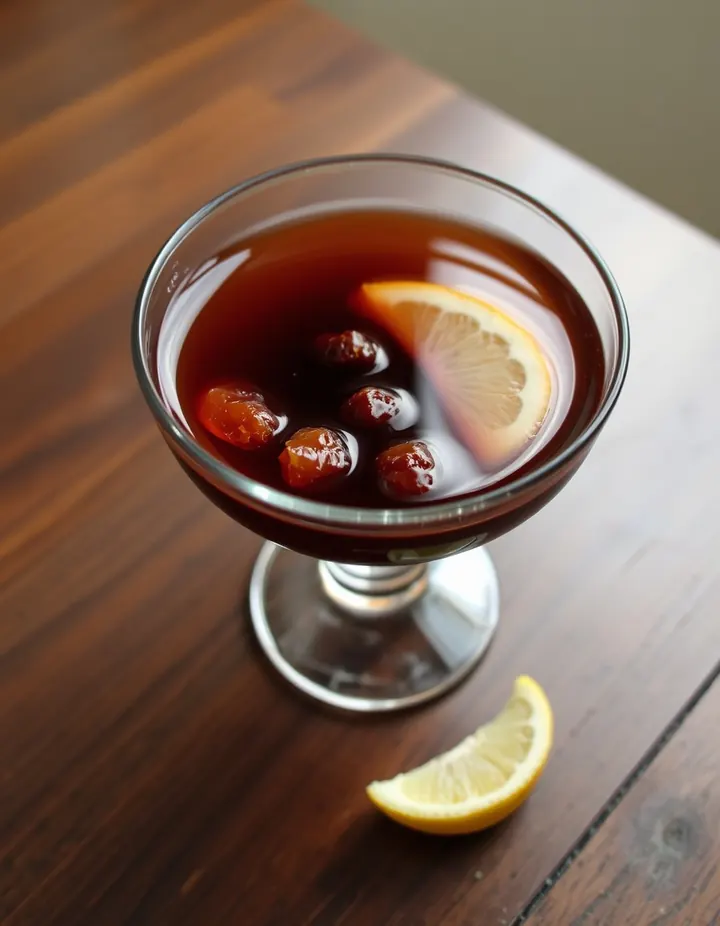 Raisin Wine64 recipes
 Lemon Whey33 recipes
 Lemon Wine31 recipes
 Lemon Squash10 recipes
The free Flavor Lab newsletter: one surprising pairing a week and the molecular reason it works, in 60 seconds. No spam, unsubscribe anytime.
Prefer an account? Create a free account to save pairings and unlock the full chemistry.