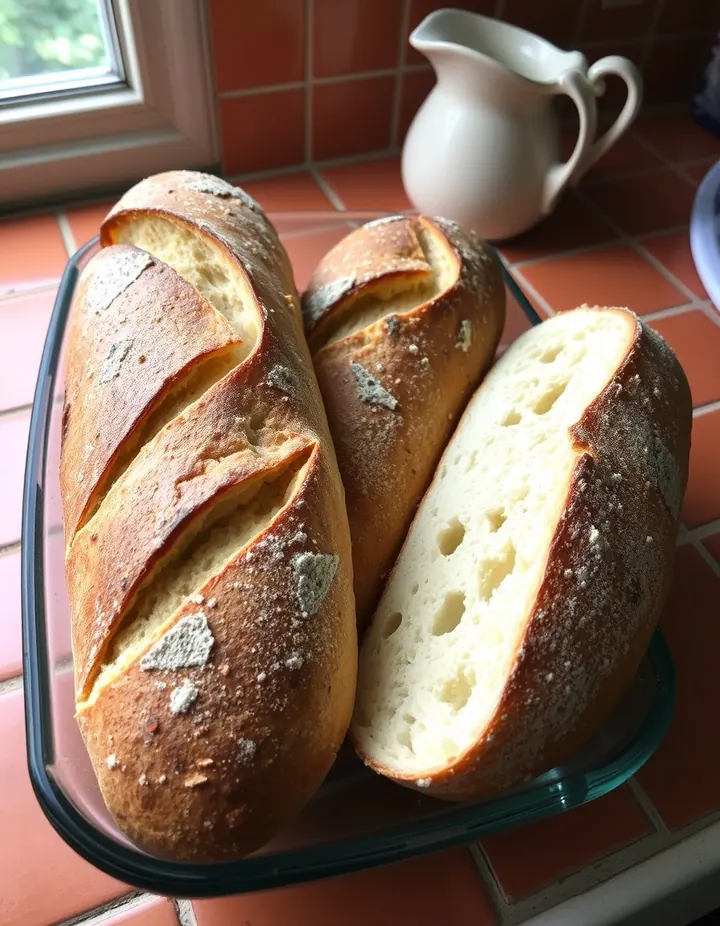
French Bread
Ingredients
Directions
The book says “a quick oven”. The 400°F (200°C) in the steps is the modern equivalent, not the book's own figure.
Make the starter
Mix the yeast with 1 cup of flour to form a stiff paste.
Knead the paste into a ball and make two cuts on top, about 1/4 inch deep.
Place the paste in a bowl of warm water with the cuts facing up.
Let it float for about 2 minutes, then remove it.
Mix and shape
On a floured surface, make a hole in 2 cups of flour and add the yeast mixture, tepid water, and salt.
Knead well and shape as desired.
Rise and bake
Place in a warm spot to rise for about 6 hours.
Bake in a preheated oven at 400°F (200°C) until golden.
Transcribed from a scanned cookbook and modernised for today's kitchens. Where the book gave no heat or time, or said "a moderate oven", the temperatures and times here may be modern equivalents rather than the book's own figures.
Photo for illustrative purposes only · Contact us to use it
Explore the science
What each ingredient does
- Yeast
- Produces carbon dioxide gas that leavens the dough so it rises and becomes light.
- Flour
- Its proteins form gluten, giving the dough the structure to hold its shape and trap gas.
The step that matters
Let the starter float. A floating paste shows that yeast has produced enough gas to make it less dense than water, confirming the yeast is active before you use it. A paste that sinks suggests weak or dead yeast, which would leave the bread flat.
“What each ingredient does” and “The step that matters” were written by Claude from this recipe’s own method and reviewed in samples by CompKitchen.
More french bread recipes
You might also like
 Cornbread345 recipes
 Bread Pudding336 recipes
 Milk Bread Rolls242 recipes
 Potato Bread124 recipes
The free Flavor Lab newsletter: one surprising pairing a week and the molecular reason it works, in 60 seconds. No spam, unsubscribe anytime.
Prefer an account? Create a free account to save pairings and unlock the full chemistry.