 Illustration
Why it works: Melon and garlic work together. They rank in the top 14% of all ingredient pairs, and 123 recipes mention both. Both carry acetic acid, which smells sour, vinegar. The science ↓
The recipe
Ingredients
Contains: egg (auto-detected from the ingredients and method; we can miss things, so check labels)
Also mentioned in the method: egg
Directions
Prepare the melons
Choose small, late melons that are green and sound. Clean them and make a circular incision around the stem, removing the piece to scoop out the pulp and seeds.
Make a pickle with enough salt and water to float an egg.
After 24 hours, remove the melons and drain them on a sieve.
Fill and seal
Prepare a seasoning with horseradish, shallots, equal parts of mustard and coriander seeds, peppercorns, allspice, mace, and cloves.
Fill the hollow of each melon with the seasoning, adding boiled onions, scalded beans, and cucumbers.
Replace the piece you removed and sew it back on firmly with coarse thread, ensuring the cut sides are up.
Pour the pickle over the melons, covering them by two inches.
Pickle in vinegar
Boil enough vinegar to cover the melons, adding cloves, pepper, and a few capsicums before straining it over the melons.
Cover with a cloth and let the jar stand near the fire for about an hour.
For the next four to five days, heat the vinegar daily, adding garlic, white peppercorns, ginger, and cardamom seeds during the last heating.
Boil for 20 minutes.
Cover the jar when the vinegar is cold and set aside for use.
Transcribed from a scanned cookbook and modernised for today's kitchens. Where the book gave no heat or time, or said "a moderate oven", the temperatures and times here may be modern equivalents rather than the book's own figures.
Found this recipe through an AI assistant? CompKitchen also shows which ingredients go well together and why, from the aroma molecules they share and how often recipes combine them. Try the pairing tools.
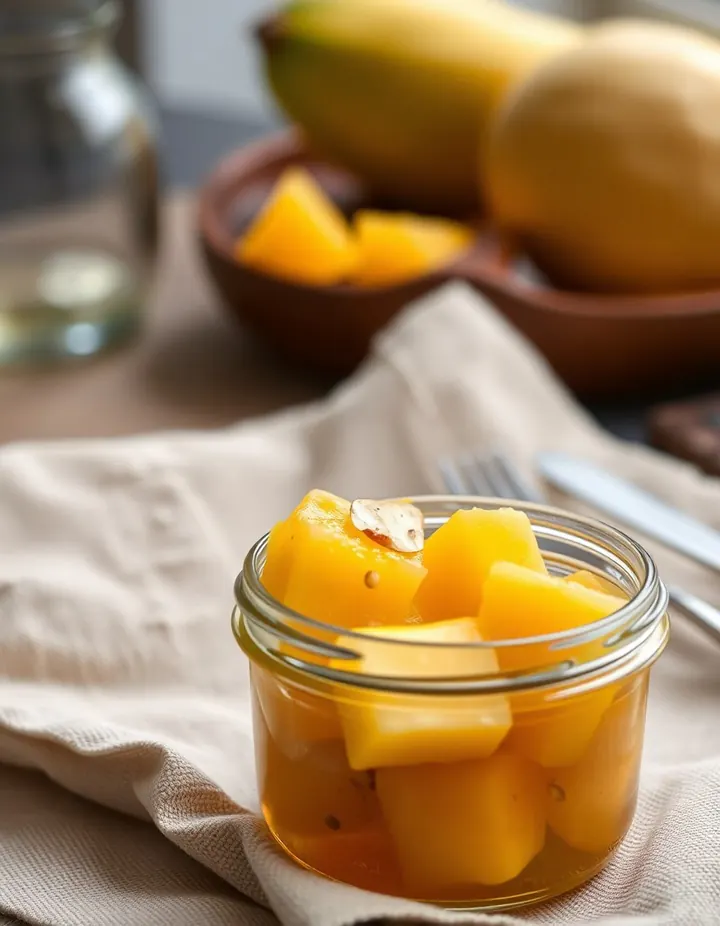
The picture is an illustration, not a photo of this recipe · Contact us to use it
Explore the science
The flavor team
The pairs that carry this dish. Each one is judged two ways: how much aroma chemistry they share, and how many recipes mention both.
-
Melon + garlictop 14% of all pairsAroma overlapmoderateMentioned together123 recipes
Shared aroma: acetic acid (sour, vinegar).
-
Allspice + clovetop 1% of all pairsAroma overlapstrongMentioned together7,711 recipes
Shared aroma: methyleugenol (clove, spice).
-
Horseradish + mustardtop 1% of all pairsAroma overlapstrongMentioned together1,813 recipes
Shared aroma: coumarin (sweet, hay).
-
Mace + clovetop 2% of all pairsAroma overlapmoderateMentioned together8,199 recipes
Shared aroma: methyleugenol (clove, spice).
-
Allspice + macetop 2% of all pairsAroma overlapstrongMentioned together3,189 recipes
Shared aroma: methyleugenol (clove, spice).
Ranks compare each pair with 20,000 random ingredient pairs on CompKitchen. How we score pairs
What each ingredient does
- Small late melons
- Form the hollow vessel that holds the seasoning and absorbs the pickling flavours.
- Coarse sea salt
- Draws water out of the melons and seasons the pickle through brining.
- Vinegar
- Acid that preserves the melons and gives the pickle its sharp flavour.
- Mustard seeds
- Add pungent heat and sharpness that penetrates the melon flesh once bruised.
- Shredded shallots
- Contribute a mild sharp onion flavour to the seasoning filling each melon.
- Garlic
- Adds pungent aroma that mellows as the vinegar is repeatedly heated.
The step that matters
Repeated heating of the vinegar. Heating the vinegar daily over several days lets the spices and aromatics infuse fully and helps keep the pickle stable. Letting the vinegar cool completely before sealing the jar prevents condensation and spoilage.
Flavor stand-ins for the shallot
How well each one fits the dish's main ingredients (melon, horseradish, mustard, coriander, allspice, mace, clove):
- Capsicumbetter flavor fit
- Cucumberbetter flavor fit
- Radishbetter flavor fit
- Shallotthe original
Fit is the average pairing score against melon, horseradish, mustard, coriander, allspice, mace, clove. Candidates are from the same food group and used in at least 100 recipes. This compares flavor only: it does not check the job the ingredient does in the dish (bulk, moisture, acidity, structure).
“What each ingredient does” and “The step that matters” were written by Claude, an AI, from this recipe’s own method. They are not checked recipe by recipe, so they can be wrong.
Make it your own
Stand-ins, a drink, and quick taste fixes for this dish, ranked by how well each fits its other ingredients: shared aroma molecules and how often recipes combine them.
You might also like
 Illustration
 Illustration
 Illustration
 Illustration
The Sunday pairing: one pairing, the chemistry behind it, and how to cook it. No spam, unsubscribe anytime.
Prefer an account? Create a free account for sign-in; Pro adds the full results and chemistry.