Why it works: Mushroom and pepper are a kitchen classic. They rank in the top 11% of all ingredient pairs, and cooks put them together in 13,580 recipes. Both carry 2-nonenal, which smells fatty, green. The science ↓
Mushroom Ketchup
Ingredients
Directions
The book says “a cool oven”. The 300°F (150°C) in the steps is the modern equivalent, not the book's own figure.
Prepare the mushrooms
Remove any decayed, dirty, or worm-eaten parts from the mushrooms.
Cut off about ½ inch from the ends of the stalks and break the rest into small pieces.
Place the mushrooms in an earthen jar and sprinkle ¾ pound of salt over them, scattering most of it on top.
Let them sit overnight.
Stir the mushrooms gently with a wooden spoon three times a day for two days.
Extract and reduce the liquid
After two days, place the jar in a cool oven at 300°F (150°C) for 30 minutes.
Strain the liquid through a coarse cloth. Do not squeeze the mushrooms.
Boil the strained liquid for 15 minutes.
Add ¼ ounce each of Jamaica pepper and black pepper, and 2 blades of mace to every quart of liquid.
Boil again until the quantity is reduced by half.
Bottle and store
Pour the liquid into dry bottles, leaving the sediment at the bottom undisturbed.
Seal the bottles with corks or tie bladders over them.
Store in a cool, dry place.
Optionally, add 2-3 drops of brandy to each pint of ketchup.
Transcribed from a scanned cookbook and modernised for today's kitchens. Where the book gave no heat or time, or said "a moderate oven", the temperatures and times here may be modern equivalents rather than the book's own figures.
Explore the science
The flavor team
The pairs that carry this dish. Each one is judged two ways: how much their aromas overlap, and how often cooks already put them together.
-
Mushroom + peppertop 11% of all pairsSmell alikemoderateCooked together13,580 recipes
Shared aroma: 2-nonenal (fatty, green).
-
Mushroom + brandytop 13% of all pairsSmell alikemoderateCooked together206 recipes
Shared aroma: guaiacol (smoky, sweet).
-
Pepper + macetop 16% of all pairsSmell alikelowCooked together12,257 recipes
Shared aroma: myristicin (spice, warm).
-
Mace + brandytop 21% of all pairsSmell alikelowCooked together1,547 recipes
-
Mushroom + macetop 21% of all pairsSmell alikelowCooked together2,529 recipes
Shared aroma: alpha-pinene (pine, turpentine).
Pepper and mace barely smell alike, yet cooks put them together in 12,257 recipes: they work on texture and structure more than aroma.
Ranks compare each pair with 20,000 random ingredient pairs on CompKitchen. How we score pairs
What each ingredient does
- Mushrooms
- Provide the main body of flavour and liquid once salted and drawn down.
- Sea salt
- Draws moisture out of the mushrooms and preserves the liquid.
- Jamaica pepper
- Adds warm, aromatic spice flavour to the reduced liquid.
- Black pepper
- Adds sharp, pungent spice to the reduced liquid.
- Mace
- Adds a delicate, aromatic warmth to the finished ketchup.
The step that matters
Do not squeeze the mushrooms. Pressing the salted mushrooms forces solids and cloudy particles into the strained liquid, making the ketchup murky and more likely to spoil. Letting it drip through the cloth keeps the liquid clear and stable for storage.
Swap the mace
How well each one fits the dish's main ingredients (mushroom, pepper, brandy):
- Thymefits better
- Clovefits better
- Marjoramfits better
- Macethe original
Fit is the average pairing score against mushroom, pepper, brandy. Candidates are from the same food group and used in at least 100 recipes.
“What each ingredient does” and “The step that matters” were written by Claude from this recipe’s own method and reviewed in samples by CompKitchen.
More mushroom ketchup recipes
You might also like
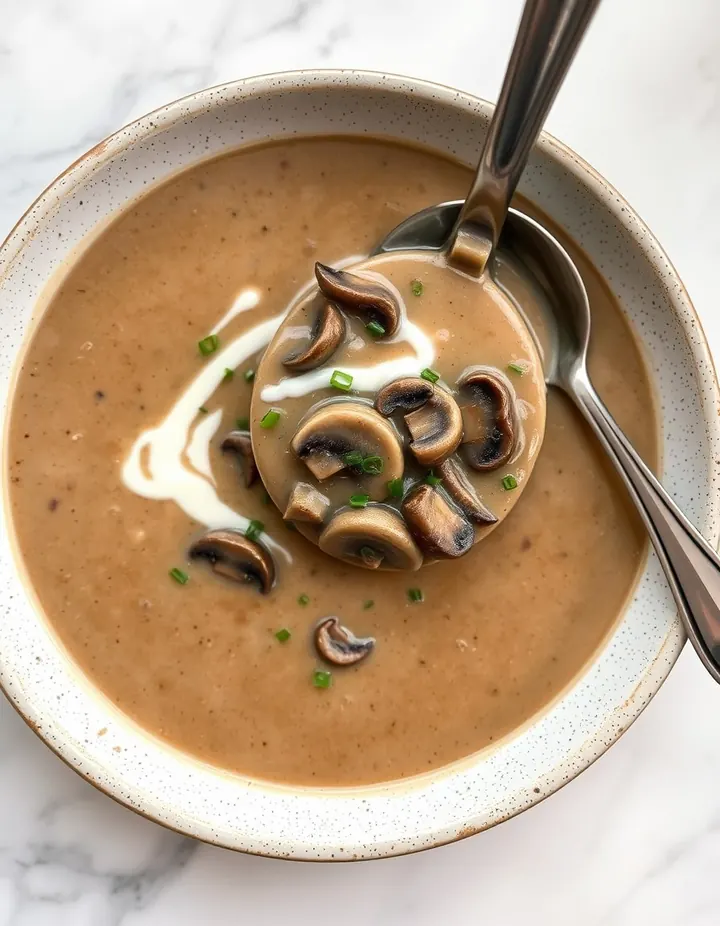 Mushroom Soup60 recipes
 Tomato Soup526 recipes
 Brown Bread461 recipes
 Mutton Broth292 recipes
The free Flavor Lab newsletter: one surprising pairing a week and the molecular reason it works, in 60 seconds. No spam, unsubscribe anytime.
Prefer an account? Create a free account to save pairings and unlock the full chemistry.