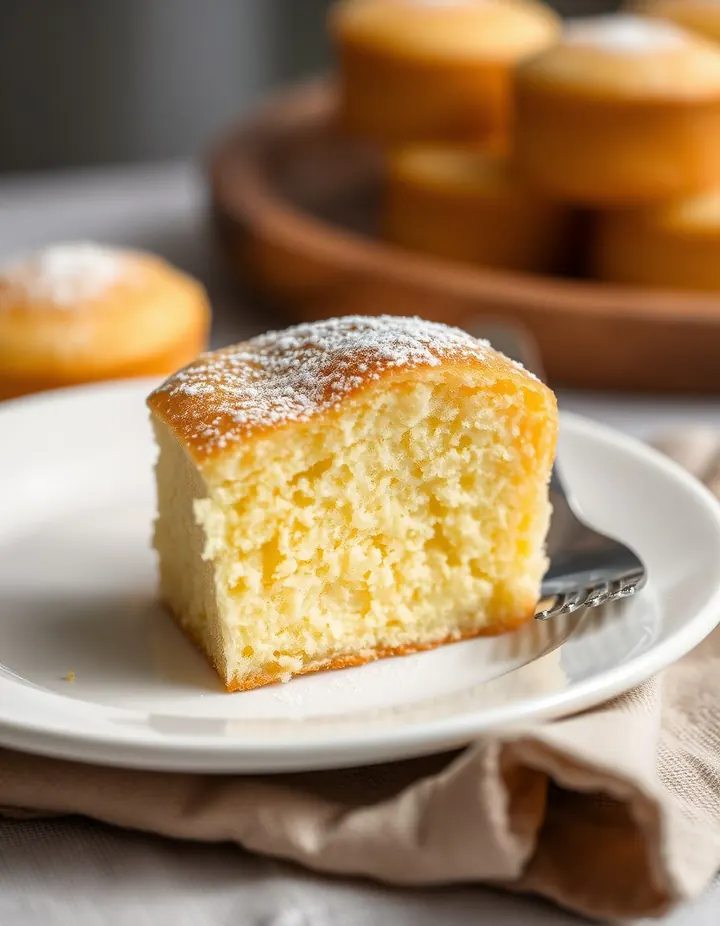
Why it works: Sugar and vanilla are a kitchen classic. They rank in the top 8% of all ingredient pairs, and cooks put them together in 35,032 recipes. Both carry beta-damascenone, which smells apple, rose. The science ↓
To Make Small Sponge Cakes
Ingredients
Directions
The book says “a quick oven”. The 400°F (200°C) in the steps is the modern equivalent, not the book's own figure.
Prepare
Weigh the flour to match the weight of five eggs.
Weigh the sugar to match the weight of eight eggs.
Ensure the flour is dry.
Ensure the sugar is well pounded and sifted.
Separate the egg whites from the yolks.
Butter the baking tins.
Make the batter
Beat the yolks with the sugar until well combined.
Whisk the egg whites until stiff peaks form.
Gently fold the egg whites into the yolk mixture until just combined.
Gradually sift in the flour.
Add the flavoring.
Bake and cool
Pour in the batter.
Sift a little sugar over the cakes.
Bake at 400°F (200°C) until pale and set.
Remove the cakes from the tins before they cool completely.
Turn them upside down until fully cooled.
Store in a closed tin canister or wide-mouthed glass bottle.
Transcribed from a scanned cookbook and modernised for today's kitchens. Where the book gave no heat or time, or said "a moderate oven", the temperatures and times here may be modern equivalents rather than the book's own figures.
Photo for illustrative purposes only · Contact us to use it
Explore the science
The flavor team
The pairs that carry this dish. Each one is judged two ways: how much their aromas overlap, and how often cooks already put them together.
-
Sugar + vanillatop 8% of all pairsSmell alikelowCooked together35,032 recipes
Shared aroma: beta-damascenone (apple, rose).
-
Flour + vanillatop 12% of all pairsSmell alikemoderateCooked together19,241 recipes
Shared aroma: isobutyraldehyde (malty, green).
-
Flour + sugartop 15% of all pairsSmell alikemoderateCooked together92,116 recipes
Shared aroma: phenylacetaldehyde (hawthorne, honey).
-
Egg + flourtop 15% of all pairsSmell alikelowCooked together106,462 recipes
Shared aroma: isobutyraldehyde (malty, green).
-
Egg + sugartop 21% of all pairsSmell alikemoderateCooked together122,807 recipes
Shared aroma: 2-nonenal (fatty, green).
Sugar and vanilla barely smell alike, yet cooks put them together in 35,032 recipes: they work on texture and structure more than aroma.
Ranks compare each pair with 20,000 random ingredient pairs on CompKitchen. How we score pairs
What each ingredient does
- Eggs
- Whites trap air when whisked, giving the sponge its light structure, while yolks add richness.
- All-purpose flour
- Provides starch that sets during baking and gives the cakes their crumb structure.
- Powdered sugar
- Sweetens the batter and, being fine, dissolves easily into the yolks for a smooth mix.
The step that matters
Folding the egg whites into the yolk mixture. Whisked whites hold air that gives the sponge its lift. Folding gently and only until combined keeps that air from collapsing, so the cakes stay light.
Swap the vanilla
How well each one fits the dish's main ingredients (egg, flour, sugar):
- Raisinfits better
- Vanillathe original
- Lemonfits less well
- Figfits less well
Fit is the average pairing score against egg, flour, sugar. Candidates are from the same food group and used in at least 100 recipes.
“What each ingredient does” and “The step that matters” were written by Claude from this recipe’s own method and reviewed in samples by CompKitchen.
You might also like
 Vanilla Ice Cream108 recipes
 White Cake431 recipes
 Pound Cake373 recipes
 Orange Bundt Cake349 recipes
The free Flavor Lab newsletter: one surprising pairing a week and the molecular reason it works, in 60 seconds. No spam, unsubscribe anytime.
Prefer an account? Create a free account to save pairings and unlock the full chemistry.