Why it works: Milk and butter are a kitchen classic. They rank in the top 7% of all ingredient pairs, and cooks put them together in 81,283 recipes. Both carry (z)-4-heptenal, which smells biscuit, cream. The science ↓
Baked Chicken Halibut with Bechamel Cream Sauce and Garnish of Potato Balls and Hard-boiled Eggs
Ingredients
Directions
The book gives no oven temperature. The 350°F (175°C) in the steps was added when the recipe was transcribed, as a starting point. The book gives no cooking times either; the times in the steps were added in transcription, so check for doneness rather than trusting the clock.
Prepare the chicken
Preheat the oven to 350°F (175°C).
Season the chicken with salt and pepper, then place it in a baking dish.
Bake the chicken for about 1 hour or until fully cooked.
Make the cheese sauce
In a saucepan, melt the butter, then stir in the flour to make a roux.
Gradually add the milk, stirring until the sauce thickens.
Add the grated cheese to the sauce and mix until melted.
Prepare the sides and serve
Boil the potatoes until tender, then scoop out and form into balls.
Slice the hard-boiled eggs.
Serve the baked chicken topped with the cheese sauce, potato balls, and slices of hard-boiled eggs.
Transcribed from a scanned cookbook and modernised for today's kitchens. Where the book gave no heat or time, or said "a moderate oven", the temperatures and times here may be modern equivalents rather than the book's own figures.
Explore the science
The flavor team
The pairs that carry this dish. Each one is judged two ways: how much their aromas overlap, and how often cooks already put them together.
-
Milk + buttertop 7% of all pairsSmell alikemoderateCooked together81,283 recipes
Shared aroma: (z)-4-heptenal (biscuit, cream).
-
Chicken + potatotop 7% of all pairsSmell alikemoderateCooked together2,756 recipes
Shared aroma: (z)-4-decenal (green, must).
-
Butter + cheesetop 8% of all pairsSmell alikemoderateCooked together7,962 recipes
Shared aroma: delta-dodecalactone (sweet, creamy).
-
Pepper + potatotop 9% of all pairsSmell alikemoderateCooked together8,305 recipes
Shared aroma: 2-isopropyl-3-methoxypyrazine (earthy, pea).
-
Milk + potatotop 9% of all pairsSmell alikemoderateCooked together3,611 recipes
Shared aroma: (e,z)-2,6-nonadienal (cucumber, melon).
Ranks compare each pair with 20,000 random ingredient pairs on CompKitchen. How we score pairs
What each ingredient does
- Butter
- Melted with flour to form a roux, which thickens the sauce and adds richness.
- Flour
- Forms a roux with melted butter, giving the bechamel its thick structure.
- Milk
- Forms the liquid base of the bechamel, which thickens as it is stirred.
- Grated cheese
- Melts into the sauce, adding flavor and a smooth, rich texture.
- Potatoes
- Boiled until tender, then shaped into balls that hold their form as a starchy side.
- Hard-boiled eggs
- Sliced and served on top, adding protein-rich body and mild flavor to the plate.
The step that matters
Gradually add the milk to the roux. Adding milk slowly while stirring lets the flour starch disperse evenly. Adding it all at once can form lumps, and constant stirring keeps the sauce smooth as it thickens.
Swap the potato
How well each one fits the dish's main ingredients (chicken, pepper, milk, butter, flour, cheese, egg):
- Potatothe original
- Capsicumfits about as well
- Asparagusfits about as well
- Chivefits less well
Fit is the average pairing score against chicken, pepper, milk, butter, flour, cheese, egg. Candidates are from the same food group and used in at least 100 recipes.
“What each ingredient does” and “The step that matters” were written by Claude from this recipe’s own method and reviewed in samples by CompKitchen.
You might also like
 Chicken Broth257 recipes
 Potato Croquettes255 recipes
 Chicken Soup156 recipes
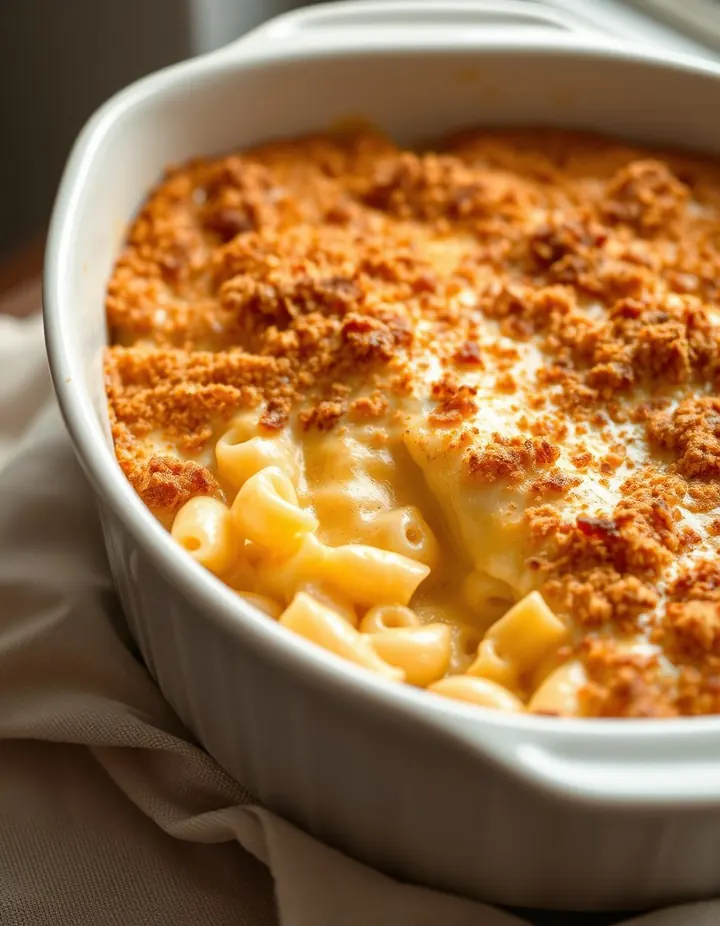 Macaroni and Cheese102 recipes
The free Flavor Lab newsletter: one surprising pairing a week and the molecular reason it works, in 60 seconds. No spam, unsubscribe anytime.
Prefer an account? Create a free account to save pairings and unlock the full chemistry.