Why it works: Butter and white wine are a kitchen classic. They rank in the top 9% of all ingredient pairs, and cooks put them together in 5,083 recipes. Both carry ethyl octanoate, which smells fruity, wine. The science ↓
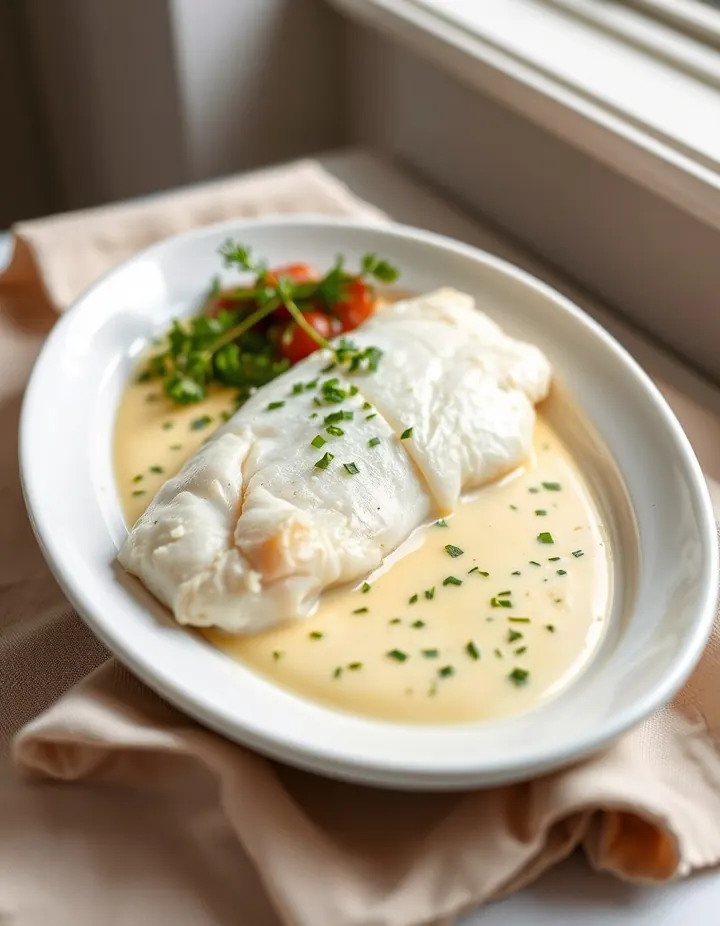
To Siew Haddock in Its Own Liquor
Ingredients
Directions
Prepare the fish
Split the haddock open and remove the bone.
Cut the fish into square pieces about the length of your finger.
Sprinkle the pounded mace and cayenne on the inside of the fish pieces, spaced about an inch apart.
Stew
Butter the sides and bottom of a large stewpan.
Place the fish in the pan, skin side down, close together but not overlapping.
Start with a cold pan and let the fish stew slowly for about 1 hour and 15 minutes.
Before the fish is done, mix the butter and flour together, then add the white wine and stir until well combined.
Pour the mixture into the pan and let it boil for about 10 minutes.
Carefully remove the fish to a deep dish, spiced side up, and pour the gravy over it.
Transcribed from a scanned cookbook and modernised for today's kitchens. Where the book gave no heat or time, or said "a moderate oven", the temperatures and times here may be modern equivalents rather than the book's own figures.
Explore the science
The flavor team
The pairs that carry this dish. Each one is judged two ways: how much their aromas overlap, and how often cooks already put them together.
-
Butter + white winetop 9% of all pairsSmell alikemoderateCooked together5,083 recipes
Shared aroma: ethyl octanoate (fruity, wine).
-
Butter + flourtop 12% of all pairsSmell alikelowCooked together124,287 recipes
Shared aroma: isobutyraldehyde (malty, green).
-
Pepper + white winetop 15% of all pairsSmell alikemoderateCooked together5,433 recipes
Shared aroma: 2-isopropyl-3-methoxypyrazine (earthy, pea).
-
Mace + peppertop 16% of all pairsSmell alikelowCooked together12,257 recipes
Shared aroma: myristicin (spice, warm).
-
Mace + white winetop 16% of all pairsSmell alikelowCooked together1,329 recipes
Shared aroma: myrcene (balsamic, herbaceous).
Butter and flour barely smell alike, yet cooks put them together in 124,287 recipes: they work on texture and structure more than aroma.
Ranks compare each pair with 20,000 random ingredient pairs on CompKitchen. How we score pairs
What each ingredient does
- Flour
- Thickens the butter and wine mixture into a smooth gravy.
- Butter
- Adds richness and fat, and helps carry flavour through the gravy.
- White wine
- Adds acidity and flavour to the gravy.
- Haddock
- Provides the main body of the dish, cooked gently until tender.
The step that matters
Start with a cold pan. Starting the fish in a cold pan and heating it slowly lets it cook gently and evenly, helping it stay tender and intact rather than toughening or breaking apart.
Swap the mace
How well each one fits the dish's main ingredients (haddock, pepper, butter, flour, white wine):
- Parsleyfits better
- Thymefits better
- Capersfits better
- Macethe original
Fit is the average pairing score against haddock, pepper, butter, flour, white wine. Candidates are from the same food group and used in at least 100 recipes.
“What each ingredient does” and “The step that matters” were written by Claude from this recipe’s own method and reviewed in samples by CompKitchen.
You might also like
 Boiled Haddock10 recipes
 Tomato Soup526 recipes
 Brown Bread461 recipes
 Mutton Broth292 recipes
The free Flavor Lab newsletter: one surprising pairing a week and the molecular reason it works, in 60 seconds. No spam, unsubscribe anytime.
Prefer an account? Create a free account to save pairings and unlock the full chemistry.