Why it works: Milk and butter are a kitchen classic. They rank in the top 7% of all ingredient pairs, and cooks put them together in 81,283 recipes. Both carry (z)-4-heptenal, which smells biscuit, cream. The science ↓
Cream Cheese
Ingredients
Directions
Make the curd
Combine the milk and rennet in a granite pan.
When the curd forms, break it down with a skimmer.
Let the curd stand for 2 hours.
Drain and press
Spread cheesecloth over a sieve.
Drain the curd onto the cheesecloth.
Salt the curd.
Gently break the curd with your hands.
Transfer the curd into a press.
Place a 2-pound weight on top of the pressed curd.
Dry and ripen
After 12 hours, wrap the cheese in linen cheesecloth.
Turn the cheese daily until dry.
Rub the outside of the cheese with butter.
Allow the cheese to ripen gradually.
Transcribed from a scanned cookbook and modernised for today's kitchens. Where the book gave no heat or time, or said "a moderate oven", the temperatures and times here may be modern equivalents rather than the book's own figures.
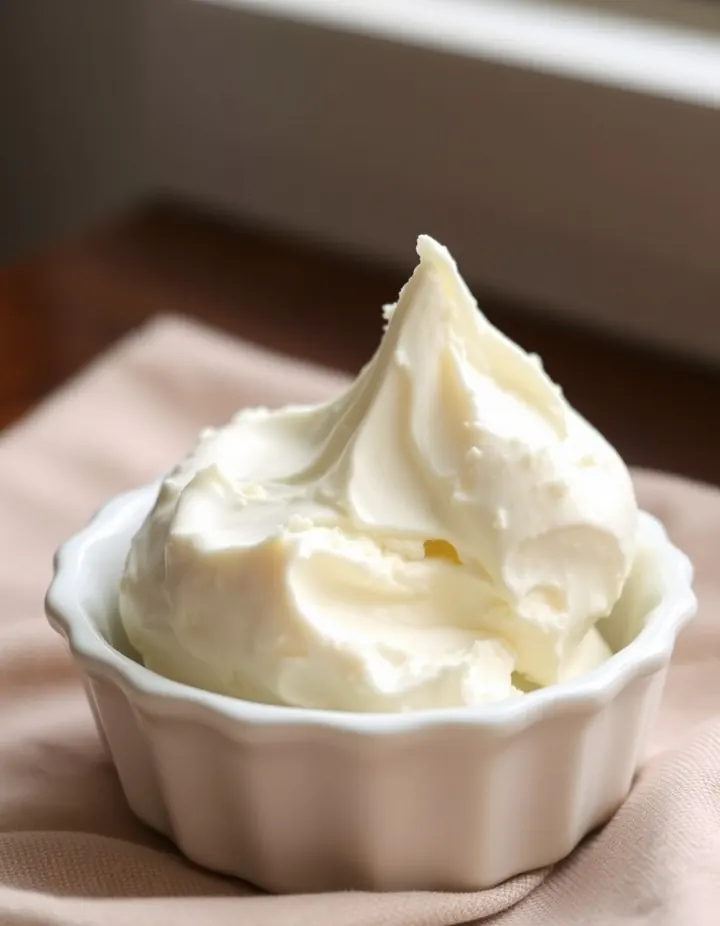
Photo for illustrative purposes only · Contact us to use it
Explore the science
The flavor team
The pairs that carry this dish. Each one is judged two ways: how much their aromas overlap, and how often cooks already put them together.
-
Milk + buttertop 7% of all pairsSmell alikemoderateCooked together81,283 recipes
Shared aroma: (z)-4-heptenal (biscuit, cream).
Ranks compare each pair with 20,000 random ingredient pairs on CompKitchen. How we score pairs
What each ingredient does
- Milk
- Supplies the proteins and fat that set into the curd and become the cheese.
- Rennet
- An enzyme that clots the milk so it separates into solid curd and liquid whey.
The step that matters
Turn the cheese daily until dry. Turning lets moisture leave evenly from all sides, so the cheese dries uniformly and is less likely to develop soft spots or mold. Regular turning also keeps the shape even as the cheese firms up during drying.
“What each ingredient does” and “The step that matters” were written by Claude from this recipe’s own method and reviewed in samples by CompKitchen.
More cream cheese recipes
You might also like
 White Cake431 recipes
 Pound Cake373 recipes
 Orange Bundt Cake349 recipes
 Spice Cake344 recipes
The free Flavor Lab newsletter: one surprising pairing a week and the molecular reason it works, in 60 seconds. No spam, unsubscribe anytime.
Prefer an account? Create a free account to save pairings and unlock the full chemistry.