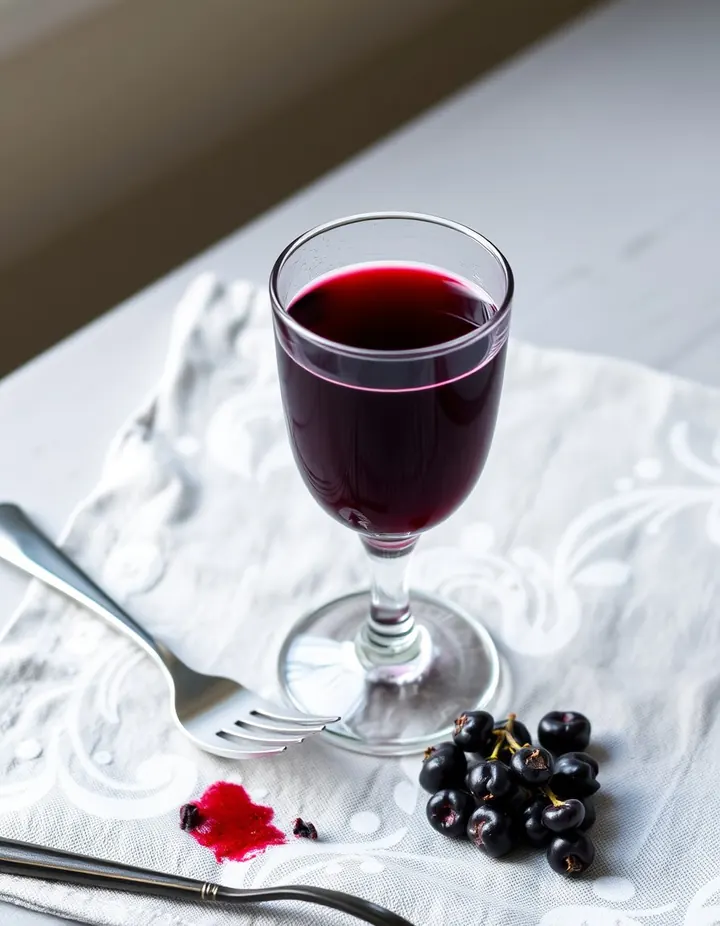
Why it works: Cinnamon and nutmeg match in chemistry and in kitchens. They rank in the top 1% of all ingredient pairs, and cooks put them together in 11,917 recipes. Both carry estragole, which smells anise, licorice. The science ↓
Elderberry Wine
Ingredients
Directions
Prepare the juice
Place elderberries in a saucepan with enough water to prevent burning and simmer until the juice flows freely.
Cool the elderberry juice.
Strain the elderberry juice.
Make the must
Boil 4 quarts of water, 4 pounds of sugar, and ½ pound of raisins together for 30 minutes.
Strain the boiled mixture.
Cool the strained mixture.
Add 1 quart of elderberry juice to the cooled mixture and let it stand for 24 hours, skimming well.
Spread yeast on a piece of toast about 1 inch square and drop it into the mixture to ferment for about 3 weeks.
Age and bottle
Strain the liquid into a cask.
Seal the cask tightly for 2 months.
Add ½ cup of brandy, rum, or alcohol per gallon of liquid before bottling.
If desired, add 1 ounce each of cloves, cinnamon, and allspice, and ½ ounce each of nutmeg and mace for every 4 gallons before bottling.
Let the wine age for 6 months before using.
Store in a cool place.
Transcribed from a scanned cookbook and modernised for today's kitchens. Where the book gave no heat or time, or said "a moderate oven", the temperatures and times here may be modern equivalents rather than the book's own figures.
Photo for illustrative purposes only · Contact us to use it
Explore the science
The flavor team
The pairs that carry this dish. Each one is judged two ways: how much their aromas overlap, and how often cooks already put them together.
-
Cinnamon + nutmegtop 1% of all pairsSmell alikestrongCooked together11,917 recipes
Shared aroma: estragole (anise, licorice).
-
Clove + cinnamontop 1% of all pairsSmell alikestrongCooked together14,189 recipes
Shared aroma: ethyl cinnamate (sweet, balsamic).
-
Clove + allspicetop 1% of all pairsSmell alikestrongCooked together7,874 recipes
Shared aroma: estragole (anise, licorice).
-
Cinnamon + allspicetop 1% of all pairsSmell alikestrongCooked together5,536 recipes
Shared aroma: estragole (anise, licorice).
-
Allspice + nutmegtop 1% of all pairsSmell alikestrongCooked together3,331 recipes
Shared aroma: estragole (anise, licorice).
Ranks compare each pair with 20,000 random ingredient pairs on CompKitchen. How we score pairs
What each ingredient does
- Elderberries
- Provide the juice that gives the wine its colour, flavour and tannins.
- Sugar
- Feeds the yeast during fermentation and sets the wine's sweetness and alcohol level.
- Raisins
- Add extra sugars and nutrients that help the yeast ferment the must.
- Yeast
- Converts the sugars into alcohol and carbon dioxide during fermentation.
- Brandy, rum, or alcohol
- Raises the alcohol content, which helps preserve the finished wine.
The step that matters
Strain the boiled mixture and cool it before adding the juice and yeast. Adding juice or yeast to a mixture that is still hot can kill the yeast, stopping fermentation before it starts. Cooling first keeps the yeast active.
“What each ingredient does” and “The step that matters” were written by Claude from this recipe’s own method and reviewed in samples by CompKitchen.
You might also like
 Raisin Wine64 recipes
 Cinnamon Tincture10 recipes
 Vegetable Soup350 recipes
 Raspberry Vinegar214 recipes
The free Flavor Lab newsletter: one surprising pairing a week and the molecular reason it works, in 60 seconds. No spam, unsubscribe anytime.
Prefer an account? Create a free account to save pairings and unlock the full chemistry.