Why it works: Allspice and clove match in chemistry and in kitchens. They rank in the top 1% of all ingredient pairs, and cooks put them together in 7,874 recipes. Both carry estragole, which smells anise, licorice. The science ↓
Boeuf Braise a LA a Tod E- -braised Beef a LA Mode
Ingredients
Directions
The book says “a moderate oven”. The 350°F (175°C) in the steps is the modern equivalent, not the book's own figure.
Prepare the beef
Bone the short hip of beef and cut it lengthwise into 3 equal pieces.
Lard the beef with strips of larding pork rolled in oil, allspice, parsley, and garlic.
Tie the beef and place it in a stone jar with the wine, brandy, carrots, onions, and herbs.
Let it macerate in a cool place for 18 to 24 hours, turning occasionally.
Heat lard or beef suet in a brazing pan.
Drain and dry the beef.
Brown and braise
Brown the beef lightly with onions and carrots.
Drain the fat.
Moisten the beef with the strained marinara.
Allow the mixture to reduce.
Add the calf's feet and gravy.
Cover the pot.
Cook in a 350°F oven for 3 to 4 hours.
Finish and serve
Place the beef on a dish.
Remove the strings.
Garnish with calf's feet, glazed onions, and carrots.
Strain the gravy.
Remove fat from the gravy.
Reduce the gravy with brown sauce.
Serve some over the meat and the rest separately.
Transcribed from a scanned cookbook and modernised for today's kitchens. Where the book gave no heat or time, or said "a moderate oven", the temperatures and times here may be modern equivalents rather than the book's own figures.
Explore the science
The flavor team
The pairs that carry this dish. Each one is judged two ways: how much their aromas overlap, and how often cooks already put them together.
-
Allspice + clovetop 1% of all pairsSmell alikestrongCooked together7,874 recipes
Shared aroma: estragole (anise, licorice).
-
Beef + porktop 1% of all pairsSmell alikestrongCooked together5,690 recipes
Shared aroma: 12-methyltridecanal (tallowy, beefy).
-
Allspice + parsleytop 3% of all pairsSmell alikestrongCooked together1,289 recipes
Shared aroma: estragole (anise, licorice).
-
Parsley + garlictop 4% of all pairsSmell alikestrongCooked together9,308 recipes
Shared aroma: beta-phellandrene (minty, terpene).
-
Parsley + clovetop 6% of all pairsSmell alikestrongCooked together6,768 recipes
Shared aroma: cuminaldehyde (Spicy, cumin).
Ranks compare each pair with 20,000 random ingredient pairs on CompKitchen. How we score pairs
What each ingredient does
- Beef
- Forms the main body of the dish, becoming tender through long slow braising.
- Larding pork
- Adds fat and moisture inside the lean beef during long cooking.
- White wine
- Acidity in the marinade helps tenderise the meat and carries flavour into it.
- Brandy
- Adds aromatic depth to the marinade and braising liquid.
- Calf's feet
- Release gelatin during long cooking, giving the gravy body and a silky richness.
- Carrots
- Add sweetness and aromatic flavour to the braising liquid and gravy.
The step that matters
Brown the beef lightly. Browning builds the Maillard flavours that the braising liquid and gravy depend on. Beef dried well before searing browns evenly; wet meat steams instead of browning.
Swap the garlic
How well each one fits the dish's main ingredients (beef, pork, allspice, parsley, clove, white wine, brandy):
- Thymefits better
- Marjoramfits better
- Nutmegfits better
- Garlicthe original
Fit is the average pairing score against beef, pork, allspice, parsley, clove, white wine, brandy. Candidates are from the same food group and used in at least 100 recipes.
“What each ingredient does” and “The step that matters” were written by Claude from this recipe’s own method and reviewed in samples by CompKitchen.
You might also like
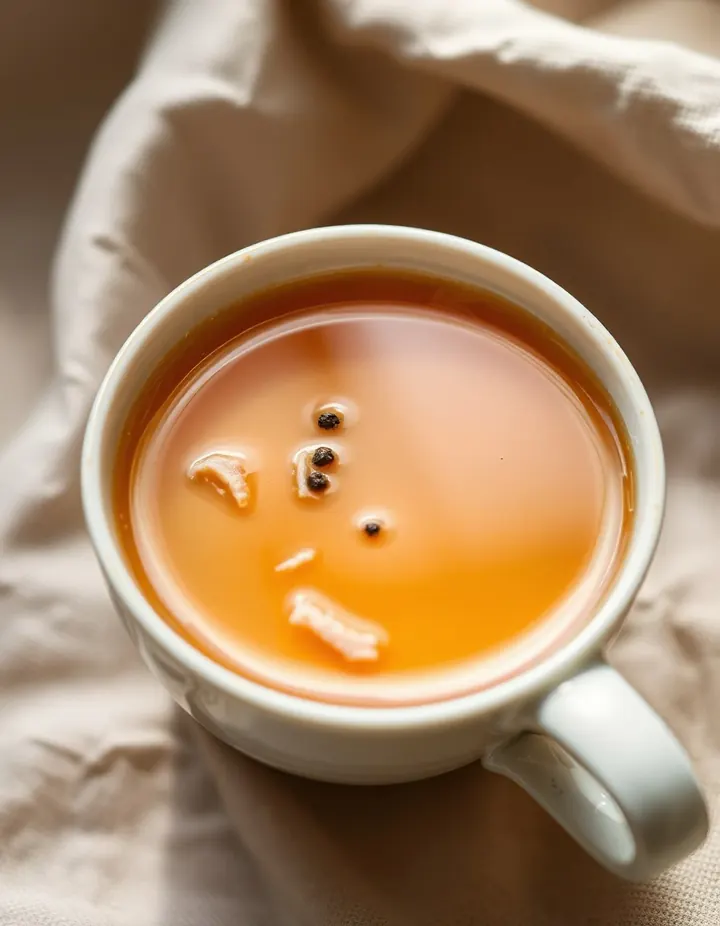 Beef, Mutton, or Veal Broth6 recipes
 Roast Beef211 recipes
 Beef Loaf175 recipes
 Carrot Soup134 recipes
The free Flavor Lab newsletter: one surprising pairing a week and the molecular reason it works, in 60 seconds. No spam, unsubscribe anytime.
Prefer an account? Create a free account to save pairings and unlock the full chemistry.