Why it works: Nutmeg and clove match in chemistry and in kitchens. They rank in the top 1% of all ingredient pairs, and cooks put them together in 8,686 recipes. Both carry estragole, which smells anise, licorice. The science ↓
Haddock and Potato
Ingredients
Directions
The book gives no oven temperature. The 400°F (200°C) in the steps was added when the recipe was transcribed, as a starting point.
Prepare the haddock layer
Preheat the oven to 400°F (200°C).
Bake the smoked haddock for a few minutes until cooked enough to handle.
Remove the skin and bone from the haddock.
Flake the fish.
Mix the flaked haddock with mashed potatoes, 3 ounces of butter, lemon peel, lemon thyme, nutmeg, salt, and Nepal pepper.
Transfer the mixture to a greased pie dish.
Smooth the top of the mixture.
Score the top with a fork.
Bake until golden brown.
Make the sauce
In a pan, fry the onion rings and chopped garlic in 2 ounces of butter with cloves and bay leaves until pale yellow.
Add the milk to the pan and simmer gently for 10 minutes.
Strain the mixture.
Mix 1 tablespoon of flour with a little cold milk.
Pour the flour mixture into the strained milk as it boils.
Stir until thickened.
Add the filleted skate, lemon rind, and nutmeg.
Cook gently until the fish is done.
Once slightly cooled, stir in the beaten egg yolk, salt, and Nepal pepper.
Warm gently without boiling to prevent curdling.
Transcribed from a scanned cookbook and modernised for today's kitchens. Where the book gave no heat or time, or said "a moderate oven", the temperatures and times here may be modern equivalents rather than the book's own figures.
Explore the science
The flavor team
The pairs that carry this dish. Each one is judged two ways: how much their aromas overlap, and how often cooks already put them together.
-
Nutmeg + clovetop 1% of all pairsSmell alikestrongCooked together8,686 recipes
Shared aroma: estragole (anise, licorice).
-
Lemon + thymetop 1% of all pairsSmell alikestrongCooked together3,973 recipes
Shared aroma: beta-phellandrene (minty, terpene).
-
Thyme + clovetop 2% of all pairsSmell alikestrongCooked together4,108 recipes
Shared aroma: cuminaldehyde (Spicy, cumin).
-
Lemon + peppertop 3% of all pairsSmell alikestrongCooked together27,047 recipes
Shared aroma: trans-2-nonenal (cardboard, fatty).
-
Thyme + nutmegtop 3% of all pairsSmell alikestrongCooked together1,907 recipes
Shared aroma: beta-phellandrene (minty, terpene).
Ranks compare each pair with 20,000 random ingredient pairs on CompKitchen. How we score pairs
What each ingredient does
- Smoked haddock
- Provides the main flaky fish flavour and texture in the pie filling.
- Butter
- Adds richness and fat, and helps the top brown in the oven.
- Flour
- Thickens the milk sauce so it becomes smooth and coats the fish.
- Egg yolk
- Enriches and thickens the sauce gently once it has cooled slightly.
- Filleted skate
- Adds delicate fish body to the sauce as it cooks gently.
The step that matters
Warm the sauce gently after adding the egg yolk. Egg yolk proteins set and curdle when overheated, so the sauce must be warmed without boiling and only once slightly cooled to stay smooth and thick.
Swap the onion
How well each one fits the dish's main ingredients (haddock, butter, lemon, thyme, nutmeg, pepper, clove):
- Shallotfits better
- Spinachfits better
- Carrotfits better
- Onionthe original
Fit is the average pairing score against haddock, butter, lemon, thyme, nutmeg, pepper, clove. Candidates are from the same food group and used in at least 100 recipes.
“What each ingredient does” and “The step that matters” were written by Claude from this recipe’s own method and reviewed in samples by CompKitchen.
You might also like
 Lemon Sauce236 recipes
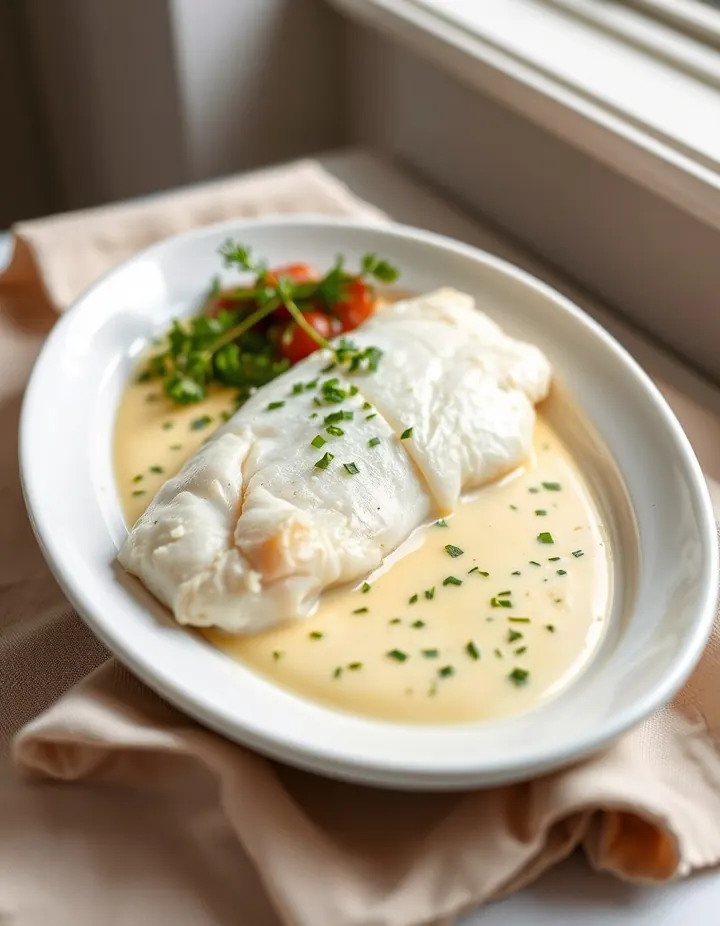 Boiled Haddock10 recipes
 Tomato Soup526 recipes
 Brown Bread461 recipes
The free Flavor Lab newsletter: one surprising pairing a week and the molecular reason it works, in 60 seconds. No spam, unsubscribe anytime.
Prefer an account? Create a free account to save pairings and unlock the full chemistry.