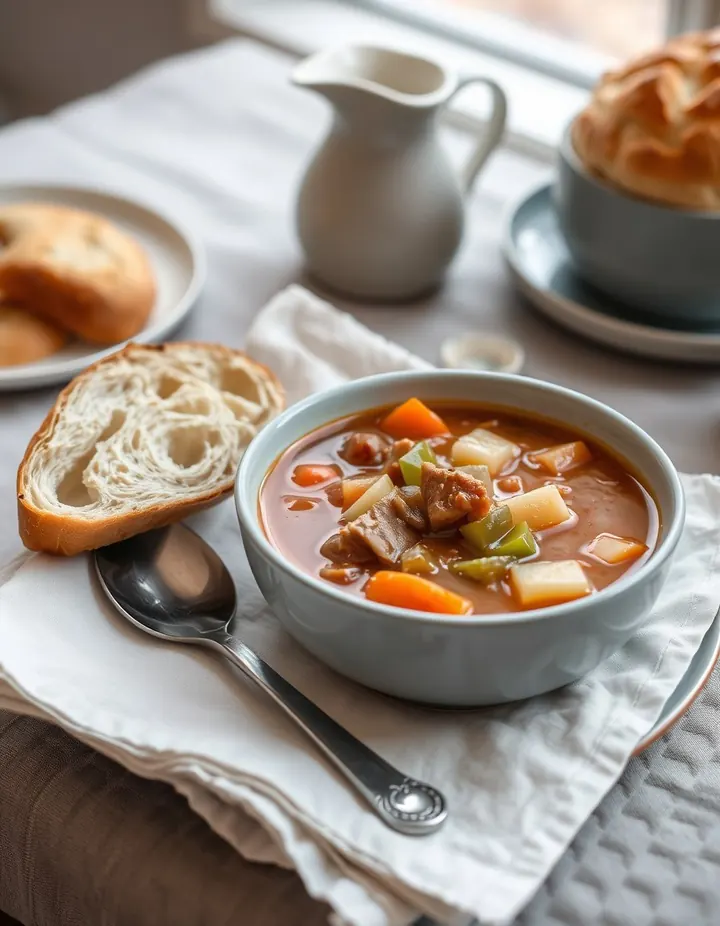
Why it works: Celery and carrot match in chemistry and in kitchens. They rank in the top 1% of all ingredient pairs, and cooks put them together in 10,173 recipes. Both carry myristicin, which smells spice, warm. The science ↓
Ox-Cheek Soup
Ingredients
Directions
Prepare the ox-cheek
Soak the ox-cheek in cold water for a couple of hours.
Break any unbroken bones.
Wash the ox-cheek in warm water.
Place the ox-cheek in a pot and cover with cold water.
Bring the pot to a boil.
Skim the surface.
Make the stock
Add celery, carrots, turnip, onions, black pepper, allspice, sweet herbs, and parsley.
Cover and simmer gently for about three hours.
Remove the ox-cheek.
Strain the soup through a fine sieve into a stoneware pan.
Cool the soup overnight.
Cut the meat into neat pieces.
Skim the broth.
Thicken and finish
Combine 2 quarts of broth and the meat in a clean stew-pan.
Simmer gently for half an hour.
Melt butter in a stew-pan.
Add enough flour to dry it up. Mix well.
Gradually brown the mixture.
Pour the soup into the flour mixture. Stir well.
Simmer for another half hour.
Strain through a hair sieve into a clean stew-pan.
Add the meat.
Stew for another half hour.
Season with cayenne pepper, coarse sea salt, and wine or brandy if desired.
Transcribed from a scanned cookbook and modernised for today's kitchens. Where the book gave no heat or time, or said "a moderate oven", the temperatures and times here may be modern equivalents rather than the book's own figures.
Photo for illustrative purposes only · Contact us to use it
Explore the science
The flavor team
The pairs that carry this dish. Each one is judged two ways: how much their aromas overlap, and how often cooks already put them together.
-
Celery + carrottop 1% of all pairsSmell alikestrongCooked together10,173 recipes
Shared aroma: myristicin (spice, warm).
-
Marjoram + lemontop 1% of all pairsSmell alikestrongCooked together957 recipes
Shared aroma: beta-phellandrene (minty, terpene).
-
Allspice + marjoramtop 1% of all pairsSmell alikestrongCooked together342 recipes
Shared aroma: estragole (anise, licorice).
-
Carrot + turniptop 1% of all pairsSmell alikestrongCooked together8,002 recipes
Shared aroma: coumarin (sweet, hay).
-
Carrot + marjoramtop 1% of all pairsSmell alikestrongCooked together687 recipes
Shared aroma: cuminaldehyde (Spicy, cumin).
Ranks compare each pair with 20,000 random ingredient pairs on CompKitchen. How we score pairs
What each ingredient does
- Ox-cheek
- Provides rich meat and gelatine that give the soup body and a silky mouthfeel.
- Celery, carrots, turnip, onions
- Aromatic vegetables that build sweetness and depth as they simmer into the broth.
- Butter and flour
- Form a roux that thickens the soup and adds toasty, browned flavour.
- Broth
- Forms the liquid base that carries the flavour of the meat and vegetables.
The step that matters
Gradually brown the flour and butter mixture. Cooking the roux slowly lets the flour toast without scorching, giving colour and nutty flavour. Adding liquid to a raw or burnt roux leads to lumps or bitter taste.
Swap the onion
How well each one fits the dish's main ingredients (celery, carrot, turnip, pepper, allspice, marjoram, lemon):
- Parsnipfits better
- Leekfits better
- Arrowrootfits better
- Onionthe original
Fit is the average pairing score against celery, carrot, turnip, pepper, allspice, marjoram, lemon. Candidates are from the same food group and used in at least 100 recipes.
“What each ingredient does” and “The step that matters” were written by Claude from this recipe’s own method and reviewed in samples by CompKitchen.
You might also like
 Lemon Sauce236 recipes
 Carrot Soup134 recipes
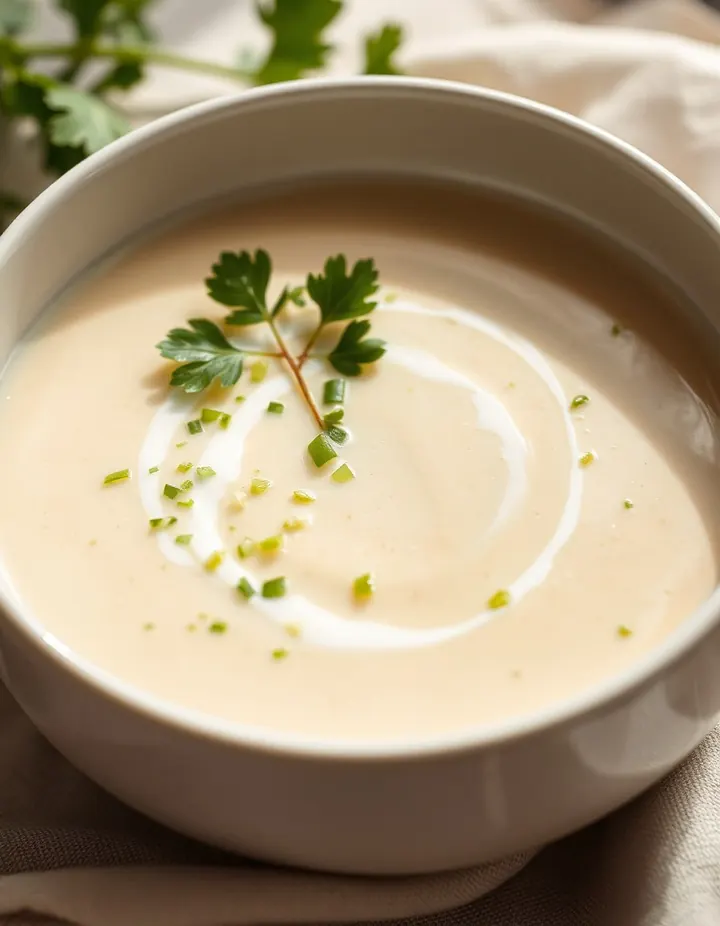 Cream of Celery Soup113 recipes
 Turnip Soup43 recipes
The free Flavor Lab newsletter: one surprising pairing a week and the molecular reason it works, in 60 seconds. No spam, unsubscribe anytime.
Prefer an account? Create a free account to save pairings and unlock the full chemistry.