Why it works: Lettuce and tamarind share more aroma than cooks usually use. They rank in the top 5% of all ingredient pairs, and 20 recipes mention both. Both carry nonanal, which smells fat, citrus. The science ↓
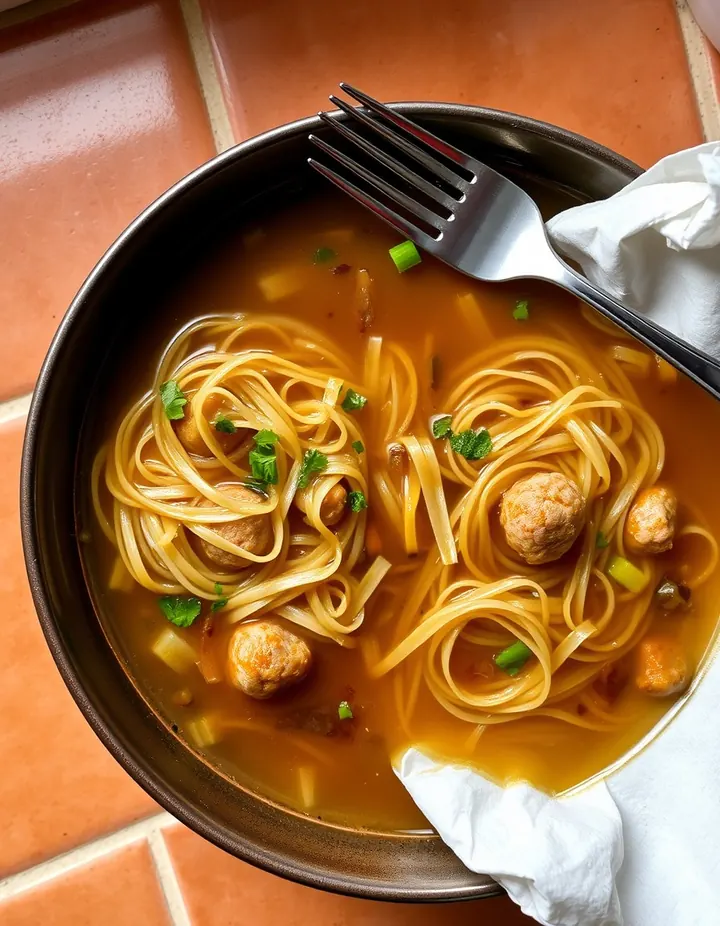
Vermicelli Soup
Ingredients
Directions
Prepare the vermicelli
Crush the vermicelli.
Add the crushed vermicelli to boiling salted water.
Cook for 5 minutes.
Drain the vermicelli.
Make the soup
Bring the clear soup to a boil in a saucepan.
Add the drained vermicelli and tomato purée to the boiling soup.
Season with salt and pepper.
Add veal and water to another saucepan.
Bring to a boil, skimming carefully.
Wash the rabbit.
Soak it in salt water for 30 minutes.
Pour boiling water over it for a few minutes.
Add rabbit, vegetables, apple, mint, sugar, and curry powder to the boiling soup.
Adjust curry to taste.
Boil for 1.5 hours.
Remove the rabbit and shred the meat.
Continue boiling the soup for 2 more hours.
Strain it through a fine sieve.
Return the soup to the saucepan, add shredded rabbit, lemon juice, and salt.
Simmer for 15 minutes.
Stir in the cream.
Serve
Serve with boiled rice and sliced lemon.
Transcribed from a scanned cookbook and modernised for today's kitchens. Where the book gave no heat or time, or said "a moderate oven", the temperatures and times here may be modern equivalents rather than the book's own figures.
Photo for illustrative purposes only · Contact us to use it
Explore the science
The flavor team
The pairs that carry this dish. Each one is judged two ways: how much aroma chemistry they share, and how many recipes mention both.
-
Lettuce + tamarindtop 5% of all pairsAroma overlapstrongMentioned together20 recipes
Shared aroma: nonanal (fat, citrus).
-
Tomato + lettucetop 6% of all pairsAroma overlapmoderateMentioned together1,655 recipes
Shared aroma: 2-isopropyl-3-methoxypyrazine (earthy, pea).
-
Tomato + tamarindtop 7% of all pairsAroma overlapstrongMentioned together137 recipes
Shared aroma: 3-hexenal (apple, fruity).
-
Tomato + peppertop 7% of all pairsAroma overlapmoderateMentioned together17,923 recipes
Shared aroma: 2-isopropyl-3-methoxypyrazine (earthy, pea).
-
Onion + lettucetop 8% of all pairsAroma overlapstrongMentioned together3,562 recipes
Shared aroma: 2-isopropyl-3-methoxypyrazine (earthy, pea).
Ranks compare each pair with 20,000 random ingredient pairs on CompKitchen. How we score pairs
What each ingredient does
- Vermicelli
- Thickens the soup and gives it a soft, starchy body as it cooks.
- Tomato purée
- Adds acidity and color, rounding the flavor of the soup.
- Rabbit
- Provides the main meat and savory flavor that enriches the broth.
- Knuckle of veal
- Releases gelatin and flavor into the broth, giving body and richness.
- Cream
- Adds fat that softens the flavor and gives a smooth, rich texture.
- Flour
- Thickens the soup and helps give it a smooth body.
The step that matters
Skimming the veal stock. Skimming removes foam and coagulated proteins that would otherwise cloud the broth and make its flavor muddy, so the soup stays clear and clean-tasting.
Flavor stand-ins for the apple
How well each one fits the dish's main ingredients (tomato, pepper, rabbit, veal, onion, lettuce, tamarind):
- Limebetter flavor fit
- Lemonbetter flavor fit
- Mangobetter flavor fit
- Applethe original
Fit is the average pairing score against tomato, pepper, rabbit, veal, onion, lettuce, tamarind. Candidates are from the same food group and used in at least 100 recipes. This compares flavor only: it does not check the job the ingredient does in the dish (bulk, moisture, acidity, structure).
“What each ingredient does” and “The step that matters” were written by Claude from this recipe’s own method and reviewed in samples by CompKitchen.
You might also like
 Tomato Soup526 recipes
 Lemon Sauce236 recipes
 Carrot Soup134 recipes
 Cream of Tomato Soup107 recipes
The Sunday pairing: one pairing, the chemistry behind it, and how to cook it. No spam, unsubscribe anytime.
Prefer an account? Create a free account for sign-in; Pro adds the full results and chemistry.