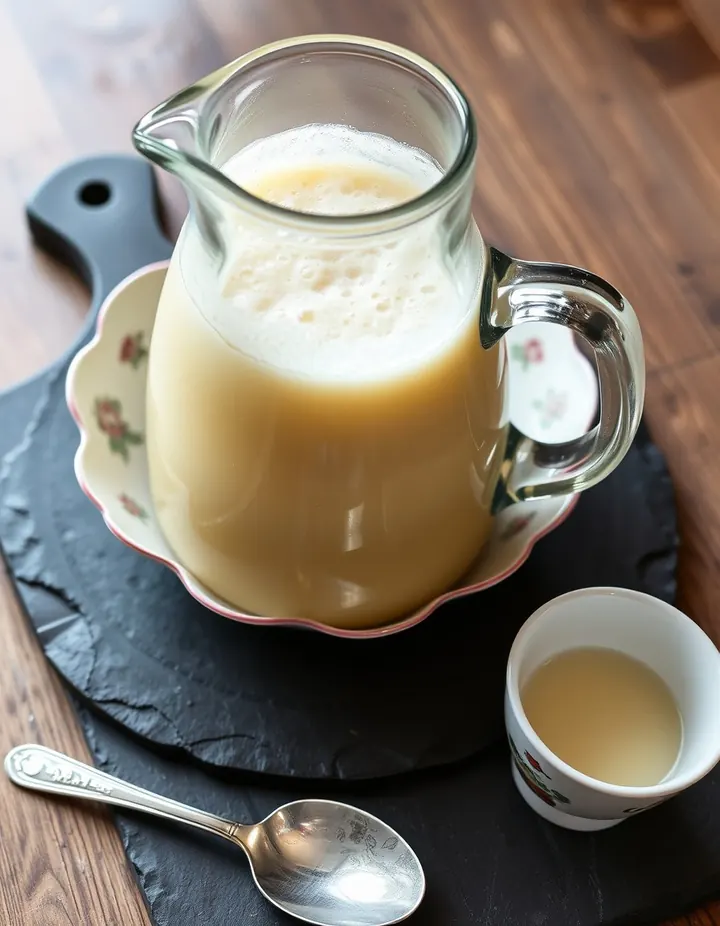
Why it works: Potato and honey work together. They rank in the top 20% of all ingredient pairs, and cooks put them together in 351 recipes. Both carry 2-acetyl-1-pyrroline, which smells popcorn, roasted. The science ↓
Potato Yeast
Ingredients
Directions
Prepare the potato mixture
Boil the potatoes until tender, then peel and weigh them.
While hot, finely bruise the potatoes and mix with boiling water, using 1 quart of water for each pound of potatoes.
Rub the mixture through a fine sieve.
Add honey or brown sugar, using 1 ounce for each quart of water, and boil until it reaches a batter‑like consistency.
Add yeast and rise
Allow the mixture to cool slightly, then add 2 tablespoons of yeast for every quart of water.
Cover with a cloth and let it rise overnight.
Store
Store in a bottle for future use, pouring off any thin liquid on top.
Make fresh yeast every 2‑3 months.
Transcribed from a scanned cookbook and modernised for today's kitchens. Where the book gave no heat or time, or said "a moderate oven", the temperatures and times here may be modern equivalents rather than the book's own figures.
Photo for illustrative purposes only · Contact us to use it
Explore the science
The flavor team
The pairs that carry this dish. Each one is judged two ways: how much their aromas overlap, and how often cooks already put them together.
-
Potato + honeytop 20% of all pairsSmell alikemoderateCooked together351 recipes
Shared aroma: 2-acetyl-1-pyrroline (popcorn, roasted).
Ranks compare each pair with 20,000 random ingredient pairs on CompKitchen. How we score pairs
What each ingredient does
- Mealy potatoes
- Provide starch and body that the yeast feeds on to build the starter.
- Honey or brown sugar
- Feeds the yeast with sugar, encouraging fermentation and rising.
- Yeast
- Ferments the starch and sugar, producing gas that makes the starter rise.
The step that matters
Cooling before adding the yeast. If the mixture is still very hot, it can kill the yeast. Letting it cool slightly before adding the yeast keeps the cells alive so they can ferment properly.
“What each ingredient does” and “The step that matters” were written by Claude from this recipe’s own method and reviewed in samples by CompKitchen.
You might also like
 Deviled Oysters25 recipes
The free Flavor Lab newsletter: one surprising pairing a week and the molecular reason it works, in 60 seconds. No spam, unsubscribe anytime.
Prefer an account? Create a free account to save pairings and unlock the full chemistry.