Why it works: Anchovy and ketchup match in chemistry and in kitchens. They rank in the top 2% of all ingredient pairs, and cooks put them together in 479 recipes. Both carry ethanol, which smells alcoholic, ethereal. The science ↓
Hashing and Mincing
Ingredients
Directions
Prepare the hash
Wash the calf's head thoroughly and boil it for 15 minutes.
Once cooled, cut the meat and tongue into thin slices.
In a stewing pan, combine the meat with the gravy and stew for 45 minutes.
Add the anchovy, mace, cayenne pepper, lemon pickle, walnut ketchup, truffles, lemon slices, sweet herbs, and white wine.
Mix the butter with some flour.
Add the butter‑flour mixture a few minutes before the meat is done.
Make the brain cakes
Soak the brains in hot water.
Beat the soaked brains finely in a bowl.
Add the eggs, flour, lemon peel, parsley, thyme, and sage to the brains.
Mix the brain mixture well.
Season the brain mixture with pepper and salt.
Form the seasoned mixture into small cakes.
Fry the cakes in boiling lard until light brown.
Drain the cakes on a sieve.
Serve
Transfer the hash to a serving dish.
Strain the gravy over the hash.
Top the hash with mushrooms, forcemeat balls, hard‑boiled egg yolks, and brain cakes.
Garnish with sliced lemon and pickles.
Transcribed from a scanned cookbook and modernised for today's kitchens. Where the book gave no heat or time, or said "a moderate oven", the temperatures and times here may be modern equivalents rather than the book's own figures.
Explore the science
The flavor team
The pairs that carry this dish. Each one is judged two ways: how much their aromas overlap, and how often cooks already put them together.
-
Anchovy + ketchuptop 2% of all pairsSmell alikestrongCooked together479 recipes
Shared aroma: ethanol (alcoholic, ethereal).
-
Pepper + lemontop 3% of all pairsSmell alikestrongCooked together27,047 recipes
Shared aroma: trans-2-nonenal (cardboard, fatty).
-
Lemon + walnuttop 10% of all pairsSmell alikestrongCooked together2,149 recipes
Shared aroma: 2-nonenal (fatty, green).
-
Lemon + white winetop 11% of all pairsSmell alikemoderateCooked together3,832 recipes
Shared aroma: myrcene (balsamic, herbaceous).
-
Pepper + walnuttop 13% of all pairsSmell alikemoderateCooked together3,039 recipes
Shared aroma: 2-nonenal (fatty, green).
Ranks compare each pair with 20,000 random ingredient pairs on CompKitchen. How we score pairs
What each ingredient does
- Calf's head
- Forms the main body of the hash, becoming tender through long stewing.
- Eggs
- Bind the brain mixture so the cakes hold their shape when fried.
- Butter
- Mixed with flour to enrich and thicken the gravy as it finishes cooking.
- Brains
- Create a soft, rich filling that becomes a creamy cake when fried.
- Walnut ketchup
- Adds a deep, savoury tang that rounds out the gravy's flavour.
- Lemon pickle
- Contributes sharp acidity that brightens the rich meat and gravy.
The step that matters
Fry the brain cakes until light brown. Frying in hot lard sets the egg-bound outside quickly, browning it while the inside stays soft. Lard that is not hot enough lets the cakes soak up fat and fall apart.
Swap the mace
How well each one fits the dish's main ingredients (anchovy, pepper, lemon, walnut, ketchup, truffle, white wine):
- Parsleyfits better
- Thymefits better
- Tarragonfits better
- Macethe original
Fit is the average pairing score against anchovy, pepper, lemon, walnut, ketchup, truffle, white wine. Candidates are from the same food group and used in at least 100 recipes.
“What each ingredient does” and “The step that matters” were written by Claude from this recipe’s own method and reviewed in samples by CompKitchen.
You might also like
 Lemon Sauce236 recipes
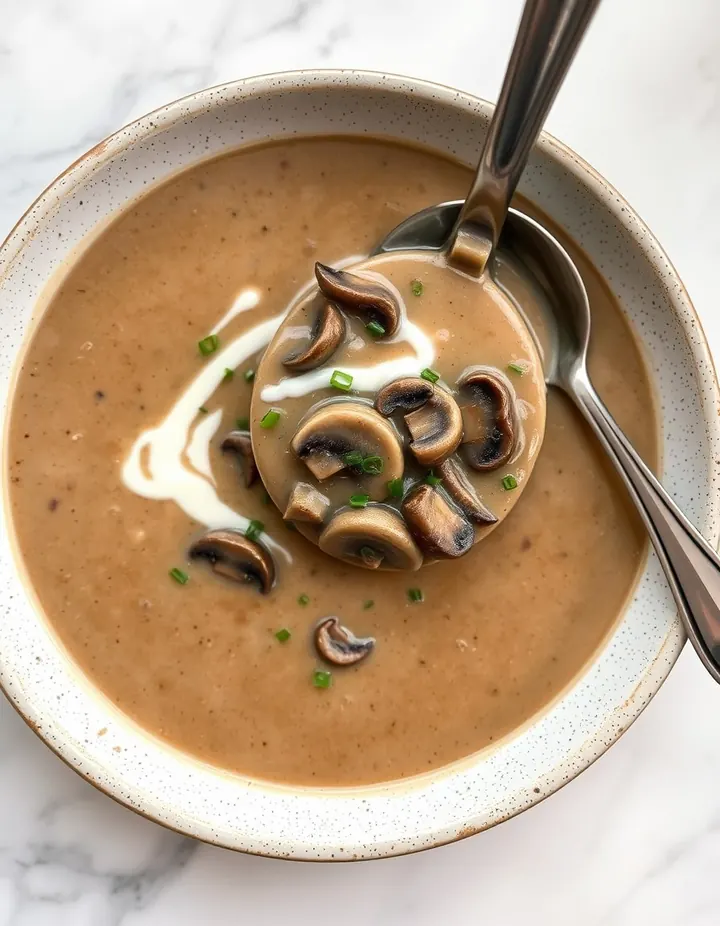 Mushroom Soup60 recipes
 Tomato Soup526 recipes
 Brown Bread461 recipes
The free Flavor Lab newsletter: one surprising pairing a week and the molecular reason it works, in 60 seconds. No spam, unsubscribe anytime.
Prefer an account? Create a free account to save pairings and unlock the full chemistry.