Why it works: Flour and butter are a kitchen classic. They rank in the top 12% of all ingredient pairs, and cooks put them together in 124,287 recipes. Both carry isobutyraldehyde, which smells malty, green. The science ↓
Pate Chaud De Mauviettes [Lark Pie]
Ingredients
Directions
The book says “a moderate oven”. The 350°F (175°C) in the steps is the modern equivalent, not the book's own figure.
Prepare
Prepare a paste like ordinary short pastry.
Line an oval raised pie mold, about 3 inches high and 6 inches long.
Bone the larks.
Stuff the larks with forcemeat, shaping them neatly.
Prepare a thin sauce with the bones, brown sauce, sherry, and consomme or gravy.
Reduce the sauce well.
Wrap a slice of bacon around each stuffed lark.
Pluck and clean a few heads of the birds.
Fry them in a little butter.
Set aside to garnish the pie before serving.
Assemble and bake
Line the bottom of the mold with thin slices of bacon.
Place a layer of larks in the mold.
Add yolks of hard‑boiled eggs here and there.
Continue layering until full.
Cover the mold with paste.
Ornament it tastefully.
Brush with egg yolk.
Bake for about 2 hours at 350°F (175°C).
Serve
When baked, carefully remove the cover.
Reduce the sauce if needed.
Pour it over the interior.
Replace the cover.
Garnish with the birds' heads before serving.
Transcribed from a scanned cookbook and modernised for today's kitchens. Where the book gave no heat or time, or said "a moderate oven", the temperatures and times here may be modern equivalents rather than the book's own figures.
Explore the science
The flavor team
The pairs that carry this dish. Each one is judged two ways: how much their aromas overlap, and how often cooks already put them together.
-
Flour + buttertop 12% of all pairsSmell alikelowCooked together124,287 recipes
Shared aroma: isobutyraldehyde (malty, green).
-
Sherry + buttertop 14% of all pairsSmell alikemoderateCooked together3,505 recipes
Shared aroma: ethyl octanoate (fruity, wine).
-
Sauce + buttertop 15% of all pairsSmell alikelowCooked together15,338 recipes
Shared aroma: ethanol (alcoholic, ethereal).
-
Egg + flourtop 15% of all pairsSmell alikelowCooked together106,462 recipes
Shared aroma: isobutyraldehyde (malty, green).
-
Beef + buttertop 16% of all pairsSmell alikemoderateCooked together10,847 recipes
Shared aroma: 2-furfurylthiol (coffee, roasted).
Flour and butter barely smell alike, yet cooks put them together in 124,287 recipes: they work on texture and structure more than aroma.
Ranks compare each pair with 20,000 random ingredient pairs on CompKitchen. How we score pairs
What each ingredient does
- Larks
- Form the main filling, providing the meat that the stuffing and sauce accompany.
- Eggs
- Hard-boiled yolks add richness and body, while the beaten yolk gives the crust a golden browned finish.
- Butter
- Adds richness and flavor when frying the birds' heads for garnish.
- Beef suet
- Adds fat that keeps the stuffing moist and tender during baking.
- Flour
- Forms the structural paste that encloses and holds the pie together.
The step that matters
Reduce the sauce well. The sauce must be concentrated so it flavors the pie without making the interior watery. Reducing it removes excess liquid and intensifies the flavor of the bones, brown sauce, and sherry.
“What each ingredient does” and “The step that matters” were written by Claude from this recipe’s own method and reviewed in samples by CompKitchen.
You might also like
 Roast Beef211 recipes
 Beef Loaf175 recipes
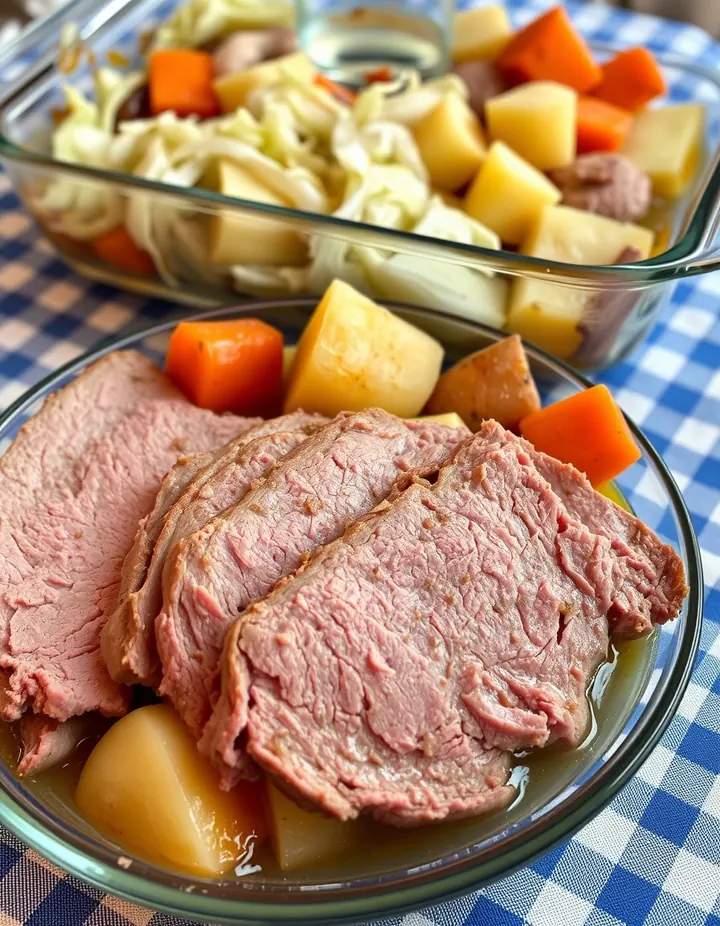 Corned Beef87 recipes
 Beef Broth67 recipes
The free Flavor Lab newsletter: one surprising pairing a week and the molecular reason it works, in 60 seconds. No spam, unsubscribe anytime.
Prefer an account? Create a free account to save pairings and unlock the full chemistry.