Why it works: Pepper and nutmeg match in chemistry and in kitchens. They rank in the top 7% of all ingredient pairs, and cooks put them together in 13,015 recipes. Both carry 4'-methylacetophenone, which smells bitter almond. The science ↓
Timbales De Faisan a LA Rothschild
eight timbalesIngredients
Directions
Prepare the molds
Mask the inside of eight timbale molds with a thin layer of aspic jelly and let it set.
Decorate the bottom and sides with thinly cut slices of truffle.
Keep the molds on ice until set, then mask the decoration with a layer of reduced supreme sauce mixed with dissolved aspic.
Make the pheasant mixture
Strip the flesh from the breast and wings of the pheasant, pound it smooth, and mix in the cream, nutmeg, salt, and pepper.
Rub the mixture through a fine sieve and place it on ice.
Fill and poach
Butter eight smaller timbale molds and partially fill them with the prepared mixture, leaving the center hollow.
Prepare a ragout with diced sweetbread and coarsely chopped truffle trimmings, moisten with a little sauce.
Put a dessert spoonful of the ragout into each mold, fill with the remaining mixture, and poach for 30 minutes.
When half cold, turn out onto a cloth and chill quickly on ice.
Assemble and serve
Place the timbales into the decorated molds and fill the sides with aspic.
Allow to set, then turn out and serve.
Transcribed from a scanned cookbook and modernised for today's kitchens. Where the book gave no heat or time, or said "a moderate oven", the temperatures and times here may be modern equivalents rather than the book's own figures.
Explore the science
The flavor team
The pairs that carry this dish. Each one is judged two ways: how much their aromas overlap, and how often cooks already put them together.
-
Pepper + nutmegtop 7% of all pairsSmell alikestrongCooked together13,015 recipes
Shared aroma: 4'-methylacetophenone (bitter almond).
-
Cream + buttertop 8% of all pairsSmell alikemoderateCooked together41,516 recipes
Shared aroma: delta-dodecalactone (sweet, creamy).
-
Sauce + creamtop 9% of all pairsSmell alikemoderateCooked together4,787 recipes
Shared aroma: ethanol (alcoholic, ethereal).
-
Truffle + buttertop 11% of all pairsSmell alikemoderateCooked together2,209 recipes
Shared aroma: nonanal (fat, citrus).
-
Cream + nutmegtop 13% of all pairsSmell alikemoderateCooked together7,920 recipes
Shared aroma: acetic acid (sour, vinegar).
Ranks compare each pair with 20,000 random ingredient pairs on CompKitchen. How we score pairs
What each ingredient does
- Pheasant
- Forms the lean, finely pounded base that gives the timbales their body.
- Cream
- Adds moisture and richness, keeping the pounded mixture soft and smooth.
- Sweetbread
- Adds tender, rich texture to the central ragout.
- Truffles
- Provide earthy aroma and a dark decorative contrast on the outside.
- Aspic jelly
- Sets into a clear gel that holds the decoration and gives a glossy finish.
- Madeira sauce
- Adds depth and a rich, slightly sweet flavor to the ragout.
The step that matters
Rub the mixture through a fine sieve. Sieving breaks down any remaining fibres and lumps so the pounded mixture sets into a smooth, even texture rather than a grainy one.
Swap the nutmeg
How well each one fits the dish's main ingredients (pheasant, truffle, sauce, cream, pepper, butter):
- Nutmegthe original
- Tarragonfits about as well
- Parsleyfits about as well
- Capersfits about as well
Fit is the average pairing score against pheasant, truffle, sauce, cream, pepper, butter. Candidates are from the same food group and used in at least 100 recipes.
“What each ingredient does” and “The step that matters” were written by Claude from this recipe’s own method and reviewed in samples by CompKitchen.
You might also like
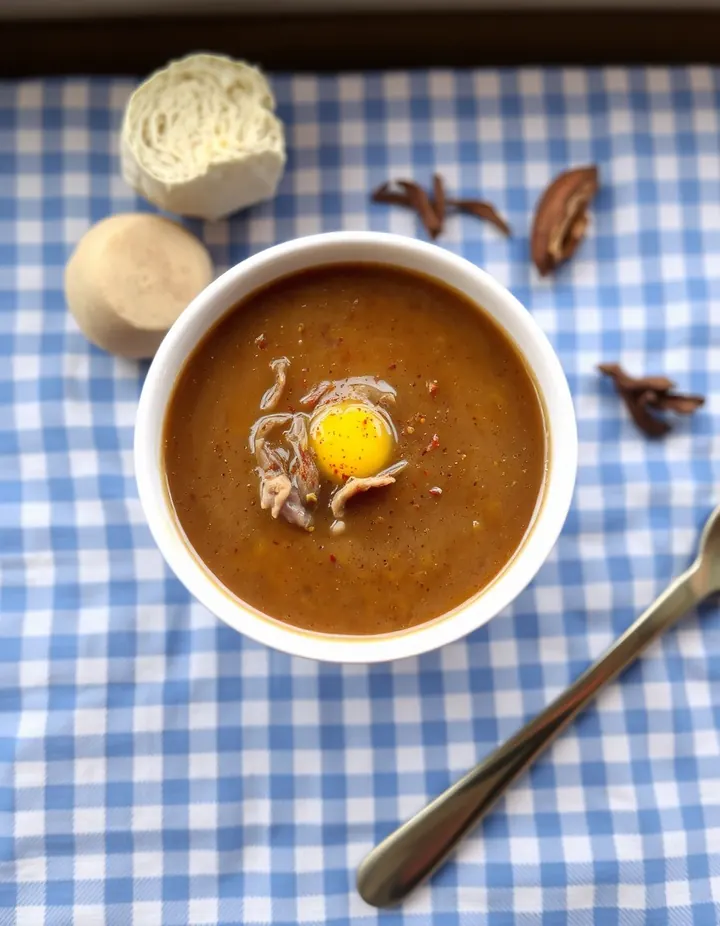 Pheasant Soup25 recipes
 Tomato Soup526 recipes
 Brown Bread461 recipes
 Mutton Broth292 recipes
The free Flavor Lab newsletter: one surprising pairing a week and the molecular reason it works, in 60 seconds. No spam, unsubscribe anytime.
Prefer an account? Create a free account to save pairings and unlock the full chemistry.