Why it works: Vinegar and mustard are a kitchen classic. They rank in the top 7% of all ingredient pairs, and cooks put them together in 14,067 recipes. Both carry isobutyraldehyde, which smells malty, green. The science ↓
A Pheasant
Ingredients
Directions
Prepare
Boil the pheasant's head for 30 minutes and let it cool.
Remove the bones and lay the bird on a clean cloth.
Sprinkle the inside with a mixture of salt, mace, and cayenne.
Place the tongue inside and roll it up, securing with a skewer and binding tightly with tape.
Cook and serve
Boil or stew the pheasant in stock for 2 hours until extremely tender.
Glaze the head and serve with rich brown gravy or preferred sauces.
Make the sauce
For Oxford brawn sauce, mix brown sugar, vinegar, mustard, and salt to taste, adding oil if desired.
Transcribed from a scanned cookbook and modernised for today's kitchens. Where the book gave no heat or time, or said "a moderate oven", the temperatures and times here may be modern equivalents rather than the book's own figures.
Explore the science
The flavor team
The pairs that carry this dish. Each one is judged two ways: how much their aromas overlap, and how often cooks already put them together.
-
Vinegar + mustardtop 7% of all pairsSmell alikemoderateCooked together14,067 recipes
Shared aroma: isobutyraldehyde (malty, green).
-
Pepper + mustardtop 9% of all pairsSmell alikemoderateCooked together15,430 recipes
Shared aroma: 2-isopropyl-3-methoxypyrazine (earthy, pea).
-
Pepper + vinegartop 14% of all pairsSmell alikemoderateCooked together27,814 recipes
Shared aroma: 4'-methylacetophenone (bitter almond).
-
Sugar + vinegartop 15% of all pairsSmell alikemoderateCooked together20,806 recipes
Shared aroma: beta-damascenone (apple, rose).
-
Mace + peppertop 16% of all pairsSmell alikelowCooked together12,257 recipes
Shared aroma: myristicin (spice, warm).
Mace and pepper barely smell alike, yet cooks put them together in 12,257 recipes: they work on texture and structure more than aroma.
Ranks compare each pair with 20,000 random ingredient pairs on CompKitchen. How we score pairs
What each ingredient does
- Pheasant
- Provides the meat, which becomes tender through long, slow cooking that breaks down connective tissue.
- Stock
- Supplies moisture for stewing, keeping the meat moist and helping it soften.
- Mace
- Adds a warm, aromatic flavour to the seasoned filling.
- Brown sugar
- Adds sweetness to the Oxford brawn sauce and helps it brown when glazed.
- Vinegar
- Adds acidity to the Oxford brawn sauce, balancing its sweetness and richness.
- Mustard
- Adds sharp, pungent flavour to the Oxford brawn sauce.
The step that matters
Simmering the pheasant for 2 hours. Connective tissue softens into gelatin during long, gentle simmering in liquid. Boiling hard can toughen the meat and break the bird apart, so keep the stock at a steady, gentle simmer until the meat is extremely tender.
Swap the mace
How well each one fits the dish's main ingredients (pheasant, pepper, sugar, vinegar, mustard):
- Tarragonfits better
- Allspicefits better
- Capersfits better
- Macethe original
Fit is the average pairing score against pheasant, pepper, sugar, vinegar, mustard. Candidates are from the same food group and used in at least 100 recipes.
“What each ingredient does” and “The step that matters” were written by Claude from this recipe’s own method and reviewed in samples by CompKitchen.
You might also like
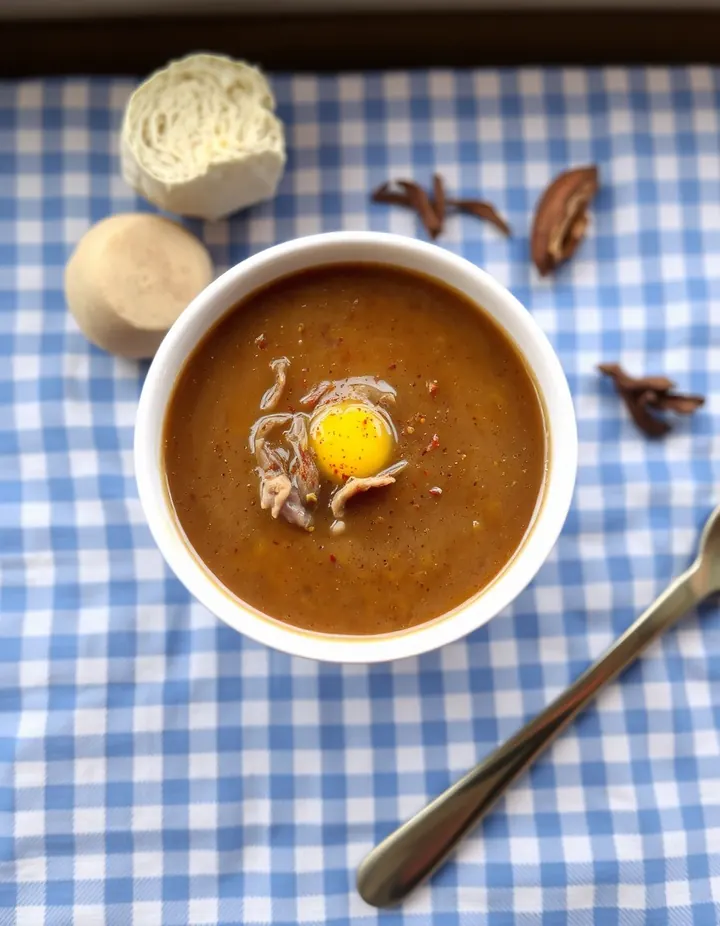 Pheasant Soup25 recipes
 Tomato Soup526 recipes
 Brown Bread461 recipes
 Mutton Broth292 recipes
The free Flavor Lab newsletter: one surprising pairing a week and the molecular reason it works, in 60 seconds. No spam, unsubscribe anytime.
Prefer an account? Create a free account to save pairings and unlock the full chemistry.