Why it works: Clove and nutmeg match in chemistry and in kitchens. They rank in the top 1% of all ingredient pairs, and cooks put them together in 8,686 recipes. Both carry estragole, which smells anise, licorice. The science ↓
To Make Ketchup
Ingredients
Directions
The book says “a very slow oven”. The 300°F (150°C) in the steps is the modern equivalent, not the book's own figure.
Salt the mushrooms
Squeeze the mushrooms in a brown pan with the salt and cover them.
Mix daily for a week without adding more salt.
After a week, place the pan in a 300°F (150°C) oven for 12 hours.
Strain and settle
Remove and strain the liquid through a cloth into another pan.
Let it sit for a few hours until sediment settles at the bottom.
Gently pour off the clear liquid into a saucepan.
Spice and boil
Add lemon rind, peppercorns, Jamaica pepper, mace, cloves, nutmeg, and crushed ginger.
Skim off any foam while boiling for a few minutes.
If not strong enough, boil longer.
Remove from heat and let cool in the pan.
Strain and bottle
Pour off the liquid from the sediment and strain through a sieve to remove spices.
Bottle the ketchup for use.
Transcribed from a scanned cookbook and modernised for today's kitchens. Where the book gave no heat or time, or said "a moderate oven", the temperatures and times here may be modern equivalents rather than the book's own figures.
Explore the science
The flavor team
The pairs that carry this dish. Each one is judged two ways: how much their aromas overlap, and how often cooks already put them together.
-
Clove + nutmegtop 1% of all pairsSmell alikestrongCooked together8,686 recipes
Shared aroma: estragole (anise, licorice).
-
Clove + gingertop 1% of all pairsSmell alikestrongCooked together6,038 recipes
Shared aroma: estragole (anise, licorice).
-
Lemon + peppertop 3% of all pairsSmell alikestrongCooked together27,047 recipes
Shared aroma: trans-2-nonenal (cardboard, fatty).
-
Mace + nutmegtop 4% of all pairsSmell alikemoderateCooked together6,557 recipes
Shared aroma: myristicin (spice, warm).
-
Lemon + gingertop 5% of all pairsSmell alikestrongCooked together5,154 recipes
Shared aroma: beta-phellandrene (minty, terpene).
Ranks compare each pair with 20,000 random ingredient pairs on CompKitchen. How we score pairs
What each ingredient does
- Mushrooms
- Form the liquid base of the ketchup, releasing their juices under salt.
- Coarse sea salt
- Draws moisture out of the mushrooms and preserves the liquid through the long salting.
- Mace
- Adds warm, aromatic flavour to the liquid during boiling.
- Nutmeg
- Adds warm, aromatic flavour to the liquid during boiling.
- Cloves
- Adds warm, aromatic flavour to the liquid during boiling.
The step that matters
Skim off any foam while boiling. Foam carries impurities and cloudy proteins from the mushrooms; removing it keeps the finished liquid clear and prevents off-flavours.
Swap the mace
How well each one fits the dish's main ingredients (mushroom, lemon, pepper, clove, nutmeg, ginger):
- Allspicefits better
- Cinnamonfits better
- Cardamomfits better
- Macethe original
Fit is the average pairing score against mushroom, lemon, pepper, clove, nutmeg, ginger. Candidates are from the same food group and used in at least 100 recipes.
“What each ingredient does” and “The step that matters” were written by Claude from this recipe’s own method and reviewed in samples by CompKitchen.
More ketchup recipes
You might also like
 Lemon Sauce236 recipes
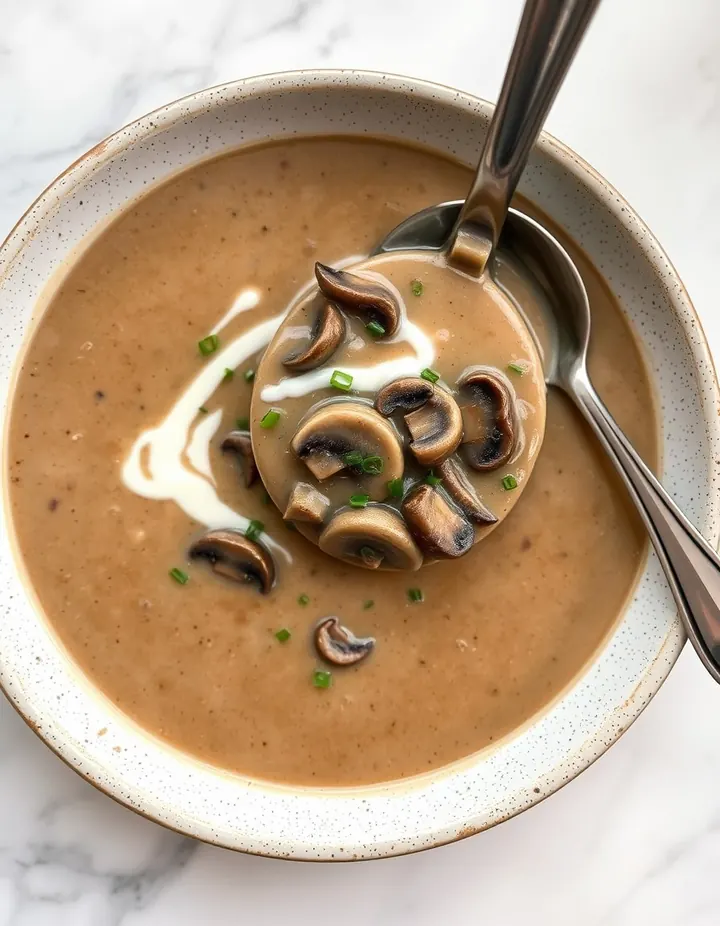 Mushroom Soup60 recipes
 Tomato Soup526 recipes
 Brown Bread461 recipes
The free Flavor Lab newsletter: one surprising pairing a week and the molecular reason it works, in 60 seconds. No spam, unsubscribe anytime.
Prefer an account? Create a free account to save pairings and unlock the full chemistry.