Why it works: Veal and ham are a kitchen classic. They rank in the top 15% of all ingredient pairs, and cooks put them together in 3,264 recipes. Both carry 2,4-decadienal, which smells seaweed. The science ↓
Rolled Veal
Ingredients
Directions
Prepare the roll
Spread a thin layer of veal forcemeat over the inside of the breast of veal.
Sprinkle the chopped pickled gherkins over the forcemeat.
Lay the slice of ham on top of the gherkins.
Roll the veal tightly and bind it securely with tape.
Cook and press
Place it in a stewpan with a plate underneath to prevent sticking.
Barely cover the veal with stock and simmer gently for about three hours.
After cooking, place it between two dishes and add a heavy weight on top to cool.
Transcribed from a scanned cookbook and modernised for today's kitchens. Where the book gave no heat or time, or said "a moderate oven", the temperatures and times here may be modern equivalents rather than the book's own figures.
Explore the science
The flavor team
The pairs that carry this dish. Each one is judged two ways: how much their aromas overlap, and how often cooks already put them together.
-
Veal + hamtop 15% of all pairsSmell alikelowCooked together3,264 recipes
Shared aroma: 2,4-decadienal (seaweed).
Ranks compare each pair with 20,000 random ingredient pairs on CompKitchen. How we score pairs
What each ingredient does
- Breast of veal
- Forms the main body of the roll and becomes tender during slow simmering.
- Veal forcemeat
- Adds a soft, savoury filling that binds the layers together as it sets.
- Pickled gherkins
- Add sharp acidity that cuts through the rich meat and forcemeat.
- Ham
- Adds salty, savoury flavour to the filling.
The step that matters
Simmering gently with the roll barely covered. A gentle simmer keeps the meat tender and prevents the proteins from toughening, while the barely-covered stock limits boiling and loosening of the roll. Too vigorous a boil can break up the forcemeat and make the meat dry and stringy.
“What each ingredient does” and “The step that matters” were written by Claude from this recipe’s own method and reviewed in samples by CompKitchen.
You might also like
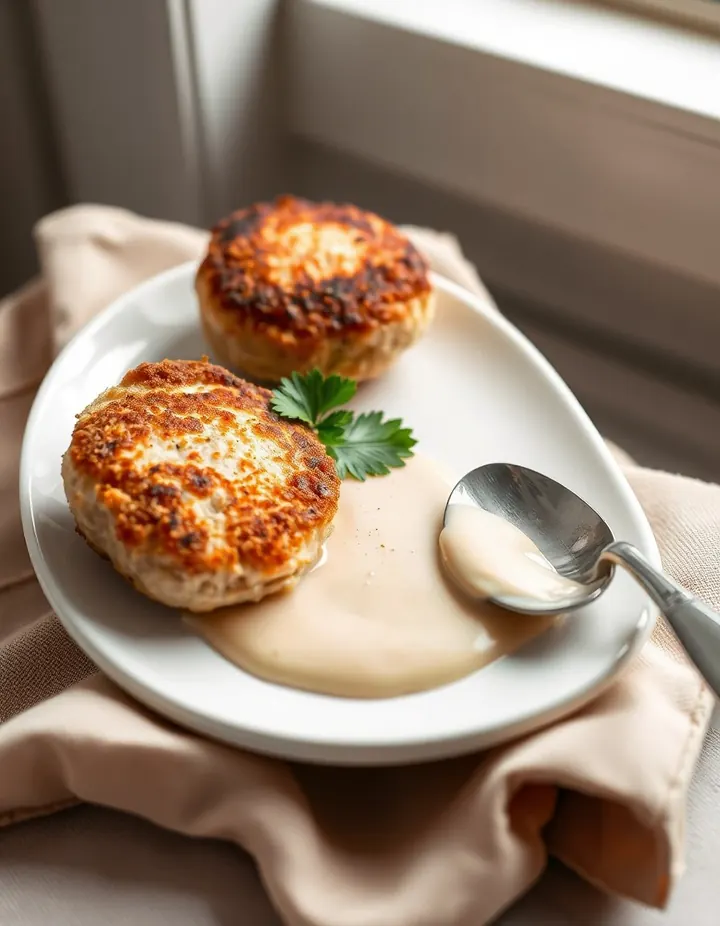 Veal Patties50 recipes
 Beef, Mutton, or Veal Broth6 recipes
 Tomato Soup526 recipes
 Brown Bread461 recipes
The free Flavor Lab newsletter: one surprising pairing a week and the molecular reason it works, in 60 seconds. No spam, unsubscribe anytime.
Prefer an account? Create a free account to save pairings and unlock the full chemistry.