Why it works: Chestnut and nutmeg match in chemistry and in kitchens. They rank in the top 3% of all ingredient pairs, and cooks put them together in 180 recipes. Both carry maltol, which smells caramel, sweet. The science ↓
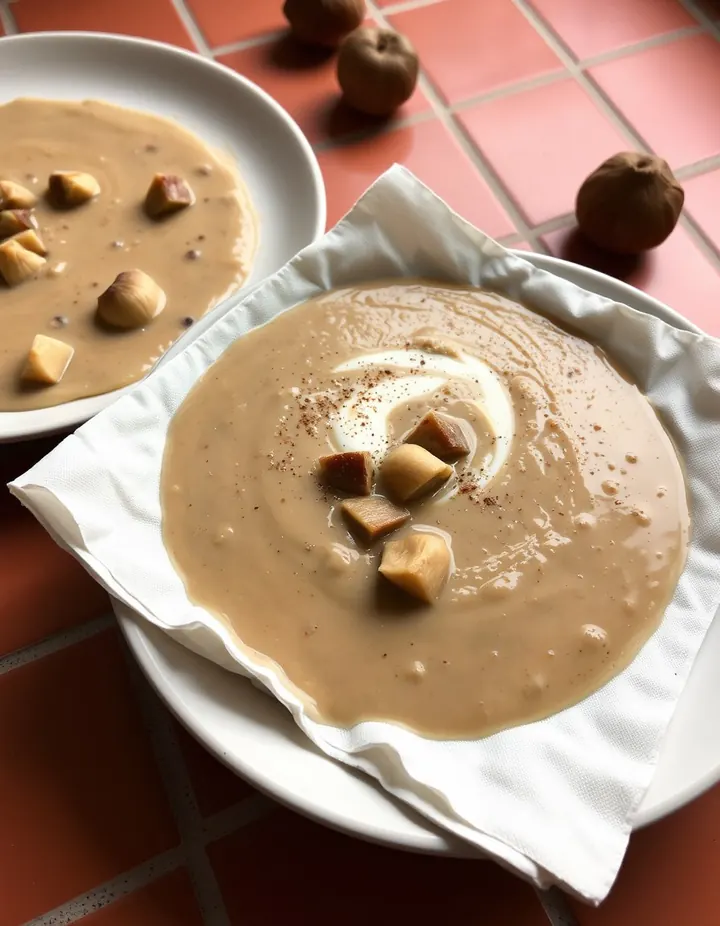
Chestnut Puree
Ingredients
Directions
Prepare the chestnuts
Wipe the chestnuts.
Slit the skins.
Boil the chestnuts for 10 to 15 minutes.
Remove the husk and brown skin.
Make the puree
Place the peeled chestnuts in a saucepan with ½ oz of butter.
Toss the chestnuts over the heat for a few minutes.
Add the stock and milk.
Cook gently until tender.
Pass the mixture through a wire sieve.
Return the pulp to the saucepan.
Season with salt, pepper, and grated nutmeg.
Bring the mixture to a boil.
Skim the surface.
Finish and serve
Add the remaining butter in small pieces just before serving.
Add the yolk of 1 or 2 eggs and 1 tablespoon of cream.
Do not allow to boil after adding.
Transcribed from a scanned cookbook and modernised for today's kitchens. Where the book gave no heat or time, or said "a moderate oven", the temperatures and times here may be modern equivalents rather than the book's own figures.
Explore the science
The flavor team
The pairs that carry this dish. Each one is judged two ways: how much their aromas overlap, and how often cooks already put them together.
-
Chestnut + nutmegtop 3% of all pairsSmell alikestrongCooked together180 recipes
Shared aroma: maltol (caramel, sweet).
-
Milk + buttertop 7% of all pairsSmell alikemoderateCooked together81,283 recipes
Shared aroma: (z)-4-heptenal (biscuit, cream).
-
Pepper + nutmegtop 7% of all pairsSmell alikestrongCooked together13,015 recipes
Shared aroma: 4'-methylacetophenone (bitter almond).
-
Chestnut + peppertop 13% of all pairsSmell alikemoderateCooked together826 recipes
Shared aroma: ethyl octanoate (fruity, wine).
-
Milk + nutmegtop 15% of all pairsSmell alikemoderateCooked together14,685 recipes
Shared aroma: eucalyptol (eucalyptus, herbal).
Ranks compare each pair with 20,000 random ingredient pairs on CompKitchen. How we score pairs
What each ingredient does
- Chestnuts
- Form the main body of the puree, providing starch that thickens and gives a soft, floury texture when cooked.
- Butter
- Adds richness and a smooth, rounded mouthfeel to the puree.
- Milk
- Adds moisture and softness, making the puree smoother and creamier.
- White stock
- Adds liquid and savoury depth, helping the chestnuts cook to a spoonable consistency.
- Eggs (in the method)
- Yolks enrich and thicken the puree, giving it a silkier body when heated gently.
- Cream (in the method)
- Adds fat and richness, softening the flavour and smoothing the texture.
The step that matters
Do not allow to boil after adding the egg yolks. Egg yolks thicken by gentle heat, but boiling causes them to curdle and turn grainy, spoiling the smooth texture of the puree.
Swap the chestnut
How well each one fits the dish's main ingredients (milk, butter, pepper, nutmeg):
- Walnutfits better
- Almondfits about as well
- Chestnutthe original
- Pistachiofits about as well
Fit is the average pairing score against milk, butter, pepper, nutmeg. Candidates are from the same food group and used in at least 100 recipes.
“What each ingredient does” and “The step that matters” were written by Claude from this recipe’s own method and reviewed in samples by CompKitchen.
You might also like
 Chestnut Soup52 recipes
 Tomato Soup526 recipes
 Brown Bread461 recipes
 Mutton Broth292 recipes
The free Flavor Lab newsletter: one surprising pairing a week and the molecular reason it works, in 60 seconds. No spam, unsubscribe anytime.
Prefer an account? Create a free account to save pairings and unlock the full chemistry.